
Close Menu
  • News
  • Industry
  • Solar Panels
  • Commercial
  • Residential
  • Finance
  • Technology
  • Carbon Credit
  • More
    • Policy
    • Energy Storage
    • Utility
    • Cummunity
What's Hot

Dutch solar owners asked to switch off during peak periods to ease the distribution crisis

June 7, 2026

The hydrogen flow: Toyota demonstrates its racing prototype on liquid hydrogen

June 7, 2026

Era of electrification exposing Australia’s weakest link

June 6, 2026
Facebook X (Twitter) Instagram
Solar Energy News
Sunday, June 7
  • News
  • Industry
  • Solar Panels
  • Commercial
  • Residential
  • Finance
  • Technology
  • Carbon Credit
  • More
    • Policy
    • Energy Storage
    • Utility
    • Cummunity
Solar Energy News
Home - Technology - Indoor perovskite solar cell based on self-assembled monolayers achieves an efficiency of 42% – SPE
Technology

Indoor perovskite solar cell based on self-assembled monolayers achieves an efficiency of 42% – SPE

solarenergyBy solarenergyOctober 22, 2024No Comments3 Mins Read
Facebook Twitter Pinterest LinkedIn Tumblr Email
Share
Facebook Twitter LinkedIn Pinterest Email

Researchers in Taiwan have developed an efficient approach for carrier transport and defect passivation at the nickel oxide/perovskite interface in perovskite solar cells, enabling devices with efficiencies of 42% under indoor lighting conditions, and more than 20% under simulated sunlight .

October 22, 2024
Valerie Thompson

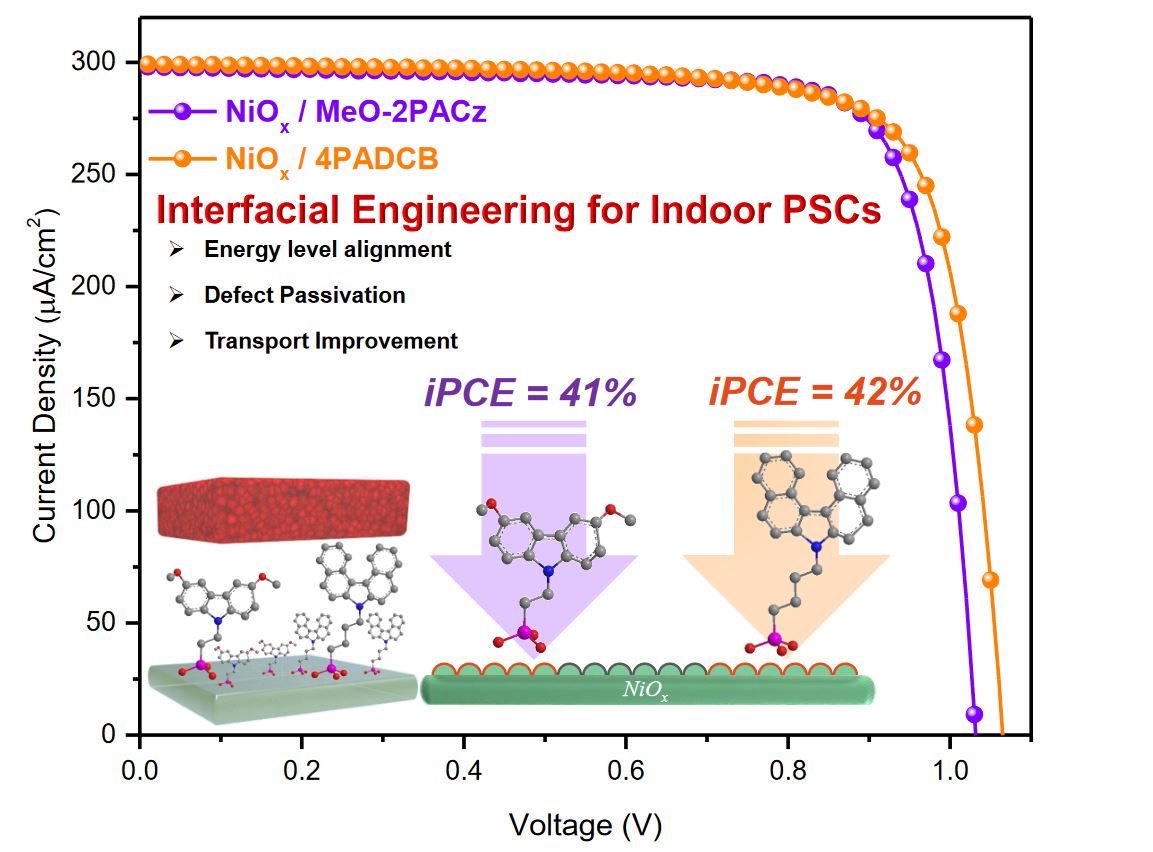
Recent advances in the development of perovskite solar cells for indoor applications have resulted in indoor energy conversion efficiency of more than 40%, driven by improvements in both bulk and passivation of interfacial defects, according to a research team led by Taiwan’s Ming Chi University of Technology .

With this in mind, the group sought to further optimize this cell technology through the use of self-assembled monolayers (SAMs), which reportedly improve perovskite growth and optoelectronic properties. The study’s lead author, Chih-Ping Chen, said pv magazine that the cell achieved an indoor energy conversion efficiency of 42% under 3,000 K LED lighting at 1,000 lux.

“This breakthrough highlights the potential of our approach to further develop indoor perovskite solar cell (PSC) technologies, expanding their applicability in low-light environments,” said Chen. “We specifically focused on the passivation effects of four commonly used SAMs for the modification of nickel(II) oxide (NiOx) in inverted perovskite solar cells, where MeO-2PACz and 4PADCB appear to be particularly effective in modifying the hole-selective layer ( HSL), optimizing surface properties and improving energy level alignment.”

In particular, the research team investigated the effect of four SAMs with different linker lengths and terminal functional groups on critical NiOx/perovskite interfacial films, depositing them via spin-coating. The SAMs used were 2PACz, MeO-2PACz, 4PADCB and Me-4PACz.

See also  PV systems can now support the electricity grid as fossil fuels decline, says IEA-PVPS – SPE

The researchers analyzed the performance of the perovskite cells made with SAM-modified NiOx layers and wide bandgap perovskite layers based on Cs0.18FA0.82Pb(I0.8Br0.2)3, finding that they achieved an “impressive performance.” of more than 20%. energy conversion efficiency under simulated sunlight at an intensity of AM 1.5 G 100 mW/cm2.

They also found that the best performing MeO-2PACz and 4PADCB devices had efficiencies of 20.19% and 20.18%, respectively. This contrasts with the best performing reference cell which had an efficiency of 14.98%. They also noted improved open-circuit voltage and fill factor values ​​for the target devices.

The target devices showed a “remarkable improvement” compared to the control device, which the researchers attributed to reduced non-radiative recombination and better carrier motion, indicating a reduction in defect density at the HSL/perovskite interface.

The cells are made with a substrate made of indium tin oxide (ITO), the NiOX film, SAMs, a perovskite absorber, an electron transport layer based on phenyl-C61-butyric acid methyl ester (PCBM), a bathocuproin (BCP) buffer layer and a silver (Ag) metal contact.

“Our strategy not only significantly improves fill factor values ​​but also paves the way for NiOx-based PSCs for indoor light harvesting applications,” the researchers concluded.

The new cell architecture was described in “Achieving indoor efficiency above 42% in wide bandgap perovskite solar cells through optimized interfacial passivation and carrier transport”, which was recently published in Journal of Chemical Technology.

This content is copyrighted and may not be reused. If you would like to collaborate with us and reuse some of our content, please contact: editors@pv-magazine.com.

See also  Swedish startup unveils tape-based stringer for back-contact solar panels – SPE

Popular content

Source link

achieves based cell efficiency Indoor monolayers perovskite selfassembled solar SPE
Share. Facebook Twitter Pinterest LinkedIn Tumblr Email
solarenergy
  • Website

Related Posts

Dutch solar owners asked to switch off during peak periods to ease the distribution crisis

June 7, 2026

Letter from China’s PV Industry: Arctech wins 2.1 GW solar deal

June 5, 2026

ComEd starts a new energy pilot with a solar rebate on the roof of a brewery

June 5, 2026
Leave A Reply Cancel Reply

Don't Miss
Energy Storage

India Awards 7.6 GW battery storage in H1 2025 – PV Magazine International

By solarenergyJuly 22, 20250

India has 5.4 GW of Colocated Solar Plus Battery Energy Storage Systems (BESS) and 2.2…

PakEnergy brings solar project management software to RE+ Texas

May 14, 2024

Swedish startup unveils tape-based stringer for back-contact solar panels – SPE

June 19, 2024

Full perovskite tandem PV cell based on carboranes achieves an efficiency of 27.2% – SPE

May 20, 2024
Stay In Touch
  • Facebook
  • Twitter
  • Pinterest
  • Instagram
  • YouTube
  • Vimeo
Our Picks

Dutch solar owners asked to switch off during peak periods to ease the distribution crisis

June 7, 2026

The hydrogen flow: Toyota demonstrates its racing prototype on liquid hydrogen

June 7, 2026

Era of electrification exposing Australia’s weakest link

June 6, 2026

‘Come out from behind your screen, our industry is ultimately about people’

June 6, 2026
Our Picks

Dutch solar owners asked to switch off during peak periods to ease the distribution crisis

June 7, 2026

The hydrogen flow: Toyota demonstrates its racing prototype on liquid hydrogen

June 7, 2026

Era of electrification exposing Australia’s weakest link

June 6, 2026
About
About

Stay updated with the latest in solar energy. Discover innovations, trends, policies, and market insights driving the future of sustainable power worldwide.

Subscribe to Updates

Get the latest creative news and updates about Solar industry directly in your inbox!

Facebook X (Twitter) Instagram Pinterest
  • Contact
  • Privacy Policy
  • Terms & Conditions
© 2026 Tsolarenergynews.co - All rights reserved.

Type above and press Enter to search. Press Esc to cancel.