
Close Menu
  • News
  • Industry
  • Solar Panels
  • Commercial
  • Residential
  • Finance
  • Technology
  • Carbon Credit
  • More
    • Policy
    • Energy Storage
    • Utility
    • Cummunity
What's Hot

Fraunhofer ISE develops colored film technology for patterned solar panels

April 23, 2026

Thermoacoustic heat pumps are on the verge of commercial breakthrough – SPE

April 23, 2026

The federal court has halted Trump administration orders that hinder solar and wind energy development

April 23, 2026
Facebook X (Twitter) Instagram
Solar Energy News
Thursday, April 23
  • News
  • Industry
  • Solar Panels
  • Commercial
  • Residential
  • Finance
  • Technology
  • Carbon Credit
  • More
    • Policy
    • Energy Storage
    • Utility
    • Cummunity
Solar Energy News
Home - News - Inorganic perovskite solar cells are almost ready for the market with record efficiency and stability
News

Inorganic perovskite solar cells are almost ready for the market with record efficiency and stability

solarenergyBy solarenergyOctober 10, 2025No Comments2 Mins Read
Facebook Twitter Pinterest LinkedIn Tumblr Email
Share
Facebook Twitter LinkedIn Pinterest Email

Inorganic perovskite solar cells are almost ready for the market with record efficiency and stability


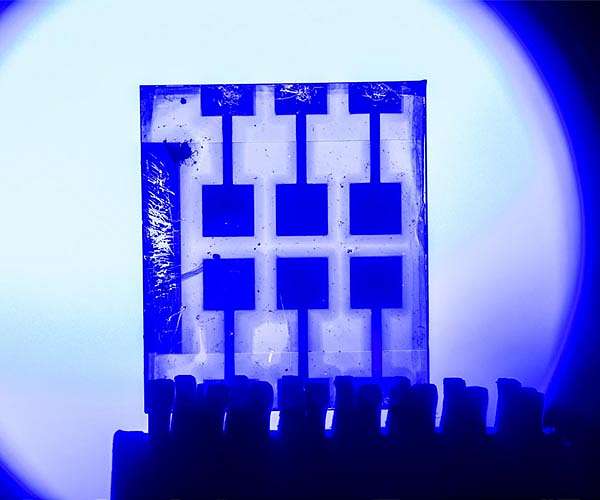
Scientists from Kaunas University of Technology (KTU), in collaboration with international partners, report one of the highest efficiencies to date for all-inorganic perovskite solar cells and, crucially, show that they can operate stably for hundreds of hours, closing the gap with commercial silicon. “Perovskite solar cells are one of the fastest growing solar technologies in the world – they can be lightweight, thin-film and flexible, and most importantly, they are made of low-cost materials,” says KTU researcher Dr. Kasparas Rakstys.

The team tackled perovskite instability by devising a passivation approach that forms a protective 2D layer on top of a 3D inorganic perovskite. They synthesized perfluorinated 2D ammonium cations whose highly electronegative fluorine atoms reduce the electron density of the ammonium group, allowing hydrogen bonding between the anchoring ammonium group and lead iodide fragments.

“Passivation makes the perovskite surface chemically inactive, eliminating defects introduced during production,” he noted. For fully inorganic compositions, adhesion is typically poor: “Simply put, 2D layers do not adhere to pure inorganic perovskite,” he said.

The new chemistry overcame that barrier: “The result was the formation of a stable 2D layer on the surface of the 3D inorganic perovskite. This time, the 2D layers finally bonded, forming robust heterostructures that remain stable even at high temperatures,” Dr. emphasized. Rakstys.

Devices exceeded 21 percent efficiency; mini modules with active areas more than 300 times larger than standard laboratory cells reached nearly 20 percent and worked stably for more than 950 hours at 85oC under continuous light.

See also  Kinematics acquires the Spanish specialist in the field of solar tracking controllers

“Although solar cells do not normally reach such high temperatures under real operating conditions, these standardized stability tests are used to assess their long-term durability, and such high stability is practically comparable to the requirements of commercial silicon cells,” he added.

The work, involving more than 20 researchers, appears in Nature Energy and underlines that next-generation perovskite technology is moving towards commercial application.

Research report:Cation interdiffusion control for 2D/3D heterostructure formation and stabilization in inorganic perovskite solar panels


Source link

cells efficiency Inorganic Market perovskite Ready record solar stability
Share. Facebook Twitter Pinterest LinkedIn Tumblr Email
solarenergy
  • Website

Related Posts

Fraunhofer ISE develops colored film technology for patterned solar panels

April 23, 2026

The federal court has halted Trump administration orders that hinder solar and wind energy development

April 23, 2026

Solar energy’s rebound effect could increase European electricity demand by 5% by 2050 – SPE

April 23, 2026
Leave A Reply Cancel Reply

Don't Miss
Cummunity

Solar Simplified acquires a solar subscription platform from a peer community

By solarenergyNovember 13, 20250

Community solar subscription and management company Solar energy simplified has announced its first acquisition –…

Solar panels deployed in France in 1992 still provide 75.9% of original output power – SPE

June 8, 2024

Sunrun completes three affordable housing projects in California

April 29, 2025

Encore Renewable Energy is breaking ground on its first solar project in New York

August 30, 2024
Stay In Touch
  • Facebook
  • Twitter
  • Pinterest
  • Instagram
  • YouTube
  • Vimeo
Our Picks

Fraunhofer ISE develops colored film technology for patterned solar panels

April 23, 2026

Thermoacoustic heat pumps are on the verge of commercial breakthrough – SPE

April 23, 2026

The federal court has halted Trump administration orders that hinder solar and wind energy development

April 23, 2026

Zendure launches battery ranges for residential PV – SPE

April 23, 2026
Our Picks

Fraunhofer ISE develops colored film technology for patterned solar panels

April 23, 2026

Thermoacoustic heat pumps are on the verge of commercial breakthrough – SPE

April 23, 2026

The federal court has halted Trump administration orders that hinder solar and wind energy development

April 23, 2026
About
About

Stay updated with the latest in solar energy. Discover innovations, trends, policies, and market insights driving the future of sustainable power worldwide.

Subscribe to Updates

Get the latest creative news and updates about Solar industry directly in your inbox!

Facebook X (Twitter) Instagram Pinterest
  • Contact
  • Privacy Policy
  • Terms & Conditions
© 2026 Tsolarenergynews.co - All rights reserved.

Type above and press Enter to search. Press Esc to cancel.