

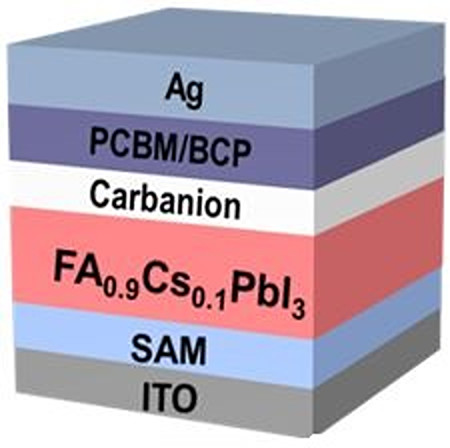
The solar cell, developed by scientists in China, reportedly achieved the highest open-circuit voltage ever measured for an inverted perovksite PV device. The lead carbanion layer was responsible for reducing defects at the interface between the perovskite layer and the electron transport layer.
A group of researchers led by NingboTech University in China has fabricated an inverted perovskite solar cell with an interface passivator based on lead carbanion (Pb-C–).
Inverted perovskite cells have a device structure known as “pin”, where hole-selective contact p is at the bottom of the intrinsic perovskite layer i with electron transport layer n at the top. Conventional halide perovskite cells have the same structure, but in reverse: a ‘nip’ arrangement. With nip architecture, the solar cell is illuminated via the electron transport layer (ETL) side; in the pin structure, it is illuminated by the hole transport layer (HTL) surface.
Inverted perovskite solar cells are known for their impressive stability, but are held back by lower efficiency in converting sunlight into electricity. This problem mainly occurs at the point where the perovskite layer meets the electron transport layer, causing energy loss instead of being converted into useful power. The energy loss is mainly caused by carrier recombination, especially at the interface between perovskite and the electron transport layer.
“Lead carbanion complexes are one of the least researched and understood carbon complex types and have so far only been observed in the liquid phase,” the study’s lead author Zhenhua Xu said. pv magazine. “In our work we present the synthesis of bulk lead carbanion complexes and aim to investigate their influence on the photoelectric properties of perovskite solar cells.”
In the study “Lead carbanion anchoring for surface passivation to increase the efficiency of inverted perovskite solar cells to more than 25%”, which was recently published in the Journal of Chemical Technologythe scientists explained that, with the carbanion treatment, the remaining lead cation (Pb2+) at the interface can be neutralized and fully coordinated.
“A comprehensive study on the properties of perovskite films, using photoluminescence (PL) mapping and scanning electron microscope (SEM) images, revealed that carbanion passivation reduces defect-rich domains and reduces grain isolation on the perovskite surface,” said Xu.
The group built the solar cell with a substrate made of indium tin oxide (ITO), a self-assembling monolayer (SAM) as HTL, the perovskite absorber, the Pb-C– passivator, an ETL based on phenyl-C61-butyric acid methyl ester (PCBM)a bathocuproin (BCP) buffer layer and a silver (Ag) metal contact.
Tested under standard lighting conditions, the device has an efficiency of up to 25.16%, an open-circuit voltage of 1.17 V, a short-circuit current density of 25.30 mA/cm2 and a fill factor of 85.0%. “This strong performance was mainly due to a high open-circuit voltage of 1.17 V and a minimum voltage drop of 0.38 V,” Xu further explained, adding that the cell achieved the highest open-circuit voltage ever recorded for an inverted perovk site PV device. “The perovskite surface was anchored with strong Pb-C− bond, which results in a stable device with a lifespan of more than 3 months.”
Looking ahead, the research group plans to explore other lead carbanion complexes with different cations, which are expected to synthesize more crystals, and should find applications beyond solar photovoltaics.
This content is copyrighted and may not be reused. If you would like to collaborate with us and reuse some of our content, please contact: editors@pv-magazine.com.
