

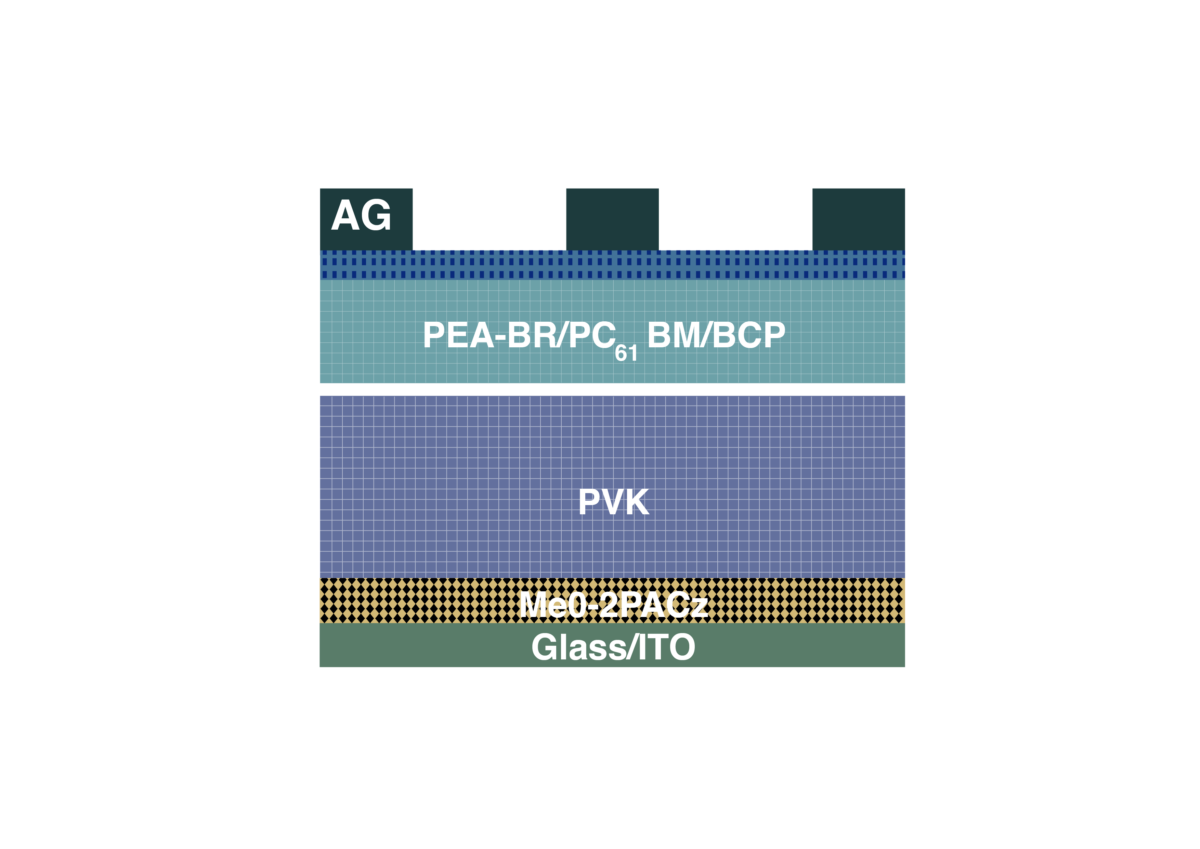
Researchers in China have designed an inverted perovskite solar cell with a new strategy aimed at optimizing the bottom region of the cell. The proposed cell was treated with two molecules known as 2-mercaptoimidazole and 2-mercaptobenzimidazole and was based on a hole transport layer supported on a self-assembling monolayer.
A group of scientists led by Jiaxing University in China has developed an inverted perovskite solar cell based on a hole transport layer (HTL) with a self-assembled monolayer (SAM).
Inverted perovskite cells have a device structure known as “pin”, where hole-selective contact p is at the bottom of the intrinsic perovskite layer i with electron transport layer n at the top. Conventional halide perovskite cells have the same structure, but in reverse: a ‘nip’ arrangement. With nip architecture, the solar cell is illuminated via the electron transport layer (ETL) side; in the pin structure it is illuminated by the HTL surface.
“The HTLs fabricated with SAM materials not only have negligible parasitic absorption, low material consumption and stable adhesion, but also exhibit inherent passivation of defects at the bottom of perovskites,” the research team explains.
The researchers used two molecules known as 2-mercaptoimidazole (2-MeIM) and 2-Mercaptobenzimidazole (2-MeBIM) as additives for the HTL. According to them, these molecules interact with the phosphonate groups in the so-called MeO-2PACz, also known as [2-(3,6-Dimethoxy-9H-carbazol-9-yl)ethyl]phosphonic acid, which inhibits the aggregation of MeO-2PACz by forming a supramolecular structure, which in turn results in a more homogeneous HTL.
The academics designed the cell with a substrate made of glass and indium tin oxide (ITO), a MeO-2PACz layer, the perovskite absorber, a phenylethylammonium bromide (PEA-Br) cation, an electron transport layer based on phenyl-C61-butyric acid methyl ester (PCBM), a bathocuproin (BCP) buffer layer and a silver (Ag) metal contact.
They tested the cell’s performance under standard lighting conditions and compared it to that of a reference cell without the additives. The champion solar cell treated with the additives achieved an energy conversion efficiency of 24.38%, an open-circuit voltage of 1.181 V and a short-circuit current density of 24.43 mA cm3.−2and a fill factor of 84.51%. The control device achieved an efficiency of 23.12%, an open-circuit voltage of 1.166 V, a short-circuit current density of 24.09 mA cm−2and a fill factor of 82.32%.
“Benefiting from the better energy alignment of the target film, the HTL with additives exhibited better charge carrier extraction capabilities,” the academics explained. “The improved properties of the additively introduced HTLs, such as better homogeneity, improved conductivity and better aligned energy bands, and the improved quality of the bottom side of the perovskite films with larger grain size with few defects, together promote the more efficient charge transfer and suppressed non- radiative recombination energy loss at the interface, which led to the better performance of the perovskite solar cells.”
The cells treated with the additives were also able to retain more than 89% of their initial efficiency after 450 hours, while the reference cell reached a value of only 74%. This was due to the higher quality of the perovskite film in the treated cells, which the group says minimizes their vulnerability to external and internal attacks.
The new cell concept was introduced in the study “Synchronous modulation of hole-selective self-assembled monolayer and buried interface for inverted perovskite solar cells,” published in Cell reports natural sciences.
This content is copyrighted and may not be reused. If you would like to collaborate with us and reuse some of our content, please contact: editors@pv-magazine.com.
