

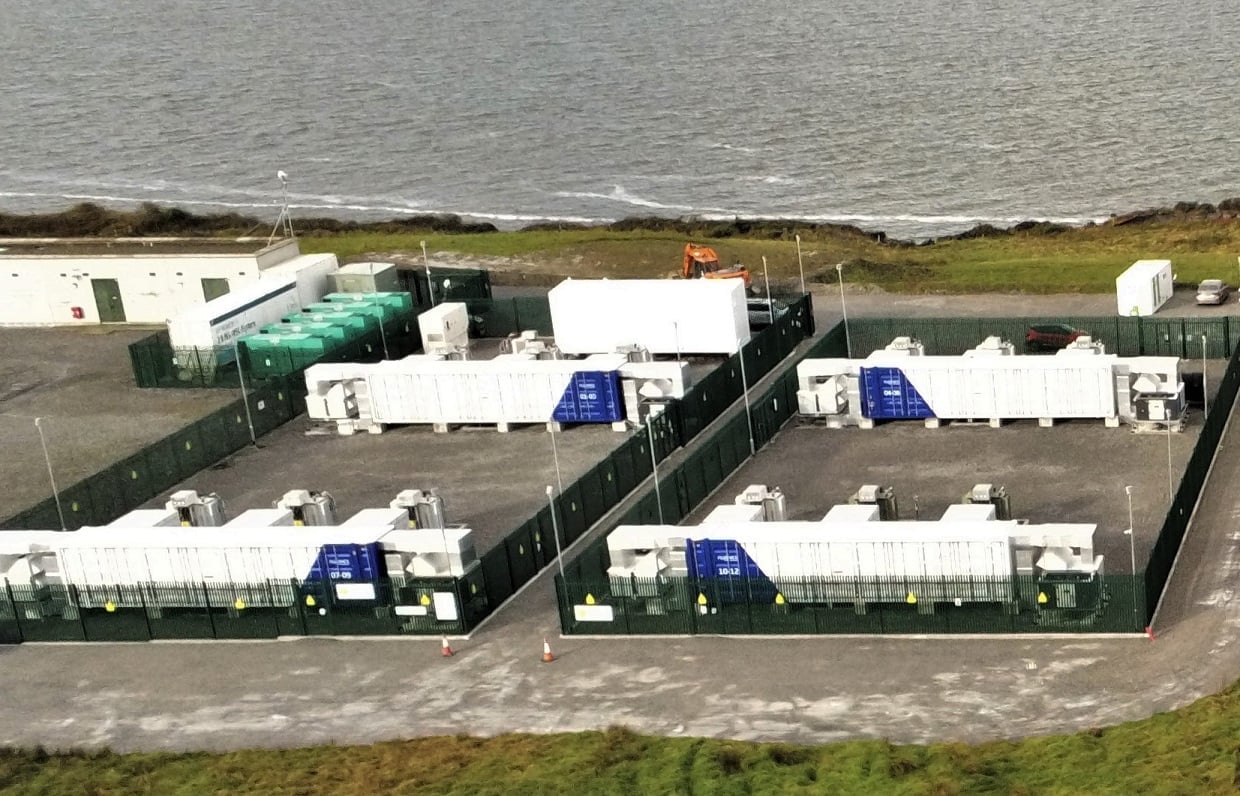
In an editorial that originally appeared in Vol.39 of PV Tech powerStatkraft’s Rory Griffin wrote about the challenges and opportunities encountered in developing Ireland’s first grid-scale 4-hour battery energy storage system (BESS).
Statkraft is currently building the BESS project in County Offaly, central Ireland. The 20MW BESS, supplied by Fluence, a global leader in utility-scale energy storage solutions and services, will be co-located with the company’s 55.8 MW Cushaling wind farm, which is also currently under construction.
As in other countries, network capacity in Ireland is becoming scarce. As developers install greater electricity generation capacity from onshore wind and solar energy, there is a good opportunity to sensibly locate storage to reduce the risk of local restrictions and support congestion management.
The Cushaling battery project will allow energy from renewable sources in the Midlands region to be stored at times of low demand, reducing costly curtailments, and later dispatched at times of peak electricity demand.
It will also support Ireland’s TSO EirGrid in ensuring network stability by providing fast-acting system services as more non-synchronous renewable energy generation comes online. Furthermore, by securing a ten-year capacity market contract, the project will contribute to energy security in Ireland.
Greater trading opportunities
Griffin explained that Statkraft sees significant potential in co-location/hybrid assets under the same grid connection and is pushing for policy changes in this area to maximize system benefits. Sharing of Maximum Export Capacity (MEC) grid connection capacity is currently not permitted in Ireland.
While system throttling can last longer than four hours, the 4-hour Fluence system was a technology that Statkraft had the confidence to deliver, and one that the company believes could limit throttling risk. Because wholesale prices are also volatile, using a four-hour duration creates greater trading opportunities for energy.
Energy arbitrage
New routes to market will drive longer-term storage, as will changes to market systems to fully enable traders to optimize asset capacity. According to Griffin, there should be more favorable treatment of network costs related to energy storage, based on its ability to provide flexibility to help manage network congestion.
As it stands, current network tariffs (namely Demand TUoS) pose a significant barrier and limit energy arbitrage opportunities for energy storage, limiting the benefits that energy storage can bring to the system.
For market access for BESS in Ireland, there are currently three revenue streams: the DS3 system services market, the capacity market and ISEM energy trading opportunities. Because each of these markets has its own challenges, it can come down to how an individual developer predicts these challenges and their risk appetite.
The DS3 programme, introduced in 2017, provided a clear route to market encouraging investment in short-term energy storage and six years later there are now around 800 MW of 0.5 hour, 1 hour and 2 hour BESS projects operational on the system.
Risk of rate reduction
However, the DS3 market is now overheated, as evidenced by signals from the TSO putting downward pressure on DS3 reserve rates and scarcity scalar rates in the latest DS3 rates consultation released at the end of March 2024. The Irish Energy Regulator (CRU) previously reduced tariffs to avoid breaching the spending cap. The CRU allowed the spending ceiling to be exceeded last year, but the sector is once again facing the risk of rate cuts.
It is not clear what the rates will be between now and April 2026, when the existing DS3 market will belatedly be replaced by the Future Arrangements System Services (FASS) market.
Rory Griffin is head of grid services at Statkraft Ireland. He has held operational roles with the Irish TSO in conventional power generation and, more recently, in grid services development. At the TSO he worked for five years at Power System Protection, followed by five years at the National Control Center. Since 2022, he has led Statkraft Ireland’s Grid Services team, which develops storage and grid stability projects.
This is an excerpt from a feature article that originally appeared in Vol.39 of PV Tech powerSolar Media’s quarterly magazine covering the solar and storage industries. Each edition includes ‘Storage & Smart Power’, a special section contributed by the Energy storage.news team, and full access to upcoming issues and the ten-year catalog are included as part of a subscription to Energy storage.news Premium.
