

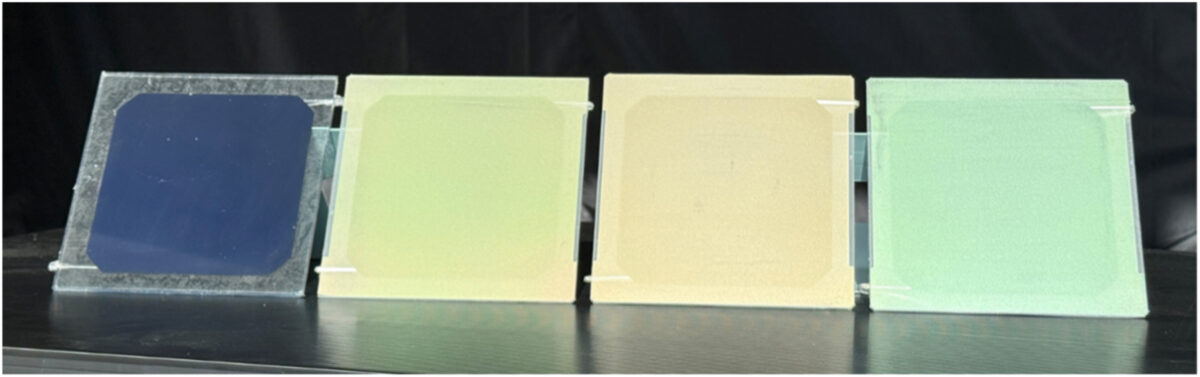
The lab-scale near-white heterojunction solar cell uses nanoclay-based scattering layers in combination with dielectric multilayer films to maintain energy conversion efficiency while increasing visual appeal. The researchers report optical losses of less than 1% at a 50% clay volume fraction, which is significantly lower than that observed with textured glass.
Researchers at Nagaoka University of Technology in Japan have fabricated a heterojunction (HJT) solar cell with a near-white appearance for applications in building-integrated solar photovoltaics (BIPV).
“This is still a laboratory-scale proof of concept, but the key processes we used, such as large-area coating and thin-film deposition sputtering, have clear industrial equivalents,” said the study’s lead author, Noboro Yamada. pv magazine. “We are not yet working directly with PV manufacturers and would welcome partners to evaluate scalability, module integration and long-term reliability.”
The scientists explained that although white-colored building materials are often used in architectural applications, they achieve a visually white appearance in solar-integrated materials at the cost of reduced efficiency. For example, in white solar cells, increased reflection and scattering of light can lead to power losses of up to 41.5%.
To address this limitation, they proposed using cover glass surface texturing to increase the scattered light. Specifically, they used nanosized clay minerals, or nanoclay, as a scattering layer to increase haze while maintaining high transmittance. In addition, dielectric multilayer films (DMFs) were used for reflection control.
The nanoclay was based on organically modified smectite, a group of clay minerals known for their layered, plate-like structure and exceptional ability to absorb water and swell.
Image: Nagaoka University of Technology, Solar Energy and Solar Cell Materials, CC BY 4.0
By comparing the optical performance of clay films with textured and flat glass, the scientists found that clay films maintain high transmission across the visible spectrum while achieving significant scattering. Unlike textured glass, which mainly scatters light at the surface and reduces transmission, clay films rely on volume scattering within nanosized clay layers, allowing them to increase lightness without significant optical loss.
At a clay content of 50 vol.%, clay films achieved a near-white appearance with an optical loss of less than 1%, while textured glass suffered a loss of more than 6% for a comparable whiteness. Furthermore, hybrid films combining clay with wavelength-selective DMFs improved whiteness while controlling optical loss.
Data on the device’s energy conversion efficiency and other electrical parameters have not been disclosed.
“These results indicate that nanoclay films may be promising whitening materials that can balance lightness and strength performance, unlike textured glass, which relies on surface scattering,” the research team highlighted. “We then designed DMFs using multi-objective Bayesian optimization and combined them with clay to study hybrid films with reduced optical loss and a whiter appearance. The optimization focused on reduced optical loss, chroma and increased lightness.”
“We did not conduct a full cost analysis in this article,” Yamada added. “However, we have made a rough internal estimate and the added materials for the near-white coating are based on commonly available, low-cost components, so we do not expect a large increase in solar cell costs.”
The new cell design was introduced in “Almost white-looking solar cells made possible by nanoclay-based scattering layers”, published in Solar energy materials and solar cells. Looking ahead, the team plans to create improved techniques to achieve a near-white or completely white appearance, test the durability of the materials under outdoor conditions, establish scalable manufacturing methods suitable for large-area production, and assess the overall cost-effectiveness of the technology.
This content is copyrighted and may not be reused. If you would like to collaborate with us and reuse some of our content, please contact: editors@pv-magazine.com.
Popular content

