

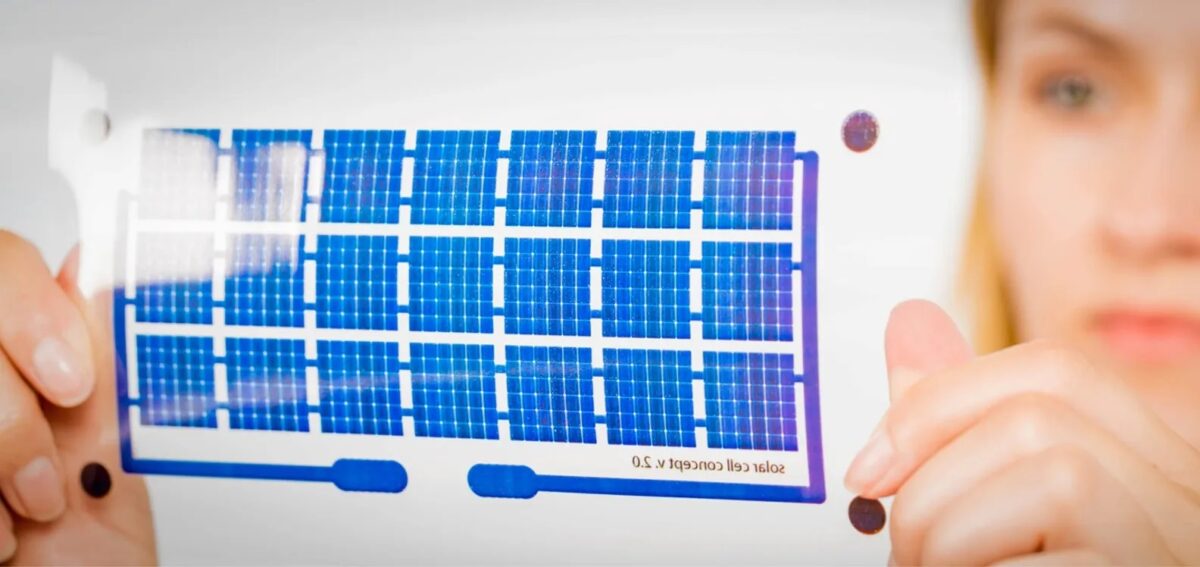
Scientists in the UK and Finland publish a new model for analyzing thin-film and other PV devices with low charge carrier mobility. The uniform diode equation for thin-film PV is claimed to provide insights into the mechanisms driving charge collection limitation and energy conversion efficiency in low-mobility PV devices.
Physicists in the UK and Finland have developed a new analytical model that they claim could improve the understanding of thin-film PV, leading to greater efficiency.
Researchers from Swansea University and Åbo Akademi University wanted to create a better method for analyzing sandwich-type thin-film PV based on undoped semiconductors. They argue that models using the Shockley ideal diode equation, which has been used for nearly eighty years to explain how current flows through solar cells, leave gaps in understanding when applied to thin-film PV.
According to the researchers, models that use the ideal diode equation to analyze the JV characteristics of PV devices fall short because they do not take into account ‘injected carriers’: charges that enter the device through the contacts. This is not a problem when analyzing a traditional silicon PV solar cell, but thin-film PV can be hundreds of times thinner, meaning that recombination between injected charges and photogenerated charges will have a greater effect due to the much larger interfacial areas present.
To better describe current in devices with low charge carrier mobility, such as thin-film PV, a model is needed that takes into account the competition between charge extraction and recombination of photogenerated charge carriers, the researchers argued.
“The traditional models simply didn’t capture the whole picture, especially for these thin-film cells with low-mobility semiconductors,” said Associate Professor Ardalan Armin of Swansea University, lead researcher on the project. “Our new research addresses this gap by introducing a new diode equation specifically tailored to these crucial injected carriers and their recombination with the photogenerated carriers.”
The researchers created an analytical model for current that takes into account the interplay between charge carrier extraction, injection and biomolecular recombination. The model is claimed to provide a new framework for designing more efficient thin solar cells and photodetectors, optimizing existing devices and analyzing material properties. The model was validated using numerical simulations and tested experimentally on organic solar cells.
“Our findings provide important insights into the mechanisms that drive and limit charge collection, and ultimately energy conversion efficiency, in low-mobility PV devices,” says Dr. Oskar Sandberg from Åbo Akademi University, principal investigator of the project.
Popular content
The full study entitled “Diode comparison for sandwich-type thin-film photovoltaic devices constrained by bimolecular recombination‘ appeared in PRXEnergy and can be accessed online for free.
“The obtained findings provide essential physical insights into the interplay between charge carrier extraction, injection and bimolecular recombination and their influence on device performance,” the scientists said. “Moreover, the derived approaches can be used to extract material parameters from experimental data, for example using a global fitting procedure, in systems where bimolecular recombination is the dominant loss mechanism of photogenerated charge carriers.”
This content is copyrighted and may not be reused. If you would like to collaborate with us and reuse some of our content, please contact: editors@pv-magazine.com.
