

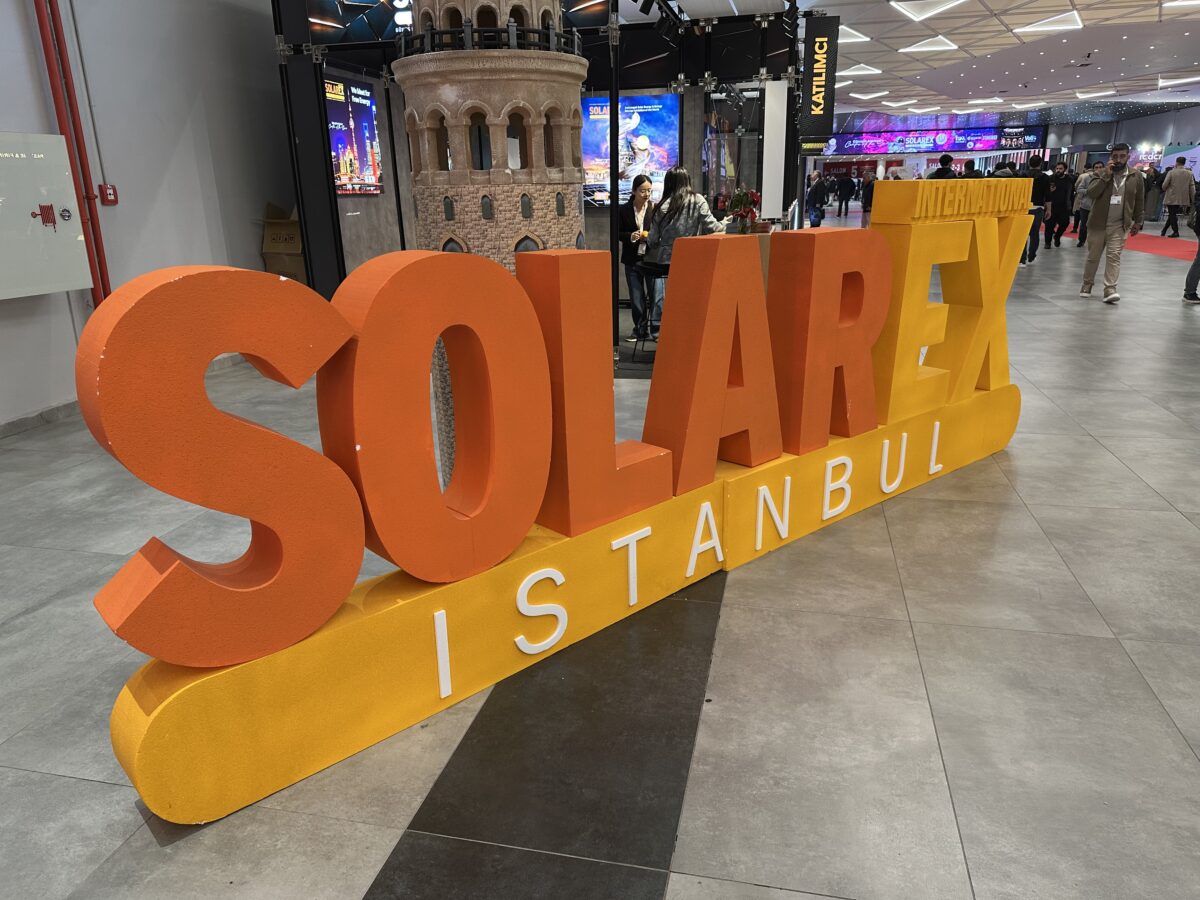
The 18th edition of SolarEx Istanbul brought together the full spectrum of Türkiye’s solar ecosystem and highlighted the sector’s growing depth and international reach. From established domestic solar cell and module manufacturers to EPC contractors and advanced technology suppliers, the show floor reflected a dynamic mix of both Turkish and global players, underscoring the country’s growing role in the renewable energy value chain.
“We hosted more than 400 exhibitors presenting more than 1,000 global brands,” said Cüneyt Er, director of foreign relations at SolarEX Istanbul, in a statement to pv magazine. “While the final visitor figures are still being drawn up, this was undoubtedly a record edition in terms of size and involvement.”
It also highlighted that the event further strengthened Türkiye’s position as an emerging “global hub” for the solar industry. “The official opening ceremony resembled a real ‘Energy Summit’, bringing together global diplomacy and business,” he noted. “The ribbon-cutting ceremony attracted strong international attention and was attended by the Director General of National Technology and Artificial Intelligence, together with the ambassadors of Ghana, Burundi, Egypt, Guatemala and Cambodia.”
Production landscape
At the same time, interest in Turkish PV products appears to be increasing. As trade barriers and regulatory challenges increasingly affect Chinese and other Asian suppliers in certain markets, Turkish manufacturers are gaining visibility as competitive and reliable alternatives. This shift opens up new export opportunities and strengthens Türkiye’s strategic positioning in the global solar supply chain.
CW Enerji, Kalyon PV, Smart Günes Teknolojileri, HT-SAAE and Schmid Pekinitas already produce or are actively planning to produce gigawatt-scale solar cells, targeting both domestic demand and export markets. However, these ambitions entail structural challenges. Although internal demand in Türkiye increased, it amounted to approximately 4.7 GW last year, which is relatively modest compared to the scale of planned production capacity. This creates a potential imbalance between supply and domestic demand, increasing dependence on exports.
At the same time, Turkish manufacturers face increasing global competition, especially from emerging solar manufacturing hubs in the Middle East and Africa, where favorable policy frameworks, lower input costs and proximity to key export markets are accelerating capacity building.
“We believe that Türkiye has become an important hub for solar energy production,” said Hamil Demirdag, CEO of Smart Günes Teknolojileri. pv magazine. “Our focus is on producing high-quality products that our customers can rely on. Comparisons with larger markets such as China are not particularly meaningful for us. Whether in Europe, the US or Türkiye, individual players may seem small in terms of global capacity. But that is not where we place our emphasis. What really matters is being strong enough to serve our own market with reliable, high-quality solutions.”
“At Solarex Istanbul, we have brought together our innovative products developed through our R&D efforts with industry representatives. In particular, our green hydrogen energy solutions, residential systems and portable hydrogen fuel cell technologies attracted a lot of attention from visitors,” said CW Enerji Chairman Tarık Sarvan. pv magazine. “We have made efforts to expand our integrated production and dealer concept, which has been successfully implemented in Türkiye, to international markets. By maintaining this strong structure in the US market, we aim to become a more effective player on a global scale.”
Representatives of the Turkish Solar Association Günder said pv magazine that growth in the Turkish market was particularly strong in distributed and self-consumption projects. They emphasized that industrial and commercial rooftop installations are currently the main drivers of expansion. However, a major limitation they point out is the regulatory framework, particularly grid connection limits and permitting processes. They emphasized that market growth is closely linked to the speed with which these administrative barriers can be addressed.
Storage market
Another notable trend at this year’s fair was the rapid rise of the battery storage segment. A growing number of exhibitors presented energy storage solutions ranging from lithium-ion battery systems to integrated solar-plus-storage offerings, reflecting rising demand for flexibility and grid stability. Both local companies and international players highlighted new partnerships, production plans and turnkey solutions, indicating that battery storage is quickly becoming a key pillar of Türkiye’s sustainable energy landscape and a natural extension of the solar industry’s growth.
“The energy storage sector in Turkey is still in its early stages, although it shows great potential,” said Ufuk Keser, Business Development Director at Maxxen, a Turkish battery manufacturer. pv magazine. “The market is considered promising, especially due to increasing opportunities in licensed energy storage projects and the integration of storage systems with existing renewable power plants. These deployments are especially valuable for increasing grid flexibility.”
A major milestone occurred almost two years ago, when a licensing round resulted in more than 30 GW of utility-scale storage capacity being awarded to investors. Although these projects are only beginning to materialize this year, they indicate a substantial development pipeline. Currently, the installed energy storage capacity in Turkey is relatively modest, around 200 MWh, but it is expected to grow rapidly.
“One of the initial barriers to market entry was regulatory uncertainty,” Keser continued. “However, this situation has improved significantly. While legislation was still in development last year, the regulatory framework is now largely finalized. Rules regarding project development, grid connection and commissioning requirements have been officially announced, providing greater clarity for investors. That said, as in many countries, some challenges remain, especially in obtaining estate approvals for projects.”
In terms of market structure, growth is expected to be driven mainly by large-scale projects rather than commercial and industrial (C&I) applications. Recent increases in electricity prices have improved the business case for energy storage by widening price differentials, increasing revenue opportunities and investor confidence.
However, compared to other European markets, Turkey still has relatively lower price volatility and smaller differences between minimum and maximum electricity prices. This somewhat limits the attractiveness for investors looking for arbitrage opportunities. Nevertheless, the strong project pipeline and long-term strategic objectives continue to support the positive outlook.
Looking ahead, Turkey has set ambitious renewable energy targets, aiming to reach around 120 GW of installed capacity from solar and wind energy by 2050. “Achieving these goals will require a substantial deployment of energy storage to ensure the flexibility and stability of the system,” Keser said. “As a result, energy storage is expected to play a crucial and growing role in the country’s energy transition.”
This content is copyrighted and may not be reused. If you would like to collaborate with us and reuse some of our content, please contact: editors@pv-magazine.com.
