

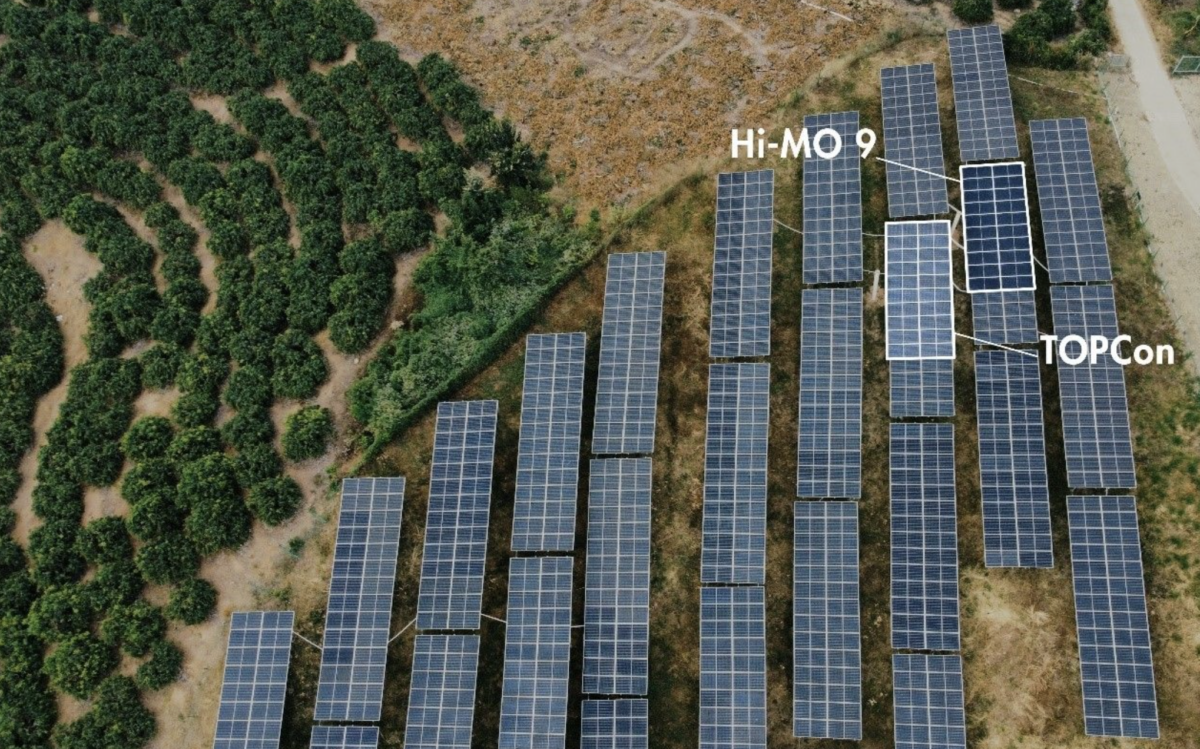
Chinese module manufacturer Longi says its Hi-MO 9 series with HPBC 2.0 cells achieved watt-for-watt power gains of 1.21% to 3.92% in real-world testing in multiple countries and climates, reducing levelized electricity costs (LCOE) compared to regular tunnel oxide passivated contact (TOPCon) modules.
Chinese module manufacturer Longi has published field data from a series of tests with its Hi-MO 9 module series. The flagship product of Longi’s back-contact (BC) series, revealed earlier this year, the Hi-MO 9 module was built on the company’s HPBC 2.0 high-efficiency cell technology.
The test scenarios include environments including temperate continental, tropical, arid regions and coastlines with high humidity to evaluate the performance of the modules under real operating conditions. Longi said the findings show that the Hi-MO 9 module “exhibits stability and consistency that exceeds expectations in terms of actual power generation performance, system economic benefits and environmental adaptability.”
The BC modules achieved stable growth in watt-for-watt power generation worldwide, with profit margins ranging between 1.21% and 3.92% compared to regular TOPCon modules.
In an assessment conducted by Enertis Applus+ on a 47 MW single-axis tracker project in Seville, Spain, the Hi-MO 9 achieved 2,209 equivalent full load hours in its first year of operation, with watt-for-watt power generation 2.4% to 3.4% higher than that of TOPCon modules at the same site. Calculations indicated that the LCOE was reduced by 3.92% and 4.47% compared to the regular TOPCon-210R and TOPCon-210 models.
Evaluation projects elsewhere led by IPVF Two 50 MW ground projects in France and Denmark showed that the Hi-MO 9’s watt-for-watt power generation was on average 1.84% higher than that of TOPCon modules, while the LCOE was 3.32% and 2.43% lower than that of TOPCon-210R and TOPCon-210 models.
In the city of Sanya, southern China, with high temperature and high humidity, an assessment by the China General Certification Center found that the Hi-MO 9 achieved a power generation gain of 1.54% watt-for-watt over TOPCon modules. The module backplane also had a 1.21C lower operating temperature and a 0.19% benefit in power degradation over six months.
Meanwhile, at a flat test site in the eastern Chinese province Zhejiang, the Hi-MO 9 modules Power generation gains reached 1.87%, with temperature and degradation rate benefits of 1.26 C and 0.38%.
Longi added that field data has also shown that under common partial shade conditions caused by vegetation, bird droppings, dust or structural shadows, the Hi-MO 9 is able to effectively suppress the hotspot effect, with hotspot temperatures significantly lower than those of conventional modules. This breakthrough is said to “take the safety of PV installations to a new level,” reducing the risks of material aging, power degradation and potential fire hazards.
The company said the publication of its field testing program “marks an important milestone in the further large-scale adoption of BC technology.”
Longi’s latest release follows case study data shared in the German market in October that found BC modules surpass TOPCon in the field of generation and costs.
This content is copyrighted and may not be reused. If you would like to collaborate with us and reuse some of our content, please contact: editors@pv-magazine.com.
