

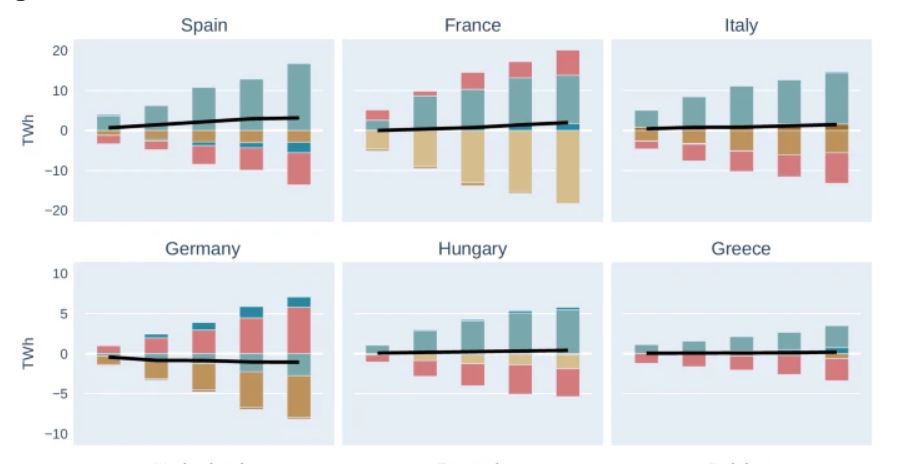
A group of scientists led by the European Commission’s Joint Research Center (JRC) has analyzed the impact of deploying more vertical PV systems on European energy markets and identified potential benefits that this scenario could bring. These include lower electricity prices, lower system costs and increasing power exchange between neighboring countries.
An international research team has investigated the impact of deploying bifacial vertical agricultural voltaic solar on a large-scale disruptive scenario in the European energy market and found that east-west oriented vertical PV panels could play an important role in achieving a more balanced and more integrated continental climate. energy system in 2040.
In particular, the scientists found that the prospect of greater penetration of vertical PV systems, mainly of commercial and industrial size, could lead to a number of important improvements, such as increasing the share and value of solar energy, reducing the base load prices for electricity and increasing energy exchange between neighboring countries.
The group explained that east-west oriented vertical PV extends a solar panel’s generation time through sunrise and sunset, periods when it is more valuable to consumers. “Such a setup typically produces 30% in the three afternoon hours, in contrast to south-facing PV systems that produce almost 70% of the output around midday,” the report points out. “Favoring vertical bifacial systems reduces peak PV production and provides a production profile that covers a greater number of hours, allowing solar-based production to maintain a higher market value.”
The analysis was based on the European Power Market Model (EPMM), a multi-market sectoral equilibrium model that simulates European wholesale electricity markets and analyzes the impact of policies on European markets. It covers the 27 countries that are members of the European Network of Transmission System Operators for Electricity (Entso-E).
The modeling took into account minimized electricity demand costs, start-up and shutdown costs, production costs and renewable energy curtailment. It covered both conventional and renewable generation and energy storage. “The primary objective of the model is to meet electricity consumption needs at the lowest system cost, taking into account the characteristics of available power plants and cross-border transmission capacities in the European energy system,” the group said.
In the five proposed sensitivity scenarios analyzed by modeling, solar power is expected to reach capacities ranging from 649 GW to 1,178 GW, compared to around 240 GW currently. However, the base case did not assume investments in vertical bifacial PV, while in the best case scenario vertical PV is expected to reach a remarkable 50% share.
“The model results clearly show an increase in solar energy generation by 2% and 3.6% in 2030 and 2040, respectively,” the researchers explain. “This increase amounts to more than 5.3% in the high PV scenario, clearly showing the potential of the vertical system. In particular, there has been a substantial increase in electricity injected into the grid through higher vertical PV use, mainly replacing gas and nuclear power generation.”
The analysis also found that more vertical PV can lead to significantly lower energy prices, in part due to lower system costs, less curtailment and the replacement of expensive conventional power generation equipment.
“In the longer term, the European energy system will become more sustainable both economically and environmentally,” the scientists concluded. “The future system will be characterized by lower CO2 emissions2 emissions and reduced dependence on imported fossil fuels, and it will also be more sustainable in economic terms, characterized by reducing overall system costs and lowering wholesale electricity prices.”
Their findings are available in the study “Impact of large-scale deployment of vertical two-sided photovoltaic solar energy on the dynamics of the European electricity market”, which was recently published in communication about nature. The research group included academics from the Hungarian Regional Center for Energy Policy Research, the University of California – Berkeley, the European Commission’s Joint Research Center (JRC), Greek consultancy Elpedison SA and software provider European Dynamics Luxembourg SA.
This content is copyrighted and may not be reused. If you would like to collaborate with us and reuse some of our content, please contact: editors@pv-magazine.com.
