

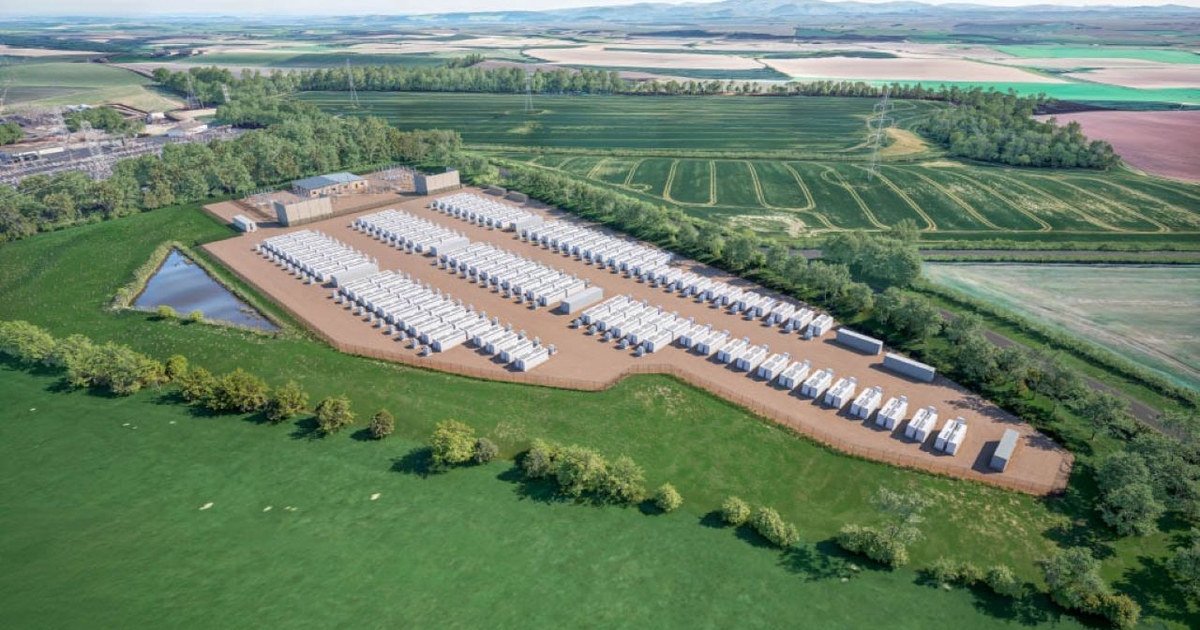
Spanish renewable energy platform Matrix Renewables has appointed Tesla for the engineering, procurement and construction (EPC) for its 500MW/1GWh battery energy storage system (BESS) in Scotland.
Tesla has signed a Full EPC agreement for the design, construction and commissioning of the 2-hour BESS, based in Eccles, Scotland. Matrix has met all planning conditions for the project and is now in the ready-to-build (RTB) phase.
The Eccles BESS will be Matrix’s first self-contained storage project in the UK. It acquired the site, along with another in Kilmarnock, Scotland, in April this year, through a partnership with Green BESS Developments UK, part of Czech investment group Creditas.
When it took on the projectsMatrix said both would be connected to the grid in 2027. The Eccles project was given consent by the Scottish Energy Consents Unit (ECU) in December 2024, but Kilmarnock only received consent in April this year, likely why Eccles was the first to make progress.
The company also said at the time that it was in negotiations with an unnamed UK EPC provider – which could theoretically still sign up to the Kilmarnock BESS.
Tesla, headquartered in Austin, Texas, is known for its electric vehicles (EVs)and it also operates a network of EV chargers worldwide. Are The energy storage activity is experiencing enormous sales growthan area where profits can be made more easily than in EV.
Matrix said it plans to expand its UK pipeline with renewable generation, energy storage and emerging technologies to create a pipeline of up to 3GW ‘in the coming years’.
Managing director for Europe and Latin America at Matrix Renewables, Sergio Arbeláez, said the installation demonstrates the company’s ability to “execute complex utility-scale storage projects through strong partnerships and a long-term strategic vision.”
When he entered the UK market in April, he said Britain was the “most advanced market in Europe for standalone battery storage”.
Both the Eccles and Kilmarnock BESS projects are located along electricity transmission corridors between Scotland and England, which are currently severely restricted.
When large amounts of wind power in Scotland produce too much electricity to be transported to where it is needed in England, the storage sites, each with a capacity of 500 MW, will store electricity that would otherwise be wasted.
