

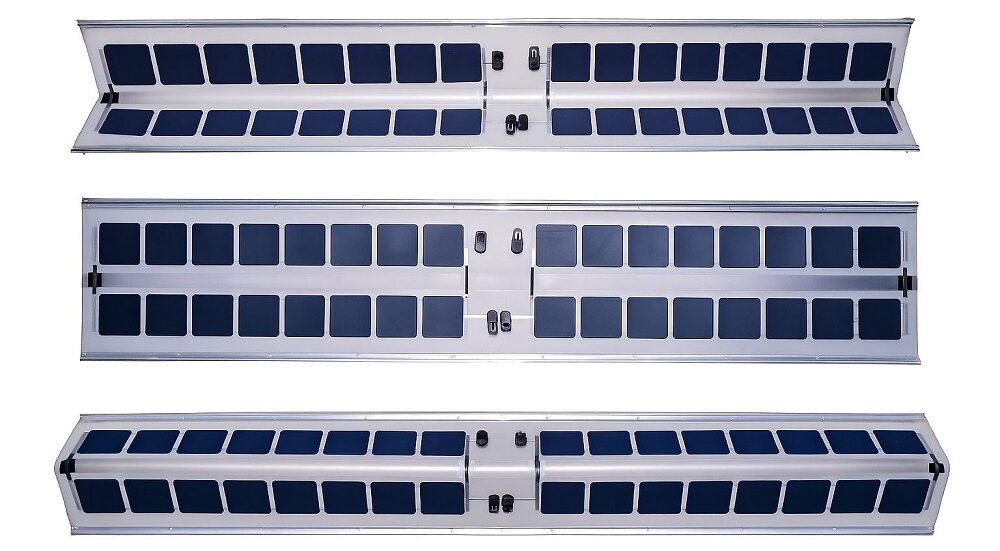
While completing pilot projects in the US and Europe, Mirai Solar has certified its lightweight PV module designed to work as a shade screen in agricultural voltaic applications, such as greenhouses.
Mirai Solar, a US-based specialty module manufacturer and spin-off of Saudi Arabia’s King Abdullah University of Science and Technology (KAUST), has certified its new 115W solar shade module with TüV Rheinland.
The patented design is a foldable, glass-free module with vacuum-laminated solar cells on lightweight flexible polymer plates. It has been developed for new greenhouses and as a retrofit for greenhouses that already have an extendable screen setup.
“This panel is designed to provide 60% solar shading and 40% light transmission, which is a common value in greenhouse shading screens, and a level of shading that our customers often request,” said Michael Salvador, CEO of Mirai Solar. pv magazine. He noted that the “shade level is adjusted via the cell density,” which is about 50%.
The IEC 61215 and IEC 61730 certified module, called NinjaYonin-115-25/48, is equipped with crystalline silicon solar cells with back contact. It weighs 1.5 kg per m2, measures 2,500 mm x 480 mm x 2 mm and is equipped with Stäubli connectors. The maximum radius of curvature is 500 mm, with a maximum design load of 1600 pa, an open-circuit voltage of 23.34 V and a short-circuit current of 6.07 A.
The company has at least eight active pilot agrivoltaic installations covering leafy greens, tomatoes, vineyards and algae, according to Michele De Bastiani, Mirai Solar R&D Director. Two of the pilots are in California, one in Germany, four in Saudi Arabia and one in Missouri. Some demonstrations take place at commercial growers, while others take place at research sites.
“Cumulatively, we have installed more than 150 kW. The largest installation is a 50 kW site in California,” says Salvador, adding that the company has a “working and scalable” solution for greenhouses, while also developing and validating an open field solution with partners. There are plans to demonstrate on a scale of 1 MW, which will require approximately 2 hectares.
Recently, the company adapted its technology for use atop a lightweight canopy-style carport on the KAUST campus. For example, a 3 kW system was integrated with energy storage to provide power for charging electric golf carts without requiring any structural changes to the carport. “We offered this as a drop-in solution, including a battery charging station,” said Salvador.
Founded in 2019, Mirai Solar has benefited from commercialization support from startup incubators in the US and the Middle East and North Africa (MENA), such as the American Made Solar Prize, Los Angeles Cleantech Incubator, the International Fresh Produce Association (IFPA) Fresh Field Catalyst and the Mega Green Accelerator, a startup business initiative of PepsiCo, SABIC and partners active in MENA.
This content is copyrighted and may not be reused. If you would like to collaborate with us and reuse some of our content, please contact: editors@pv-magazine.com.
