
Close Menu
  • News
  • Industry
  • Solar Panels
  • Commercial
  • Residential
  • Finance
  • Technology
  • Carbon Credit
  • More
    • Policy
    • Energy Storage
    • Utility
    • Cummunity
What's Hot

Dutch solar owners asked to switch off during peak periods to ease the distribution crisis

June 7, 2026

The hydrogen flow: Toyota demonstrates its racing prototype on liquid hydrogen

June 7, 2026

Era of electrification exposing Australia’s weakest link

June 6, 2026
Facebook X (Twitter) Instagram
Solar Energy News
Monday, June 8
  • News
  • Industry
  • Solar Panels
  • Commercial
  • Residential
  • Finance
  • Technology
  • Carbon Credit
  • More
    • Policy
    • Energy Storage
    • Utility
    • Cummunity
Solar Energy News
Home - News - Molecular adjustments increase the efficiency of organic solar cells
News

Molecular adjustments increase the efficiency of organic solar cells

solarenergyBy solarenergySeptember 17, 2024No Comments3 Mins Read
Facebook Twitter Pinterest LinkedIn Tumblr Email
Share
Facebook Twitter LinkedIn Pinterest Email

Molecular adjustments increase the efficiency of organic solar cells


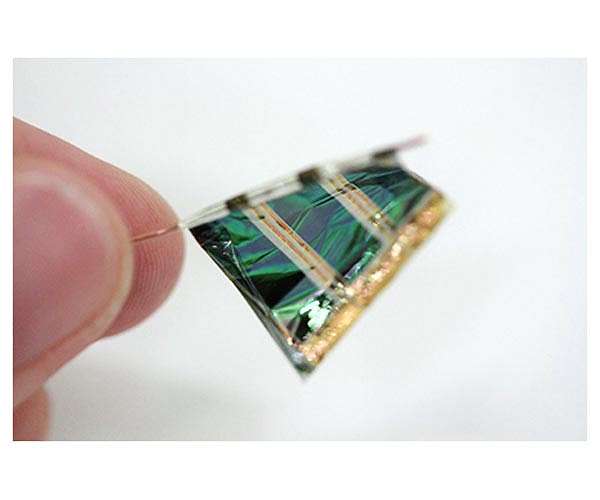
Organic solar cells (OSCs) offer a promising alternative to traditional inorganic solar cells, thanks to features such as tunable chemistry that allow scientists to fine-tune their properties for better performance. Researchers in Japan have now used this tunability to achieve higher energy conversion efficiency in OSCs.

A recent study published in ‘Angewandte Chemie International Edition’ by researchers from Osaka University reports the development of a new organic semiconductor that surpasses the energy conversion efficiency of standard models.

OSCs are lightweight, flexible and can be mass-produced at relatively low cost, making them well suited for applications such as agrivoltaics, where large areas are used for both agriculture and solar energy production.

Normally, OSCs are composed of two organic semiconductors: one that transports electrons (the acceptor) and one that transports holes (the donor). When excitons – combinations of electrons and positive holes – split into their components, a current is created. The challenge lies in breaking these tightly bound excitons with enough energy from sunlight to create a useful current.

“Reducing the amount of energy required to break down an exciton – the exciton binding energy – makes it easier to convert the light into the desired current,” explains Seihou Jinnai, lead author of the study. “We therefore focused on the factors that contribute to the binding energy, including the distance between the electron and the hole. As this increases, the binding energy should decrease.”

To address this, the researchers designed a molecule with side units that separated the parts of the molecule responsible for holding the electron and the hole. This molecule was tested as an acceptor in a bulk heterojunction OSC alongside a donor material, and the system demonstrated improved energy conversion efficiency compared to standard models. It also performed well as the sole component in an OSC, efficiently converting light into power.

See also  Redwire will supply additional solar panels for Thales Alenia Space satellites

“The molecule we designed shows that the nature of side units in acceptor molecules is key to the exciton behavior and its consequent efficiency,” said Yutaka Ie, senior author of the study. “This result provides an important demonstration of what can be achieved by tailoring chemistry for OSC applications.”

The research suggests that rational design of organic semiconductors could lead to the development of new, high-performance OSCs, including wavelength-selective transparent models. Such advances are expected to improve the role of OSCs in large-scale photovoltaic applications and contribute to sustainable energy solutions.

Research report:Non-fullerene acceptors with spiro-substituted bithiophene units in organic solar cells: tuning the cross-border molecular orbital distribution to reduce exciton binding energy


Source link

adjustments cells efficiency increase molecular organic solar
Share. Facebook Twitter Pinterest LinkedIn Tumblr Email
solarenergy
  • Website

Related Posts

Dutch solar owners asked to switch off during peak periods to ease the distribution crisis

June 7, 2026

Letter from China’s PV Industry: Arctech wins 2.1 GW solar deal

June 5, 2026

ComEd starts a new energy pilot with a solar rebate on the roof of a brewery

June 5, 2026
Leave A Reply Cancel Reply

Don't Miss
Policy

Solar Fabrik launches 400 W red-brown module for historic roofs – SPE

By solarenergyApril 1, 20260

Solar Fabrik has introduced a 400W red-brown glass-glass PV module designed to meet strict aesthetic…

Ohio wants to encourage the deployment of residential solar energy in underserved communities

April 25, 2024

Solex Energy and ISC Konstanz unveil a new back-contact solar panel concept

October 31, 2025

Site selection for PV plants on Coal Gangue Hills – PV Magazine International

May 20, 2025
Stay In Touch
  • Facebook
  • Twitter
  • Pinterest
  • Instagram
  • YouTube
  • Vimeo
Our Picks

Dutch solar owners asked to switch off during peak periods to ease the distribution crisis

June 7, 2026

The hydrogen flow: Toyota demonstrates its racing prototype on liquid hydrogen

June 7, 2026

Era of electrification exposing Australia’s weakest link

June 6, 2026

‘Come out from behind your screen, our industry is ultimately about people’

June 6, 2026
Our Picks

Dutch solar owners asked to switch off during peak periods to ease the distribution crisis

June 7, 2026

The hydrogen flow: Toyota demonstrates its racing prototype on liquid hydrogen

June 7, 2026

Era of electrification exposing Australia’s weakest link

June 6, 2026
About
About

Stay updated with the latest in solar energy. Discover innovations, trends, policies, and market insights driving the future of sustainable power worldwide.

Subscribe to Updates

Get the latest creative news and updates about Solar industry directly in your inbox!

Facebook X (Twitter) Instagram Pinterest
  • Contact
  • Privacy Policy
  • Terms & Conditions
© 2026 Tsolarenergynews.co - All rights reserved.

Type above and press Enter to search. Press Esc to cancel.