

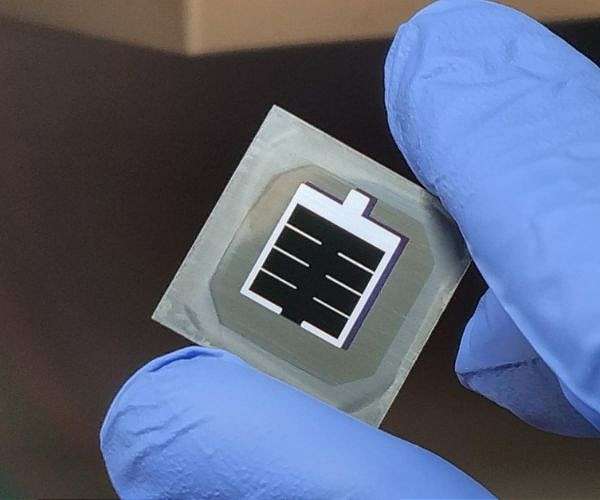
Researchers in Munich and international partners have increased the efficiency of perovskite-silicon tandem solar cells to 31.4 percent by adjusting the molecular contacts at the interface between the absorber and charge collection layers. The team reports the result in the journal Joule, noting that the tandem cell was manufactured entirely in the Munich region on crystalline silicon bottom cells representative of industrial devices. The work involved scientists from the Ludwig-Maximilians-Universitat Munich (LMU), the Southern University of Science and Technology (SUSTech) in Shenzhen, the City University of Hong Kong and the King Abdullah University of Science and Technology (KAUST) in Saudi Arabia.
Perovskite-silicon tandem cells divide the solar spectrum between two absorbers, with the perovskite top cell capturing high-energy blue light, while the silicon cell below converts the red portion. By using two materials with different band gaps, these tandem structures can convert a larger fraction of incoming sunlight into electricity than single-junction silicon cells. The overall performance is highly dependent on the interfaces, where photogenerated charges must be efficiently extracted with minimal recombination losses.
A central component in this architecture is the self-assembling monolayer, or SAM, which forms an ultra-thin molecular contact just a few nanometers thick. This SAM is designed to facilitate charge transport from the perovskite to the underlying charge collection layers. However, on pyramidally structured silicon surfaces, standard SAM molecules with simple alkyl chains can arrange unevenly, leaving gaps and inhomogeneous coverage that reduce device efficiency.
To overcome this limitation, the researchers synthesized a molecule designed for structured, rough surfaces, allowing for more uniform coverage and stable electronic contact. This tailored molecular structure improves charge transport across the interface and provides a more robust connection between the perovskite and silicon subcells. During a detailed analysis of the interfacial chemistry, the team noticed that a commercially available SAM precursor contained trace amounts of brominated impurities.
These brominated species were found to be beneficial because they passivated interfacial defects and increased the efficiency of the tandem cells. ‘That such a small chemical change can have such a big effect even surprised us,’ explains project leader Aydin. “This discovery shows how decisive the precise interplay of materials at the molecular level is for the energy yield of emerging solar cells.” Building on this finding, the researchers deliberately combined brominated and non-brominated molecules to exploit the defect-passivation effect without sacrificing overall chemical stability.
The resulting SAM design enables denser packing of molecules on the structured surface and better passivation of electronic defects at the perovskite-silicon interface. This denser layer improves charge extraction, increases device stability and supports higher operating efficiency. By refining the molecular composition of the contact, the group created conditions in which photogenerated carriers enter the electrical circuit more effectively rather than recombining at the interface.
Using this optimized SAM, the tandem devices achieved a certified efficiency of 31.4 percent, helping the LMU-led collaboration between the laboratories boost the performance of perovskite-silicon tandems. The fact that the result was achieved on industrially relevant crystalline silicon bottom cells underlines the potential to transfer the approach to commercial production. The new SAM also improves long-term stability because the tightly packed molecules protect the sensitive interfacial region from chemical and structural damage over time.
The team now plans to subject the tandem cells to accelerated aging protocols to investigate their behavior under conditions that simulate long-term exposure to outdoor air. “As a next step, we want to show that our tandem cells can prove their value not only in the laboratory, but also in accelerated aging tests, which provide insight into the behavior of real environmental conditions,” says Aydin. At the same time, the researchers are evaluating how the technology could be adapted for use in space, with a focus on satellites in low Earth orbit, where low mass, radiation tolerance and high power are essential.
Research report:Enhanced charge extraction in textured perovskite-silicon tandem solar cells via molecular contact functionalization
