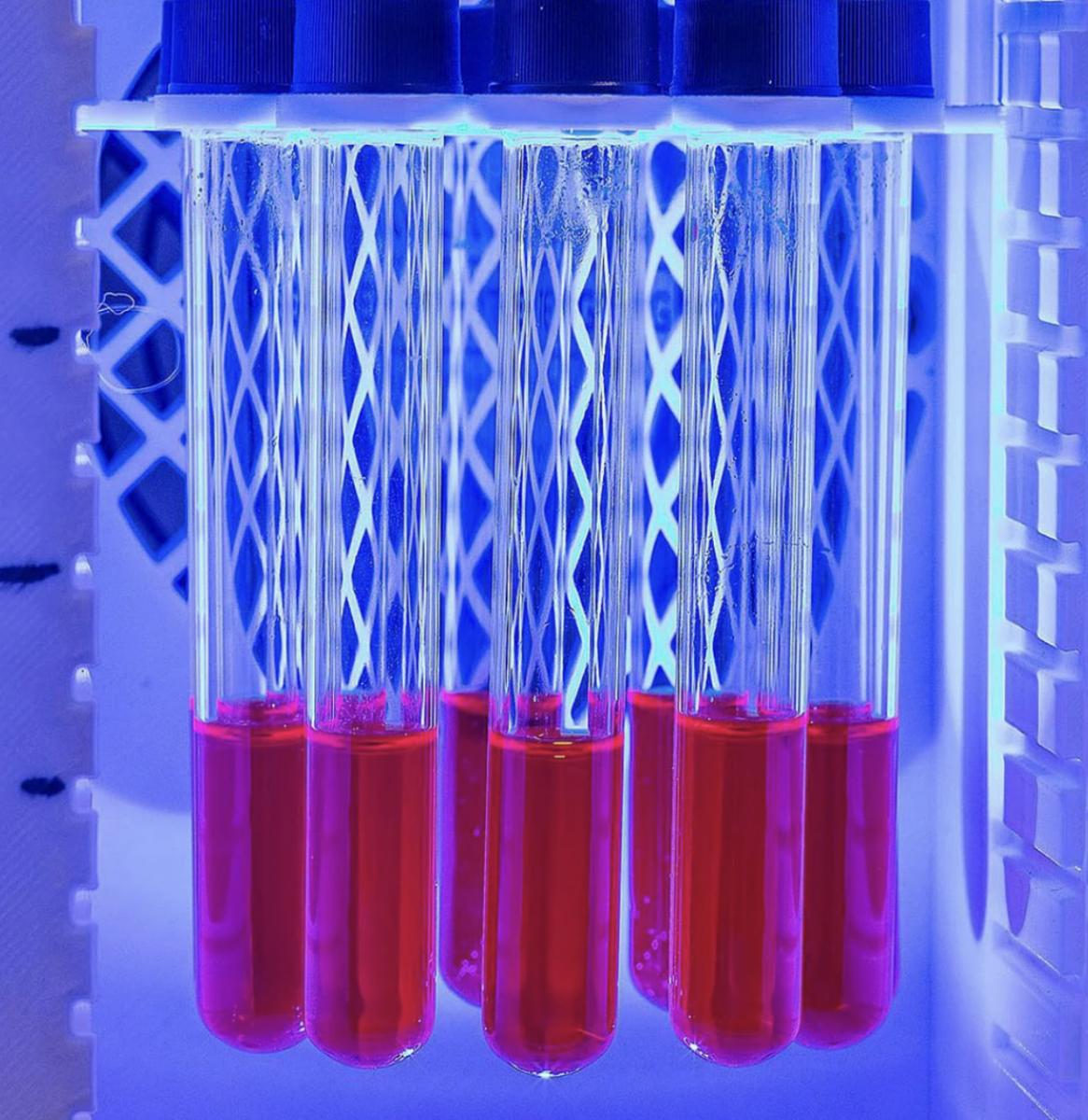
Image: Elvira Eberhardt, University of Ulm
A research team from the University of Ulm and the Friedrich Schiller University Jena has developed a molecular solar battery that stores photovoltaic energy and releases it on demand as hydrogen – even in the dark, without any solar energy input. The results have been published in Nature Communications.
At the heart of the system is a water-soluble copolymer with high redox activity, designed to act simultaneously as an electron storage medium and a photocatalytic platform. The material captures electrons generated by solar radiation and holds them stably for several days at a charging efficiency of more than 80%.
The approach decouples solar energy generation from hydrogen production – a departure from conventional systems that require electrolysis and renewable generation to operate simultaneously. Once energy is stored in the copolymer, adding an acid and a hydrogen evolution catalyst combines the stored electrons with protons, generating hydrogen with a conversion efficiency of 72%. The process works in the dark, giving operators flexibility over when and how hydrogen is produced.
The system is also chemically reversible. Multiple charge, store and discharge cycles are possible without isolating the active material. Regeneration only requires a pH adjustment – neutralization – which reactivates the photocatalytic process under irradiation. The researchers say its cyclic behavior, based on reversible copolymer redox reactions, positions the material as a candidate for chemical energy storage applications.
The work brings together macromolecular chemistry and photocatalysis – two fields with limited prior overlap – into a single molecular architecture that handles capture, storage and conversion. The researchers said the approach could support low-cost, scalable hydrogen storage, with potential applications in energy-intensive industrial processes such as steelmaking and synthetic fuel production, where on-demand hydrogen generation could facilitate the integration of variable renewable energy sources.
The research is part of the CataLight consortium, which focuses on converting solar energy into chemical energy using molecular catalysts.
This content is copyrighted and may not be reused. If you would like to collaborate with us and reuse some of our content, please contact: editors@pv-magazine.com.
Popular content