

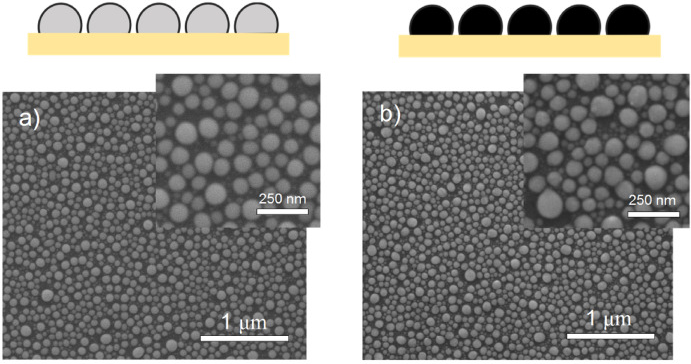
A Spanish research team demonstrated a broadband anti-reflective coating for gallium arsenide solar cells. Based on thermally oxidized gallium nanoparticles, the nanostructured coating reduced reflectance by 30% across the solar spectrum and increased solar cell performance by 10%.
Researchers led by a team from Spain’s Technical University of Madrid (ISOM-UPM) have demonstrated a broadband anti-reflective coating (ARC) for gallium arsenide-based solar cells. The nanostructured coating was based on thermally oxidized gallium nanoparticles.
“Unlike conventional plasmonic metallic nanoparticles that can cause parasitic absorption, the fully oxidized gallium oxide nanoparticles (GaxOy-NPs) preserve the nanoparticle morphology and act as non-resonant, all-dielectric ARCs,” shared Sergio Catalán Gómez, corresponding author. pv magazine.
“These GaxOy NPs reduce reflection by approximately 30% across the entire solar spectrum and improve solar cell external quantum efficiency and short-circuit current density by approximately 10%,” he stated.
The study, which is detailed in “Thermally oxidized gallium nanoparticles as broadband anti-reflective coatings for GaAs solar cells”, published in Optical materialsbuilds on previous work with Ga-NPs, but with a focus on oxidation and dielectric nanoparticle layer technology for anti-reflective functionality. It provides “new insights into “scalable oxide nanostructured coatings for solar photovoltaics,” said Catalán Gómez.
“Although plasmonic Ga NPs have attractive light-scattering properties, their practical use in GaAs solar cells is limited because plasmonic resonances can overlap with the cell absorption spectrum, causing losses,” explains Catalán Gómez.
The search for an alternative with the “morphological advantages of these NPs but without plasmonic losses” resulted in the choice of gallium oxide. Gallium oxide emerged as an “excellent” candidate due to its refractive index and large band gap.
The group fabricated the GaAs solar cells in-house using standard photolithography and metallization procedures to ensure that the study reflected the performance of the devices it monitored during the manufacturing and coating processes.
“We then deposited Ga-NPs directly on the front surface of these custom cells and performed the oxidation treatment to form the GaxOy-NPs,” says Catalán Gómez. The process allowed precise tuning of the optical properties of both size and surface coverage.
The results indicated that when the “initial NP radius remains below ~30 nm,” complete oxidation occurred without compromising structural integrity. It was confirmed by microscopic examination.
Simulations based on atomic force microscopy (AFM) measurements accurately reproduced the experimental spectra, validating the optical model. “The resulting GaxOᵧ NPs exhibit a uniform, smooth morphology that is essential for predictable optical behavior and robust anti-reflection performance,” the researchers said.
“When implemented on GaAs solar cells, these coatings deliver reproducible improvements in external quantum efficiency and short-circuit current density, with average improvements of approximately 10%,” they noted, adding that control experiments confirmed that the gain is “due solely to the presence of these oxidized NPs.”
Discussing the results further, the group highlighted how the plasmon-free technology is compatible with standard device processing and that the graded index optical coating shows “great promise” for III-V photovoltaic applications.
Researchers from the Universidad de Cádiz participated in the study.
Of interest for future research is optimizing anti-reflection performance and creating larger stable GaxOy-NPs. Furthermore, the integration of these coatings into other III-V multijunction solar cells and long-term stability studies under operational conditions are priorities for future work, Catalán Gómez said.
This content is copyrighted and may not be reused. If you would like to collaborate with us and reuse some of our content, please contact: editors@pv-magazine.com.
