

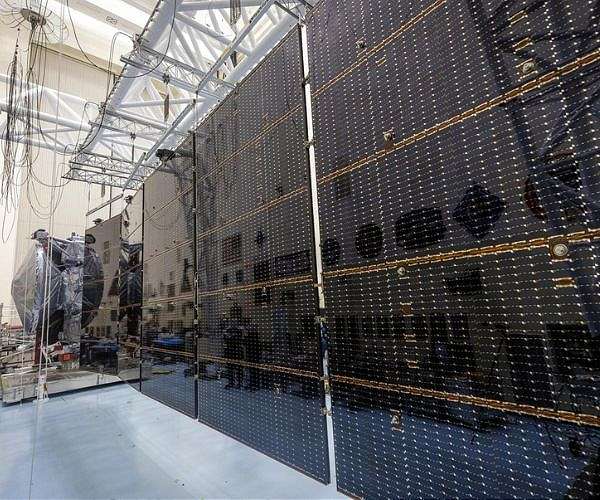
NASA’s Europa Clipper equipped with huge solar panels for the Jupiter mission
NASA’s Europa Clipper spacecraft, the largest ever built for planetary exploration, is equipped with an array of giant solar panels at the Kennedy Space Center in Florida. These arrays, each measuring approximately 14.2 meters in length and 4.1 meters in height, are the largest NASA has ever developed for a planetary mission. Their size is crucial to harness the maximum amount of sunlight as the spacecraft explores Jupiter’s icy moon Europa, which is five times further from the sun than Earth.
Folded and secured for launch, when deployed into space, the arrays will expand the Europa Clipper to a diameter of more than 30.5 meters – wider than a professional basketball court. Due to their enormous size, the arrays were opened one by one in the cleanroom of Kennedy’s Payload Hazardous Servicing Facility, where the spacecraft is being prepared for launch, which will begin on October 10.
Navigating deep space
As the spacecraft undergoes final preparations, engineers are also evaluating the radiation resistance of the transistors. The spacecraft’s journey to the Jupiter system will take more than five years, with an expected arrival in 2030. Once there, Europa Clipper will fly past Europa several times, using its scientific instruments to determine whether the ocean beneath the ice sheet the moon could support life.
The spacecraft is designed to operate in an area of the solar system that receives only 3% to 4% of the sunlight that Earth receives. Each solar panel, consisting of five panels, was developed by the Johns Hopkins Applied Physics Laboratory (APL) in Maryland and Airbus in the Netherlands. These panels are more sensitive than typical residential solar panels and will efficiently convert limited sunlight into power.
At Jupiter, the arrays will collectively generate about 700 watts of electricity, enough to power a small microwave or coffee maker. This energy will be stored in the spacecraft’s batteries to run the electronics, scientific instruments, communications equipment, computer systems and the propulsion system, which includes 24 engines.
The arrays must operate in extremely cold conditions, with temperatures dropping to minus 400 degrees Fahrenheit (minus 240 degrees Celsius) in Jupiter’s shadow. To ensure they can withstand these extremes, the panels have been tested in a cryogenic chamber at the Liege Space Center in Belgium.
“The spacecraft is cozy. It has heating elements and an active thermal loop, which keeps it in a much more normal temperature range,” explains Taejoo Lee, the product delivery manager for solar panels at APL. “But the solar panels are exposed to the vacuum of space without heating. They are completely passive, so whatever the environment, those are the temperatures they get.”
Approximately 90 minutes after launch, the arrays unfold from their compact position for a period of approximately 40 minutes. Two weeks later, six antennas attached to the arrays will also be deployed. These antennas, which are part of the radar instrument, will extend up to 17.6 meters (57.7 feet) and will be used to search for water in and beneath Europa’s thick ice cover.
“At the beginning of the project, we really thought it would be virtually impossible to develop a solar panel strong enough to hold these gigantic antennas,” Lee said. “It was tough, but the team brought a lot of creativity to the challenge and we got through it.”
