

An international research team has proposed a series of optimization techniques for antimony trisulfide (Sb2S3) solar cells that could reportedly increase the efficiency of these PV devices to more than 11%. The resulting new cell design is said to significantly improve band alignment control and parameter optimization.
An international research team has outlined a new design for solar cells based on antimony trisulfide (Sb2S3) that can reportedly result in 30% higher efficiency compared to existing Sb2S3 concepts for solar cells.
This kind of cell typology is far from reaching commercial production so far, due to the low crystallinity and high resistance of the Sb2S3 film, which affects the performance of the device in terms of efficiency. Zb2S3However, it has a good band gap, ranging from 1.70 to 1.90 eV, and a remarkable light absorption coefficient.
In the study “Investigation of transport phenomena and recombination mechanisms in thin film Sb2S3 solar panels,” published in scientific reportsthe scientists explained that Sb2S3 devices can achieve an efficiency of up to 26% below the radiation limit, but defects in the absorber material usually reduce this to about 8%.
“The novelty of this work lies in the detailed theoretical research of Sb2S3 solar cells, specifically aimed at the complex interplay of different transport mechanisms such as tunneling-enhanced recombination, Sb2S3/CdS interface recombination and non-radiative recombination,” she added.
Their analysis revealed that two of the most important factors affecting Sb2S3 The performance of the cells is the doping and the thickness of the cadmium sulfide (CdS) layer, which affects the open-circuit voltage and short-circuit current of the device. Moreover, they found that band gap and electron affinity influence light absorption and charge transfer, respectively.
They also explained that refining the CdS layer with a high band gap allows a greater number of photons to effectively enter the absorber. “At the same time, lower electron affinity plays a crucial role in improving key parameters such as short-circuit current and open-circuit voltage, ultimately increasing the overall conversion efficiency of the solar cell,” they pointed out. “This improvement comes from establishing optimal band alignment on the CdS/Sb2S3 interface, reducing the barrier height and facilitating the smooth passage of electrons from the absorber layer to the CdS.”
The group also analyzed the effect of bulk traps at the interface between CdS and Sb2S3 and found that the influence of these interfacial defects can impact the minority lifetime, diffusion length, and surface recombination rate of carriers. “Scientists can develop strategies to mitigate its adverse effects,” the academics said. “This includes engineering interface structures, optimizing material properties and improving passivation techniques to minimize recombination and improve CdS/Sb reliability.2S3 interface, ultimately leading to more efficient and robust solar cell designs.”
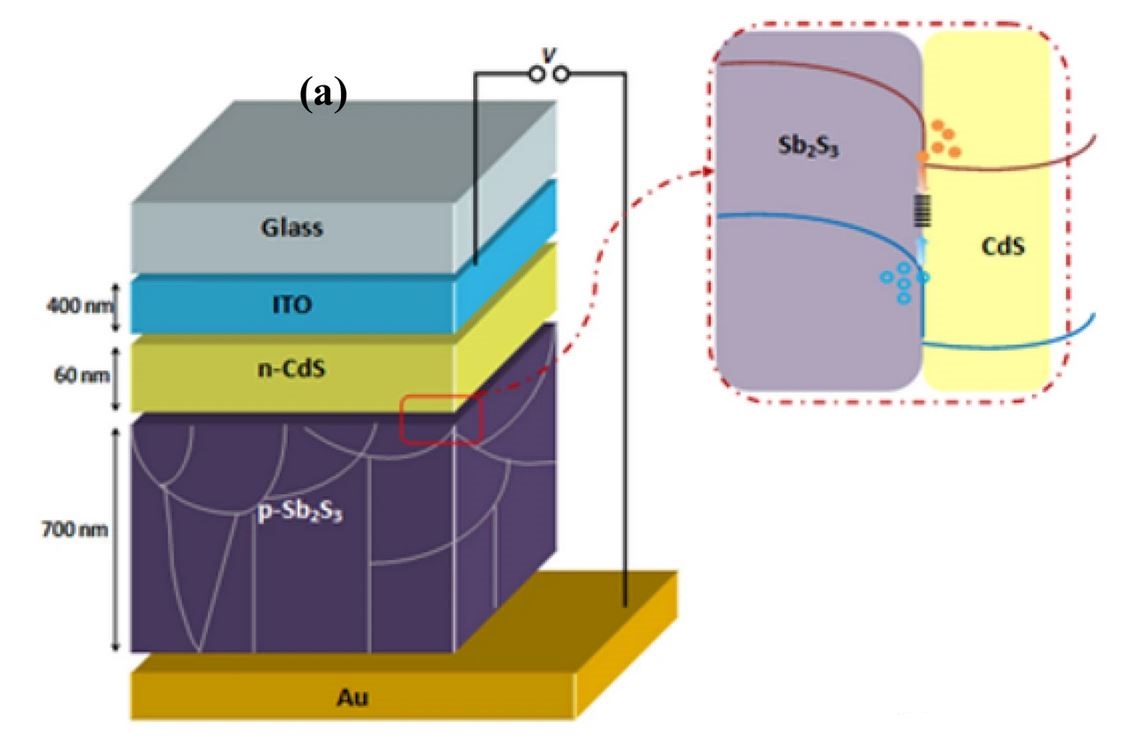
The team outlined a simple solar cell architecture with the proposed optimized parameters. The device was based on a glass and indium tin oxide (ITO) substrate, a CdS layer, an Sb2S3 absorber and a gold (Au) metal contact.
Simulated and tested under standard lighting conditions, the device exhibited a power conversion efficiency of 11.68%, an open-circuit voltage of 1.16 V, and a short-circuit current density of 9.5 mA cm.−2and a fill factor of 54.7%. “Particularly the optimized Sb2S3 solar cell not only exhibits superior performance but also demonstrates improved reliability in reducing interfacial traps at the CdS/Sb2S3 interface, thanks to improved band alignment control and parameter optimization,” the scientists said.
The research group included scientists from the Algerian Research Institute Laboratory HNS-RE2SD, the Bangladesh Atomic Energy Commission, Mexico’s Universidad Autónoma de Querétaro, India’s Saveetha Institute of Medical and Engineering Sciences and the Kalasalingam Academy of Research and Education, as well as King Saud University . in Saudi Arabia and Yeungnam University in South Korea.
This content is copyrighted and may not be reused. If you would like to collaborate with us and reuse some of our content, please contact: editors@pv-magazine.com.
