
Close Menu
  • News
  • Industry
  • Solar Panels
  • Commercial
  • Residential
  • Finance
  • Technology
  • Carbon Credit
  • More
    • Policy
    • Energy Storage
    • Utility
    • Cummunity
What's Hot

Dutch solar owners asked to switch off during peak periods to ease the distribution crisis

June 7, 2026

The hydrogen flow: Toyota demonstrates its racing prototype on liquid hydrogen

June 7, 2026

Era of electrification exposing Australia’s weakest link

June 6, 2026
Facebook X (Twitter) Instagram
Solar Energy News
Monday, June 8
  • News
  • Industry
  • Solar Panels
  • Commercial
  • Residential
  • Finance
  • Technology
  • Carbon Credit
  • More
    • Policy
    • Energy Storage
    • Utility
    • Cummunity
Solar Energy News
Home - News - Stacking molecules improves the efficiency of organic solar cells
News

Stacking molecules improves the efficiency of organic solar cells

solarenergyBy solarenergyAugust 10, 2024No Comments2 Mins Read
Facebook Twitter Pinterest LinkedIn Tumblr Email
Share
Facebook Twitter LinkedIn Pinterest Email

Stacking molecules improves the efficiency of organic solar cells


Harnessing solar energy is essential for a sustainable future. Efficient optoelectronic devices such as solar cells are crucial for this. Researchers from Osaka University have discovered a new method to improve the efficiency of these devices by controlling the stacking of light-absorbing molecules.

Organic optoelectronic devices, including solar cells, are gaining popularity due to their flexibility and lightweight nature. Their efficiency depends on how well their light-absorbing organic molecules convert light into ‘free charge carriers’ that generate electric current. The energy required to create these carriers is known as ‘exciton-binding energy’.

Lower exciton binding energy means easier generation of free charge carriers, improving device performance. However, designing molecules with low exciton binding energy in a solid state has been a challenge.

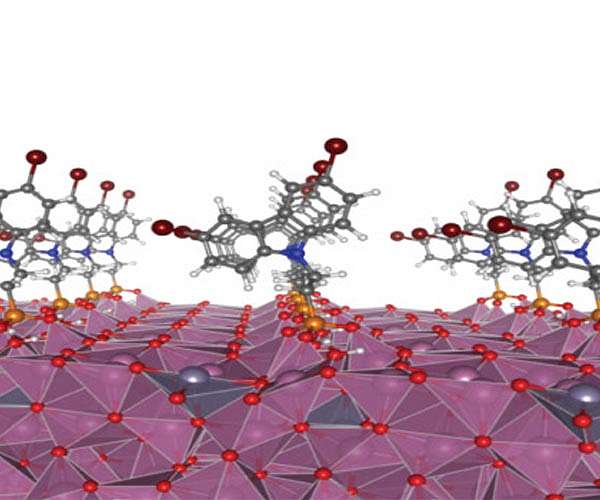
The research team discovered that the exciton binding energy in solid materials is affected by the way molecules stack up, a phenomenon known as aggregation.

“We synthesized two types of similar star-shaped molecules, one with a flexible center and the other with a rigid center,” explains lead author Hiroki Mori. “The individual molecules behaved similarly when dispersed in solution, but very differently when stacked on top of each other in thin, solid films.”

The stiff molecules stack well, like plates, while the flexible molecules do not. Consequently, the rigid solid-state molecules exhibit much lower exciton binding energy than the flexible ones. To confirm this, the team built a single-component organic solar cell and a photocatalyst using each type of molecule. The devices made with the rigid molecules showed superior performance due to their low exciton binding energy, leading to the generation of high free charge carriers.

See also  HKUST researchers reveal hidden structure for improved perovskite solar cells

“Our findings, that making molecules that aggregate well can reduce exciton binding energy, are really exciting,” says senior author Yutaka Ie. “This could give us a new way to design more efficient optoelectronic devices.”

The research underlines the importance of molecular interactions in solids for device performance. It suggests that designing high-performance optoelectronic devices should look beyond individual molecular properties. This approach to reducing exciton binding energy could power the next generation of optoelectronic device architectures.

Research report:A dibenzo[g,p]Chrysene-based organic semiconductor with small exciton binding energy via molecular aggregation


Source link

cells efficiency improves molecules organic solar Stacking
Share. Facebook Twitter Pinterest LinkedIn Tumblr Email
solarenergy
  • Website

Related Posts

Dutch solar owners asked to switch off during peak periods to ease the distribution crisis

June 7, 2026

Letter from China’s PV Industry: Arctech wins 2.1 GW solar deal

June 5, 2026

ComEd starts a new energy pilot with a solar rebate on the roof of a brewery

June 5, 2026
Leave A Reply Cancel Reply

Don't Miss
Finance

British solar capacity is approaching 19 GW Mijlpaal

By solarenergyJune 30, 20250

The UK currently has 18.9 GW operational solar energy. Image: EDF renewable energy sources. The…

Consortium reaches financial closure on 2 GW Saudi Solar Project – PV Magazine International

August 20, 2025

China’s Intelamp sets the world record for LED display on solar energy-PV Magazine International

September 12, 2025

Costs of living, government discounts accelerate the solar and battery trees of Australia – PV Magazine International

June 13, 2025
Stay In Touch
  • Facebook
  • Twitter
  • Pinterest
  • Instagram
  • YouTube
  • Vimeo
Our Picks

Dutch solar owners asked to switch off during peak periods to ease the distribution crisis

June 7, 2026

The hydrogen flow: Toyota demonstrates its racing prototype on liquid hydrogen

June 7, 2026

Era of electrification exposing Australia’s weakest link

June 6, 2026

‘Come out from behind your screen, our industry is ultimately about people’

June 6, 2026
Our Picks

Dutch solar owners asked to switch off during peak periods to ease the distribution crisis

June 7, 2026

The hydrogen flow: Toyota demonstrates its racing prototype on liquid hydrogen

June 7, 2026

Era of electrification exposing Australia’s weakest link

June 6, 2026
About
About

Stay updated with the latest in solar energy. Discover innovations, trends, policies, and market insights driving the future of sustainable power worldwide.

Subscribe to Updates

Get the latest creative news and updates about Solar industry directly in your inbox!

Facebook X (Twitter) Instagram Pinterest
  • Contact
  • Privacy Policy
  • Terms & Conditions
© 2026 Tsolarenergynews.co - All rights reserved.

Type above and press Enter to search. Press Esc to cancel.