
Close Menu
  • News
  • Industry
  • Solar Panels
  • Commercial
  • Residential
  • Finance
  • Technology
  • Carbon Credit
  • More
    • Policy
    • Energy Storage
    • Utility
    • Cummunity
What's Hot

Why the UK solar industry needs to own its safety story

April 23, 2026

Fraunhofer ISE develops colored film technology for patterned solar panels

April 23, 2026

Thermoacoustic heat pumps are on the verge of commercial breakthrough – SPE

April 23, 2026
Facebook X (Twitter) Instagram
Solar Energy News
Thursday, April 23
  • News
  • Industry
  • Solar Panels
  • Commercial
  • Residential
  • Finance
  • Technology
  • Carbon Credit
  • More
    • Policy
    • Energy Storage
    • Utility
    • Cummunity
Solar Energy News
Home - News - New efficiency record set for environmentally friendly nanocrystal solar cells
News

New efficiency record set for environmentally friendly nanocrystal solar cells

solarenergyBy solarenergyOctober 26, 2024No Comments2 Mins Read
Facebook Twitter Pinterest LinkedIn Tumblr Email
Share
Facebook Twitter LinkedIn Pinterest Email

New efficiency record set for environmentally friendly nanocrystal solar cells


As climate change accelerates the shift to renewable energy sources, solar cells are becoming increasingly important. For example, solar energy generation in Spain grew by 28% in 2023 compared to the previous year, contributing to 20.3% of the country’s total energy mix. However, despite their widespread use, solar cells still rely on materials that are not always environmentally sustainable. Expanding solar technology to a wider range of applications, such as powering buildings, infrastructure and vehicles, requires the development of flexible, lightweight and cost-effective solar cells.

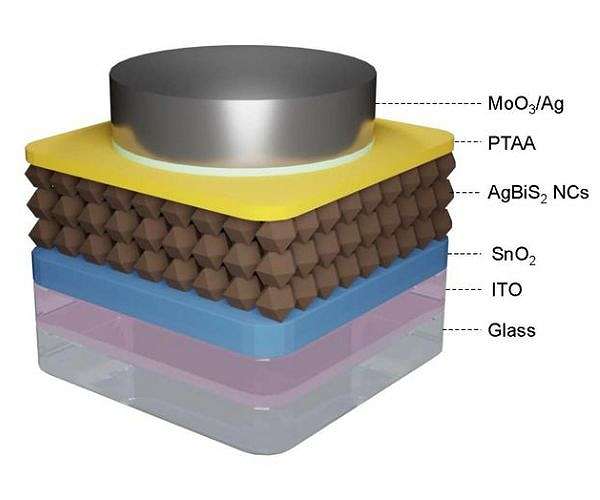
Colloidal silver bismuth sulfide (AgBiS2) nanocrystals have recently emerged as a promising environmentally friendly material for ultrathin solar cells. These nanocrystals have an exceptionally high absorption coefficient, but current production techniques for such solar cells are based on multi-step processes that are expensive and inefficient. A new one-step approach using nanocrystal inks could streamline production, but defects on the nanocrystal surfaces have limited efficiency.

To tackle this problem, researchers from the Institute of Photonic Sciences (ICFO), led by ICREA Prof. Gerasimos Konstantatos, developed an innovative post-deposition in situ passivation (P-DIP) technique. This method improves surface passivation, leading to nanocrystalline ink films with superior optoelectronic properties. Their work, published in “Energy and Environmental Science,” achieved an energy conversion efficiency of approximately 10%, surpassing the performance of previous AgBiS2-based solar cells.

Dr. Jae Taek Oh, the study’s first author, explained the importance of surface passivation: “Imagine a bumpy road that slows down cars. Surface passivation is like re-paving the road, making it smoother so cars can move without getting stuck In our case, removing surface defects is very important to facilitate the transport of charge carriers created by light absorption in nanocrystal films.”

See also  SEIA publishes draft solar supply chain transparency standard

The research team’s P-DIP strategy improved the quality of the nanocrystal films by addressing surface defects, leading to a significant increase in efficiency. By using a multifunctional molecular agent containing chlorine, they were able to stabilize the nanocrystals and ensure even dispersion in the solution, resulting in smooth film coatings and improved carrier transport.

This combination of techniques has set a new performance record for sustainable, environmentally friendly solar cells.

Research report:Post-deposition in situ passivation of AgBiS2 nanocrystal inks for high-efficiency ultra-thin solar cells


Source link

cells efficiency Environmentally friendly nanocrystal record Set solar
Share. Facebook Twitter Pinterest LinkedIn Tumblr Email
solarenergy
  • Website

Related Posts

Why the UK solar industry needs to own its safety story

April 23, 2026

Fraunhofer ISE develops colored film technology for patterned solar panels

April 23, 2026

The federal court has halted Trump administration orders that hinder solar and wind energy development

April 23, 2026
Leave A Reply Cancel Reply

Don't Miss
Solar Industry

US is launching the National Security Condition in the import of Polysilicon

By solarenergyJuly 15, 20250

The US Department of Commerce (DOC) says that it will investigate the potential for export…

EU updates Photovoltaic geographical information system – PV Magazine International

May 28, 2025

TMEIC will open a 9 GW solar inverter factory in Texas

August 27, 2024

Chinese EV -Battery giant Catl wants to pick up $ 4 billion in Hong Kong IPO

May 12, 2025
Stay In Touch
  • Facebook
  • Twitter
  • Pinterest
  • Instagram
  • YouTube
  • Vimeo
Our Picks

Why the UK solar industry needs to own its safety story

April 23, 2026

Fraunhofer ISE develops colored film technology for patterned solar panels

April 23, 2026

Thermoacoustic heat pumps are on the verge of commercial breakthrough – SPE

April 23, 2026

The federal court has halted Trump administration orders that hinder solar and wind energy development

April 23, 2026
Our Picks

Why the UK solar industry needs to own its safety story

April 23, 2026

Fraunhofer ISE develops colored film technology for patterned solar panels

April 23, 2026

Thermoacoustic heat pumps are on the verge of commercial breakthrough – SPE

April 23, 2026
About
About

Stay updated with the latest in solar energy. Discover innovations, trends, policies, and market insights driving the future of sustainable power worldwide.

Subscribe to Updates

Get the latest creative news and updates about Solar industry directly in your inbox!

Facebook X (Twitter) Instagram Pinterest
  • Contact
  • Privacy Policy
  • Terms & Conditions
© 2026 Tsolarenergynews.co - All rights reserved.

Type above and press Enter to search. Press Esc to cancel.