Researchers in India have developed an algorithm for swapping quadrants in PV arrays, allowing new quadrants to be created with both shaded and unshaded modules. The method was tested in ten shading scenarios with different irradiance levels and showed ‘superior’ performance compared to conventional approaches.
Researchers from India’s M. Kumarasamy College of Engineering have developed a new reconfiguration technique to improve the performance of partially shaded solar photovoltaic systems. The approach, known as the quadrant swap reconfiguration algorithm, creates new quadrants composed of shaded or unshaded modules to optimize power generation.
“The output power of the array is maximized in the proposed reconfiguration technique using series-parallel connections for a 4×4 matrix PV array,” the researchers explain. “PV modules are connected in series to form strings, which are then linked in parallel. The proposed quadrant switching method increases the fill factor under shading conditions, while significantly reducing the mismatch loss (ML) and power loss (PL).”
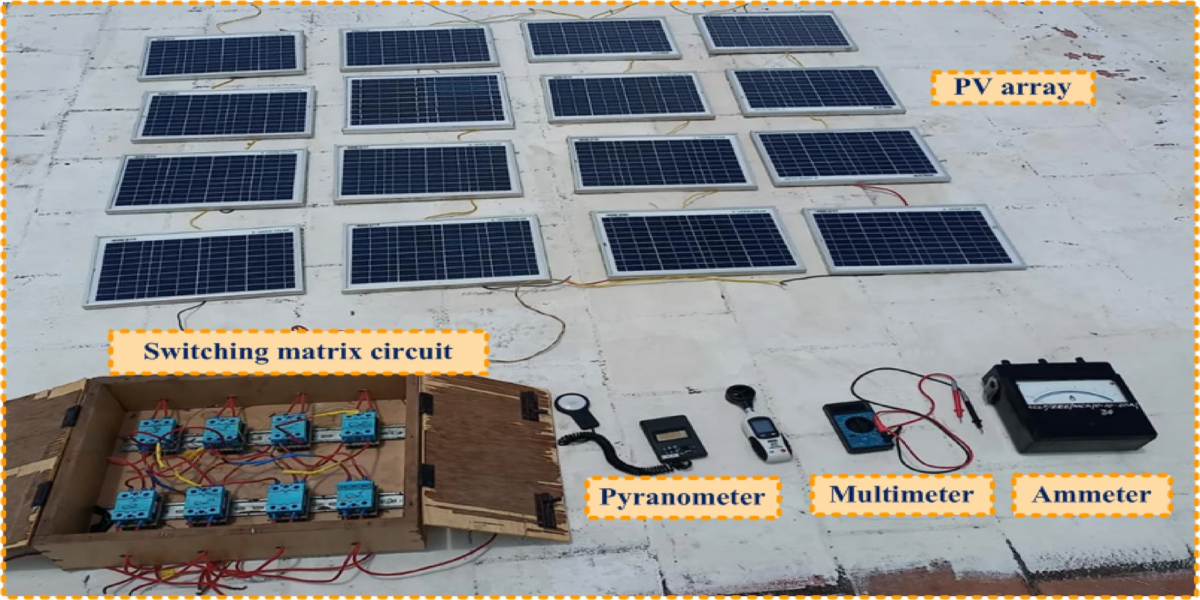
In the 4×4 arrangement, each corner of the matrix represents a four-panel quadrant. Eight switches are included in the circuit to control and regulate the current between quadrants. When shading occurs, the current is adjusted accordingly. However, the team did not specify whether the switch was automated or manual for each shadow scenario.
Each of the 16 panels had a maximum output power of 10 W, for a total of 160 W across the entire array.
The researchers tested the technique under ten different shade conditions, with solar radiation levels ranging from 100 W/m² to 1,000 W/m². The new method was compared to four reference configurations – series-parallel (SP), total-cross-tie (TCT), SP-TCT and honeycomb (HC)-TCT – and showed “improved” performance in all cases.
Image: M. Kumarasamy College of Engineering, Scientific Reports, CC BY 4.0
“Through experimental validation under ten different shading conditions, the proposed approach consistently outperformed conventional configurations such as SP, TCT, SP-TCT and HC-TCT,” the researchers reported. “Total power and fill factor (FF) were both effectively improved by the quadrant switching technique.”
Of the cases tested, what the scientists described as scenario (f) produced the best results. In this setup, four modules were exposed to irradiation of 900 W/m², six to 700 W/m² and six to 1,000 W/m². The configuration achieved the highest output power of 136 W, a fill factor of 0.57, a mismatch loss (ML) of 2 W and a power loss (PL) of 1.4%.
At the other end of the spectrum, another set, called scenario (i), had the lowest performance, producing 80 W output power with a fill factor of 0.34, a mismatch loss of 5 W, and a power loss of 5.88%. In this case, three modules received 300 W/m² of irradiation, nine modules received 400 W/m² and the remaining four modules received 1,000 W/m².
The team also conducted a techno-economic analysis, finding that the proposed system has an expected lifespan of six years – approximately 13.3% longer than that of a traditional SP configuration in scenario (a). “These findings demonstrate that, compared to other configurations, the proposed quadrant swapping reconfiguration technique has superior performance and is technically and economically feasible,” the researchers concluded.
Their findings were presented in “Quadrant alternating technique for partially shaded photovoltaic solar energy systems”, published in Scientific reports. Researchers from India’s M. Kumarasamy College of Engineering, SRM Institute of Science and Technology, Sri Ramakrishna Engineering College, Kamaraj College of Engineering and Technology and Norway’s University of Southeast Norway participated in the study.
This content is copyrighted and may not be reused. If you would like to collaborate with us and reuse some of our content, please contact: editors@pv-magazine.com.
Popular content