

Spanish researchers found that combining agrivoltaic energy with regulated deficit irrigation (RDI) can reduce tomato irrigation water use by about 50%, while improving land use efficiency through simultaneous crop and solar energy production.
A research group from Spain has used regulated deficit irrigation (RDI) under agrivoltaic systems to grow tomatoes in both Madrid and Seville.
RDI is a technique used to reduce irrigation water use by deliberately watering plants during less sensitive growth stages, while monitoring leaf water potential to prevent excessive stress and maintain yields.
“This innovative combination aims to reduce the evaporation needs of the plants through the shading of photovoltaic panels, allowing more efficient use of land and water,” the academics said in a statement. “Our results indicate that although the shading of the panels reduces available radiation, the design of the system allows adequate plant development to be maintained at most stages of the crop cycle.”
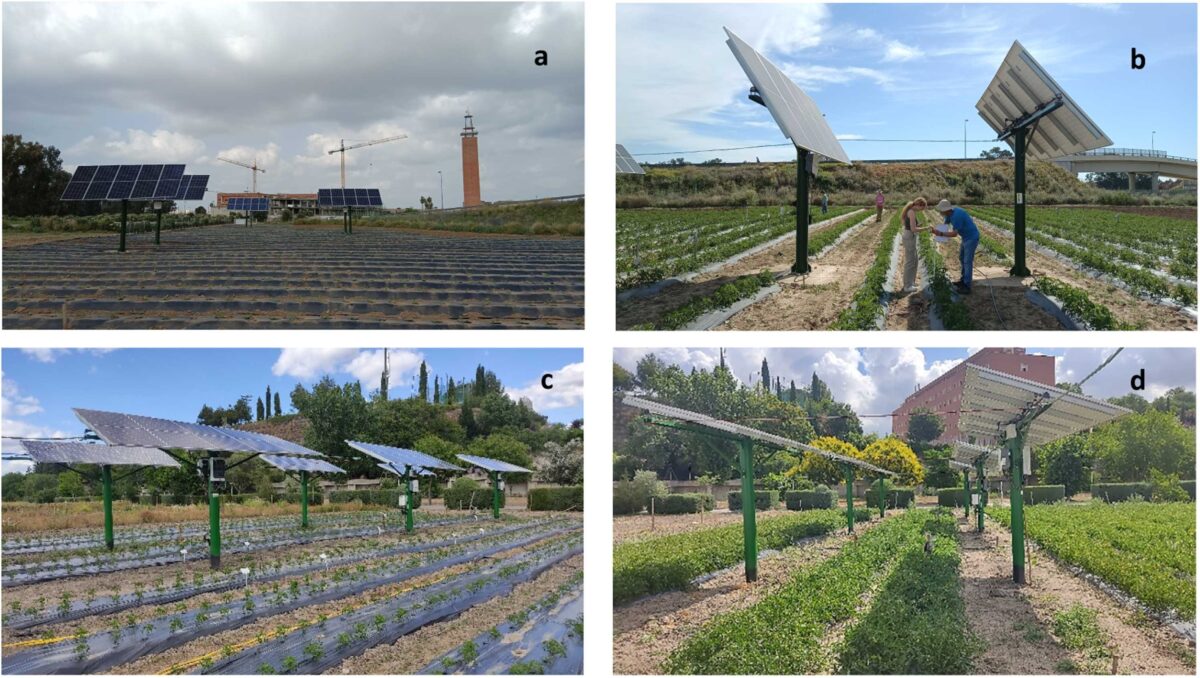
In both Madrid and Seville, the experiments took place during the spring growing season of 2024. Maximum temperatures were often higher in Seville than in Madrid during most of the season, and the specific tomato seed varieties were selected based on climatic conditions. The agrivoltaic systems at the two sites consisted of a two-monopole structure per plot, supporting five monocrystalline silicon modules with a power of 450 W each.
The structures were 2.5 m high in Madrid and 3 m high in Seville, with a mutual distance of 5 m and 4.5 m, respectively. The tilt angle was 17° in Madrid and 20° in Seville, while the orientation was 25° and 15° from the north-south axis, respectively. In addition, both sites had a plot using only RDI without an agrivoltaic system, as well as a control plot receiving full irrigation to meet crop water needs and prevent water stress.
The researchers evaluated three irrigation treatments with three repetitions under different shade and water management conditions. Control plots received full irrigation based on crop evapotranspiration (ETc) to avoid water stress, while the RDI applied controlled water stress based on plant growth stages and potential leaf water thresholds in the afternoon. Irrigation levels in the RDI varied dynamically between 25% and 125% of ETc depending on plant stress measurements. The agrivoltaic plot combined the same irrigation strategy as RDI with the cultivation of crops under photovoltaic structures. Measurements were only taken at centrally located plants within each plot to minimize boundary effects.
The analysis showed that agrivoltaic design and latitude had a strong influence on the radiation distribution and microclimate of crops in Madrid and Seville. At both sites, the agrivoltaic plots received radiation levels similar to those of the control plots, while the shaded agrivoltaic plots showed large reductions in photoradiation.Osynthetically active radiation (PAR), especially around noon. In Madrid, shadow effects persisted throughout the season, with an afternoon PAR reduction of around 90% and daily light integral (DLI) values remaining around 70% of open field conditions. In Seville, shading effects were mainly limited to early growth stages, and DLI differences virtually disappeared later in the season.
Furthermore, the scientists found that air temperatures gradually increased during the experiments, with maximum temperatures approaching 40 C at both sites, with agrivoltaic plots showing slightly higher average temperatures than control plots, especially during warm days and night-time conditions. During the day, however, agrivoltaic shading resulted in a lower temperature in Madrid, but not in Seville, where the agrivoltaic plots were often slightly warmer.
Soil temperature responses also differed by site: agrivoltaic shade reduced soil temperature in Madrid early in the season, while RDI increased soil temperature later due to reduced irrigation and canopy cover. In Seville, the control plots remained the coolest due to higher irrigation, while the agrivoltaic plots became the warmest due to the limited shade and heat released by photovoltaic panels.
“One of the most striking findings is that the deficit irrigation strategy reduced water use by approximately 50% compared to traditional irrigation,” the scientists said. “However, this drastic water reduction led to a yield decrease of approximately 20% in the RDI treatment, mainly attributed to severe water stress during the ripening phase. Despite this decrease in total tomato production, irrigation water productivity increased significantly in the Seville treatments, demonstrating that more fruit can be obtained for every drop of water invested.”
Furthermore, the overall performance of the agrovoltaic system was validated by the land equivalent ratio (LER), which combines agricultural and electricity production efficiency. In Madrid, the LER value obtained was 1.54, while in Seville it was 1.67, confirming that combined production is more efficient than growing tomatoes and generating energy on separate plots. “This implies that although tomato yields under the panels decrease, the profitability and sustainability of the system increase due to the generation of clean energy in the same space,” the researchers said.
Their findings were presented in “Regulated deficit irrigation based on plant water status and agricultural voltaic systems as possible improvements in water management in tomatoes”, published in Agricultural water management. Scientists from the Spanish Research Center for the Management of Agricultural and Environmental Risks (CEIGRAM), the Technical University of Madrid, the University of Seville, the Spanish National Research Council and the University of Castilla-La Mancha took part in the study.
This content is copyrighted and may not be reused. If you would like to collaborate with us and reuse some of our content, please contact: editors@pv-magazine.com.
