
Close Menu
  • News
  • Industry
  • Solar Panels
  • Commercial
  • Residential
  • Finance
  • Technology
  • Carbon Credit
  • More
    • Policy
    • Energy Storage
    • Utility
    • Cummunity
What's Hot

Why the UK solar industry needs to own its safety story

April 23, 2026

Fraunhofer ISE develops colored film technology for patterned solar panels

April 23, 2026

Thermoacoustic heat pumps are on the verge of commercial breakthrough – SPE

April 23, 2026
Facebook X (Twitter) Instagram
Solar Energy News
Thursday, April 23
  • News
  • Industry
  • Solar Panels
  • Commercial
  • Residential
  • Finance
  • Technology
  • Carbon Credit
  • More
    • Policy
    • Energy Storage
    • Utility
    • Cummunity
Solar Energy News
Home - News - New layered perovskite structure explored for improved optical properties
News

New layered perovskite structure explored for improved optical properties

solarenergyBy solarenergyApril 29, 2024No Comments2 Mins Read
Facebook Twitter Pinterest LinkedIn Tumblr Email
Share
Facebook Twitter LinkedIn Pinterest Email

New layered perovskite structure explored for improved optical properties


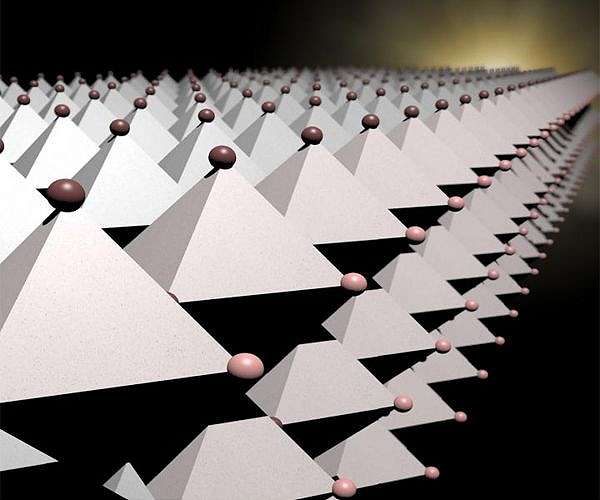
Perovskites are of critical importance in the field of materials science due to their different and varied properties arising from their unique crystal structure. These properties have potentially revolutionary applications in advanced technology areas. One method to exploit these properties involves precise manipulation of defects within the perovskite structure, such as missing atoms or replacing one type of atom with another.

In the field of oxide chemistry, it is well known that such defects in oxides can self-organize within the crystal structure when they reach a certain threshold, leading to improved material properties. Although this defect ordering phenomenon is well documented in perovskite oxides, it is not as common in hybrid halide perovskites, which consist of an organic component, a metal, and a halogen.

A recent study highlighted in ACS Materials Letters reveals findings from Associate Professor Takafumi Yamamoto and his team at the Tokyo Institute of Technology, who discovered a new defect-ordered layered halide perovskite. The research builds on previous work where the introduction of thiocyanate ions (SCN-) into the FAPbI3 lattice led to structured defect formations. Dr. Yamamoto suggests, “Increasing the SCN concentration could enhance the formation of these defect structures, similar to those observed in vacancy-ordered oxide perovskites.”

The research involved the synthesis of FAPbI3 in powder and crystal forms, using specific ratios of SCN-. When a sufficiently high SCN ratio was used, the resulting perovskite was FA4Pb2I7.5(SCN)0.5. This compound showed organized defects in all its layers – even more so than its predecessor, FA6Pb4I13.5(SCN)0.5, where fewer defects were organized.

See also  Optical progress offers a boost for designing the next generation of solar module

The study identifies this material as part of a ‘homologous series’ – a series in which systematic changes in the chemical formula yield predictable changes in properties, here observed as variations in the optical band gap correlated with defect concentration.

“This marks the first instance of a homologous series based on the order of defects in hybrid organic-inorganic perovskites,” notes Dr. Yamamoto op. “Our findings provide a fundamental strategy for manipulating defect structures to tailor the optical properties of perovskites, offering a promising avenue for innovation in materials science.”

The implications of this research are significant and could potentially pave the way for new perovskite materials with tailored properties for future technological applications.

Research report:FA4Pb2I7.5(SCN)0.5: n = 3 Member of Perovskite Homolog Series FAn+1Pbn-1I3n-1.5(SCN)0.5 with organized defects


Source link

explored improved layered optical perovskite properties structure
Share. Facebook Twitter Pinterest LinkedIn Tumblr Email
solarenergy
  • Website

Related Posts

Manufacturing perovskite solar cells with robot boxes

April 21, 2026

Tandem PV launches commercial production of perovskite silicon in California – SPE

April 21, 2026

Oxford PV brings perovskite solar expertise to the UK EV R&D project

April 16, 2026
Leave A Reply Cancel Reply

Don't Miss
Technology

Perovskite Tandems’ US Prospects Scaling Perovskite – PV Magazine International

By solarenergySeptember 18, 20250

Three American manufacturers actively work on commercializing their respective Perovskiet-Silicon Tandem technologies argue for dental…

EU approves the subsidy plan of grant from Spain – PV Magazine International

March 20, 2025

Statkraft and Luminous Energy sign ‘first of its kind’ solar PPA

July 3, 2024

Small grooves unlock a new potential in the production of solar cells

March 4, 2025
Stay In Touch
  • Facebook
  • Twitter
  • Pinterest
  • Instagram
  • YouTube
  • Vimeo
Our Picks

Why the UK solar industry needs to own its safety story

April 23, 2026

Fraunhofer ISE develops colored film technology for patterned solar panels

April 23, 2026

Thermoacoustic heat pumps are on the verge of commercial breakthrough – SPE

April 23, 2026

The federal court has halted Trump administration orders that hinder solar and wind energy development

April 23, 2026
Our Picks

Why the UK solar industry needs to own its safety story

April 23, 2026

Fraunhofer ISE develops colored film technology for patterned solar panels

April 23, 2026

Thermoacoustic heat pumps are on the verge of commercial breakthrough – SPE

April 23, 2026
About
About

Stay updated with the latest in solar energy. Discover innovations, trends, policies, and market insights driving the future of sustainable power worldwide.

Subscribe to Updates

Get the latest creative news and updates about Solar industry directly in your inbox!

Facebook X (Twitter) Instagram Pinterest
  • Contact
  • Privacy Policy
  • Terms & Conditions
© 2026 Tsolarenergynews.co - All rights reserved.

Type above and press Enter to search. Press Esc to cancel.