

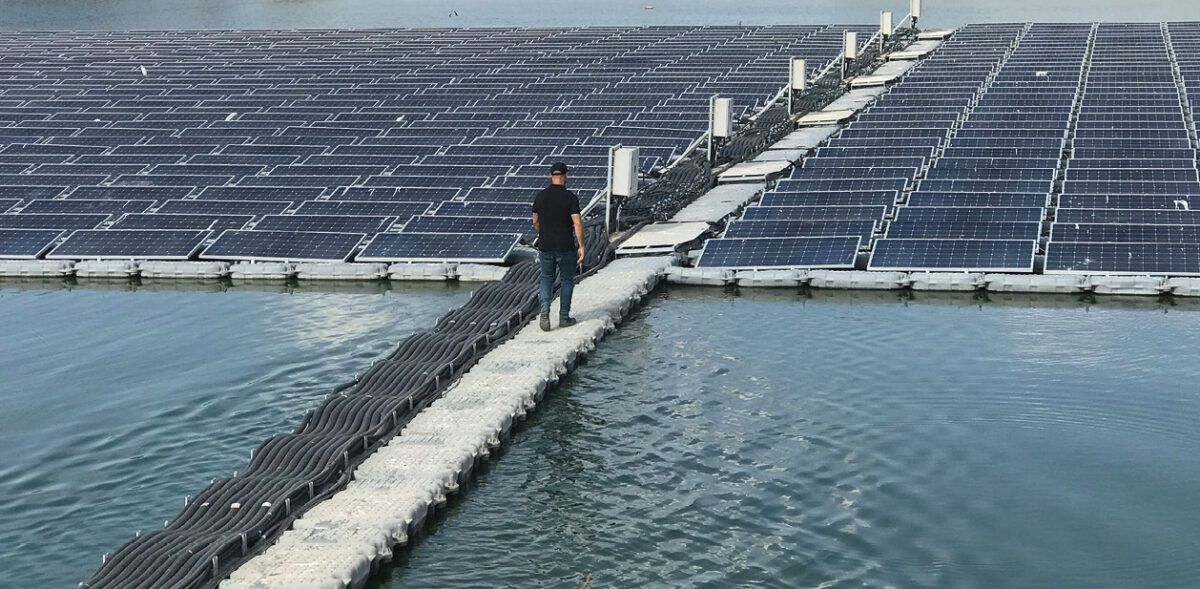
Researchers from TU Delft have modeled a variety of floating PV structures at sea to reveal the design parameters that influence sustainability and yield.
Using a multiphysics framework that integrated mechanical and optoelectric properties of offshore floating PV systems, researchers from TU Delft in the Netherlands investigated structural loads experienced by a variety of floating PV structures and the associated electrical power losses .
“Simulations like the one we ran shed light on which configurations perform best before being implemented in a pilot system,” corresponding author Alba Alcañiz Moya said. pv magazinenoting that the model allows for things like fatigue testing, extreme loading and platform life cycle assessment, “none of which are easily feasible on a physical testing platform.”
“Ultimately, developing such a framework will allow us to develop a digital twin of the platform,” she said.
Various float configurations were investigated, including several large floats and several small floats connected with free hinges. Structural design decisions were entered, as well as wave action and weather conditions such as high winds, irradiation and optoelectronic performance to calculate yield. The optoelectric formulation was numerically implemented in Python using the PVLIB-Python modeling tool produced by Sandia National Laboratory.
The results showed a design trade-off for the number of floats. Fewer floats seemed to cause less PV movement and achieve better yield, while more floats tended to allow less elastic strain to achieve a more durable structure.
“More floats increase the stability of the system because the tension is distributed between them and the hinges allow more freedom of movement. However, this movement flexibility causes the modules to move more, increasing power mismatch losses,” explains Alcañiz Moya. “This trade-off gives us the opportunity to identify the optimal balance for each location. Furthermore, our research provides us with the tools and insights needed to determine this ideal setup.”
The team noted the influence of structural properties on the power mismatch losses in different scenarios. “It is observed that the Young’s modulus of the material only affects longer floats where the elastic response dominates,” the report said. “Conversely, changes in cross-sectional fill ratio affect shorter floats, where the rigid body response predominates. The thickness of the float beam has the greatest impact on different float lengths.”
The results from the 25 and 50 float scenarios showed an elastic dominant response at low float thickness and a rigid body response at high float thickness. “As a result, a thinner float resulted in lower mismatch losses, thanks to the added resilience of the hydroelastic response. A similar trend was observed when varying the fill ratio, with a low fill ratio yielding lower power mismatch losses due to the hydroelastic response. Therefore, a low power mismatch loss scenario can be achieved by a single long float with high bending stiffness or multiple small floats with lower bending stiffness,” the researchers said.
“The most surprising result for me was that the power mismatch losses caused by waves were not as high as I expected,” says Alcañiz Moya. “I imagined the modules of a floating system that continuously moves due to waves, each with a different orientation. That should cause huge power mismatch losses. However, the results showed relatively small power mismatch losses.”
In their closing remarks, the group emphasized a “symbiosis” between offshore solar energy and offshore wind energy. “The choice of a large number of small floats leads to a transition from an elastic to a rigid body response, resulting in minimal elastic stresses. Fortunately, the largest mismatch losses occur on sunny, windy winter days, i.e. during periods of low production. This lower generation can be compensated by wind turbines, promoting the symbiosis between the two offshore renewable energy sources,” the report said.
The details of the study are reported in “Structural analysis and power losses in floating solar platform in offshore environment”, published in Applied energy.
Looking ahead, the researchers say the focus will be on 3D analysis, examining irregularly shaped floating PV platforms and their interaction with mooring lines. “Furthermore, the hydroelastic model will be developed to take into account the non-linearity in the ocean waves and the structural response. Exploring alternative locations and different floating structures, such as membranes, is also worthwhile,” they noted.
This content is copyrighted and may not be reused. If you would like to collaborate with us and reuse some of our content, please contact: editors@pv-magazine.com.
