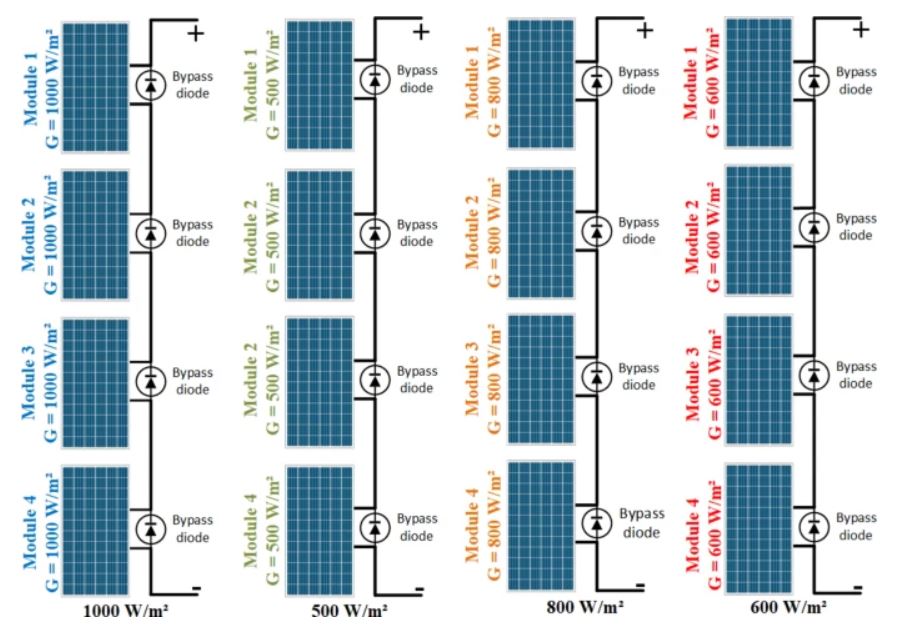
Researchers have proposed using a hybrid version of the so-called Salp Swarm Algorithm (SSA) algorithm for maximum power point tracking in PV systems operating under highly fluctuating environmental conditions. The new method also integrates the hill climbing algorithm, which simulates the process of climbing a mountain and is said to help find the best possible solution to a given problem.
An international research team has developed a hybrid Maximum Power Point Tracking (MPPT) technique for PV systems operating in partial shade or rapidly changing atmospheric parameters.
The proposed hybrid MPPT algorithm combines the advantages of two algorithms: salp swarm algorithm (SSA) and hill climbing (HC).
The SSA (SSA) is a metaheuristic algorithm designed to solve single-objective optimization problems. It was inspired by the swarming behavior of salps in oceans, which tend to drift together in a manner commonly described as ‘salp chains’. In this algorithm, the leader is the salp at the front of the chain and the other salps are called followers.
“The salp leader initiates a search movement for food sources and is followed by the followers,” the scientists said. “With food sources replaced by a global optimal, the salp leader takes up the concept of finding the global optimal and is pursued by salp followers whose initial salp herd population is random. The movement of the Salp leader towards the global optimum automatically leads the movement of the Salp chain towards it.”
The HC algorithm is often used in artificial intelligence (AI) to help find the best possible solution to a given problem. It simulates the process of climbing a mountain and is considered ideal for problems with numerous possible solutions.
In the proposed hybrid algorithm configuration, the SSA is intended to find the MPP when irradiance fluctuations occur quickly and slowly, while the HC is intended to determine the best position of the MPP to avoid deviation from the actual power below the slow fluctuation in irradiance. “The mobility of the transition between SSA and HC during exploration and exploitation during target search allows the energy extraction process to occur quickly, minimize oscillations and avoid deviations from the actual power location,” the scientists explained.
Image: Universiti Malaysia Perlis, Scientific Reports, Creative Commons License CC BY 4.0
The hybrid algorithm can reportedly eliminate oscillations at the beginning of the tracking and the steady state, which according to the researchers saves the convergence of power loss in a short time. Moreover, only one parameter is needed to balance the exploitation and exploration of the optimization process. Furthermore, it can reportedly execute MPPT faster than other algorithms.
“Based on the intelligence and drift of the bio-inspired swarm concept and the dynamic perturbation step size of conventional HC, the hybrid SSA-HC helps avoid traps on the local MPP and not deviate from its tracking location,” the research group emphasized.
It also highlighted that the algorithm has a tracking efficiency of 97.54%, compared to 95.56% for the locust optimization algorithm. (GOA), 94.27% for particle swarm optimization (PSO), 91.63% for standard SSA, 92.70% for the Gray Wolf optimizer (GWO) and 90.78% for the butterfly optimization algorithm (BOA).
“The results of simulation and experiment with hybrid SSA-HC under fast and slow fluctuation conditions under uniform and partial conditions demonstrate the superiority of hybrid SSA-HC over all existing algorithms,” the academics said.
“It can be concluded that the hybrid SSA-HC shows accurate and good dynamic change response within a short sampling time (0.02 s and 0.03 s) compared to state-of-the-art algorithms. Moreover, this hybrid technology can increase reliability and robustness. The advantage of this technique is that it is free from undesirable initial conditions and is easy to implement on MPPT control under different environmental conditions,” she added.
The research group included scientists from Universiti Malaysia Perlis, Aswan University in Egypt, India’s Chaitanya Bharathi Institute of Technology and Yuan Ze University in Taiwan. The algorithm was presented in “Hybrid salp-swarm algorithm for maximum powerpoint tracking for photovoltaic systems in highly fluctuating environmental conditions”, published in communication about nature.
This content is copyrighted and may not be reused. If you would like to collaborate with us and reuse some of our content, please contact: editors@pv-magazine.com.
Popular content