

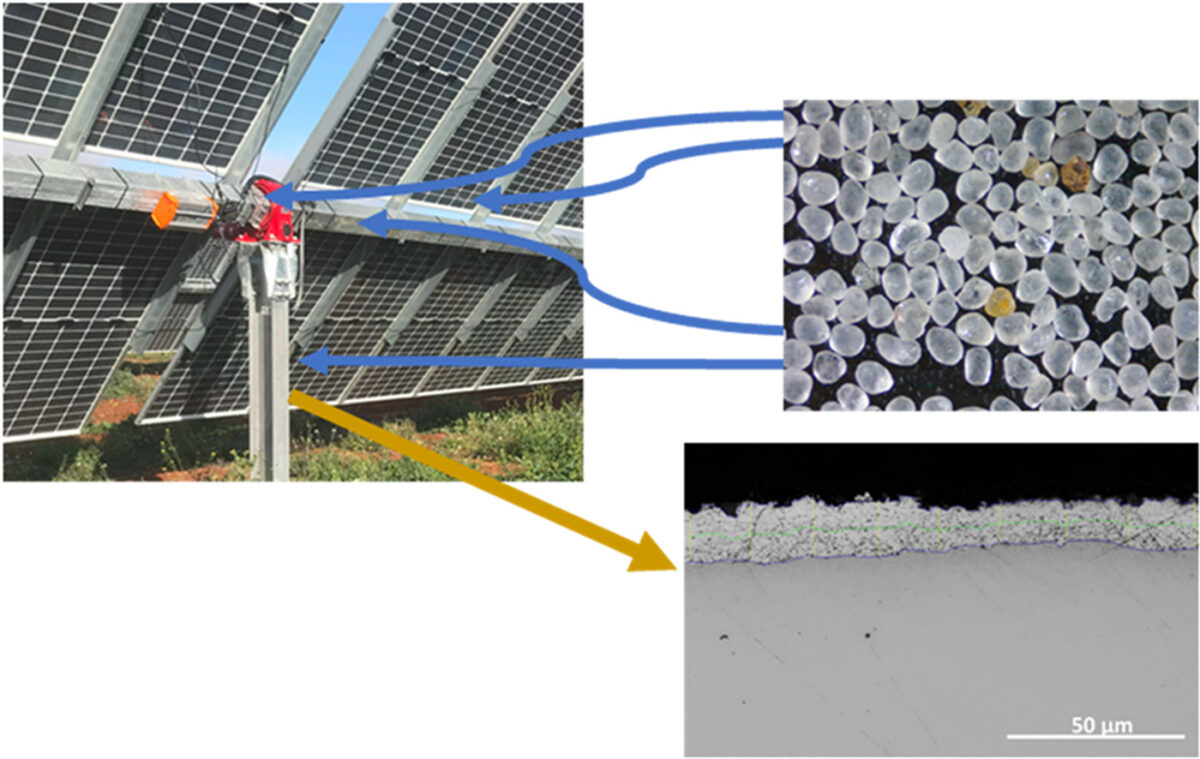
Researchers in Spain tested the erosion resistance of common galvanized coatings using both free-fall sand and forced sand impact methods. The study found that continuously galvanized steel coatings exhibited the lowest erosion rates and outperformed HDG and Zn-Al-Mg coatings.
A research team led by scientists from Spain’s National Center for Metallurgical Research (CENIM-CSIC) has investigated the erosion resistance of commonly used galvanized coatings in large-scale PV mounting systems.
“Although the degradation of PV panels and the corrosion of structural elements have been well studied, limited research has focused on the specific impact of sand erosion on metal structures in desert and semi-desert environments,” the scientists said. “In these environments, photovoltaic support structures are constantly exposed to wind-driven sand particles. The resulting erosion gradually wears away the protective zinc layer on galvanized steel. Once this layer is compromised, the underlying steel becomes highly susceptible to corrosion.”
The erosion resistance of PV mounting systems was assessed using two standardized methods: a free-falling sand test and a forced sand impingement test. The research focused on three common galvanized coatings, each with specific applications: continuously galvanized steel (Z275) for torsion tubes, Zn-Mg-Al alloy (ZM310) for trusses and hot-dip galvanized steel (HDG) for poles. These coatings differ in composition and durability, prompting considerations as to which provides the best balance between performance and longevity under erosive conditions.
All samples were commercial and measured 10 x 15 cm. An additional sample of aluminum-based motion components with an organic coating was also tested.
In free-falling sand tests, samples were placed at a 45° angle while Ottawa quartz sand fell by gravity. HDG, Z275 and ZM310 coatings were tested for 150 cycles, while the organic coating underwent 180 cycles. In each cycle, 2 liters of sand fell at a rate of 9,094 g/min, with an estimated impact velocity of 4–5 m/s.
In the forced air system, silica sand particles were projected onto samples at angles of 45° or 90° using a controlled air flow of 0.13 l/s. The impact velocity was 10 m/s, with mass flow rates of 7 g/min and 15 g/min.
The free-falling sand test showed clear differences in wear resistance. The organic coating performed well at 3.75 l/μm, with a slow wear phase of approximately 7.8 μm/h, followed by faster erosion at 33 μm/h. Of the galvanized coatings, Z275 eroded the slowest (4.03 μm/h), HDG slightly faster (5.52 μm/h) and ZM310 the fastest (9.43 μm/h).
In the forced air test, Z275 again proved to be the most resistant (1.38 ± 0.26 μm/h), ZM310 was less durable (2.47 ± 0.16 μm/h) and HDG showed erosion in two phases, starting at ~1.7 μm/h before increasing to 5.7 μm/h. These results suggest that although some coatings maintain constant resistance, others degrade more rapidly under long-term erosive conditions.
Increasing the severity to 15 g/min significantly increased erosion: Z275 reached 2.78 μm/h at 90° and 4.5 μm/h at 45°, while ZM310 reached 6.9 μm/h at 45°.
“The results indicate that continuously galvanized steel coatings exhibit the lowest erosion rate compared to HDG and Zn-Al-Mg coatings,” the researchers said. “This study also shows that higher hardness does not necessarily improve erosion resistance. The superior performance of Z275 highlights the importance of other factors, including ductility, coating continuity and resistance to brittle failure, in determining erosion behavior.”
Their findings appeared in “Surface erosion damage in mounting structures of large-scale photovoltaic systems”, published in Solar energy materials and solar cells. Researchers from Spain National Center for Metallurgical Research (CENIM-CSIC)PV solutions specialist Soltec, and the Brazilian Federal Center for Technological Education “Celso Suckow da Fonseca” participated in the study.
This content is copyrighted and may not be reused. If you would like to collaborate with us and reuse some of our content, please contact: editors@pv-magazine.com.
