

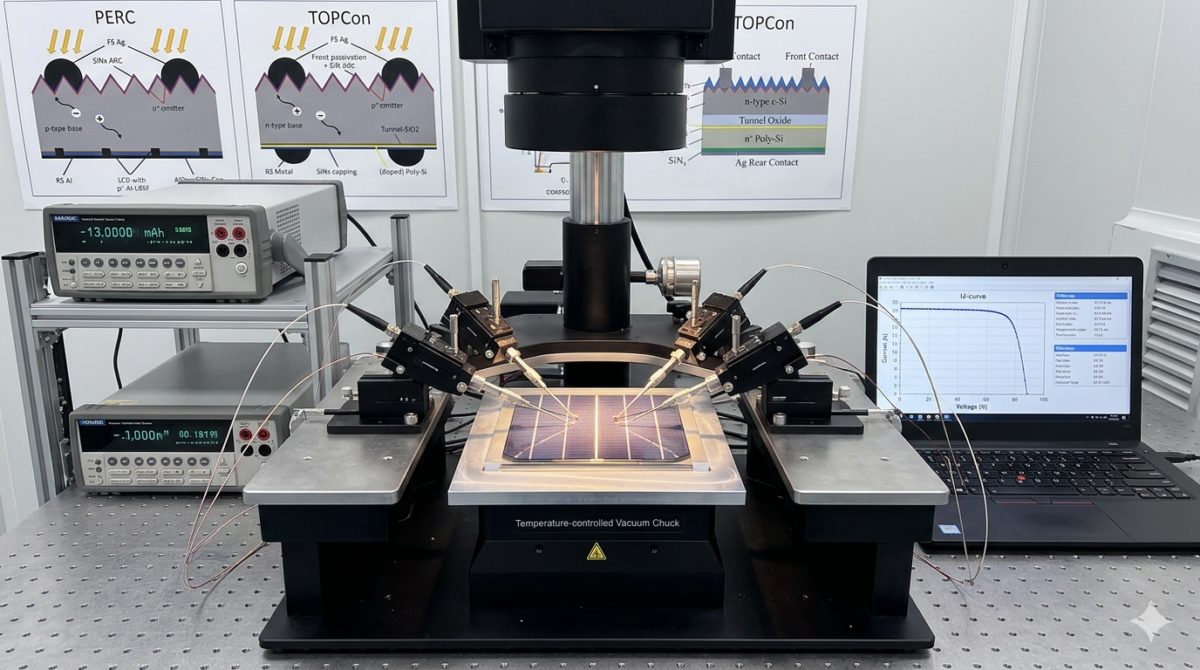
New research shows that the degradation of ultraviolet radiation in TOPCon solar cells is determined by physical mechanisms at the interface level, including hydrogen dynamics, defect formation and charge evolution. These processes are strongly influenced by the design of the silicon nitride/alumina passivation stack, which determines the long-term stability of the device.
Researchers from Yangzhou University in China have investigated ultraviolet-induced degradation (UVID) pathways in both passivated emitter and back cell (PERC) and tunnel oxide passivated contact (TOPCon) solar cells and concluded that this phenomenon is mainly determined by the design of the front passivation stack.
UVID is especially important for the TOPCon technology because the high-efficiency passivation structures are based on ultra-thin dielectric and interfacial layers that are more sensitive to UV-driven defect creation and charge accumulation, which can directly impact long-term performance and field reliability.
“UV radiation induces the breaking of silicon-hydrogen (Si-H) bonds and the formation of interfacial defects, while the optimized silicon nitride (SiNx)/aluminum oxide (AlOx) passivation structure in TOPCon solar cells maintains stable field-effect passivation and effectively suppresses recombination losses,” corresponding author Qinqin Wang said. pv magazine. “Our work has further demonstrated that rational passivation layer engineering, including optimized AlOx thickness and SiNx optical matching design, is critical for improving the long-term UV stability of TOPCon solar cells.”
The research team explained that the role of interfacial chemistry and hydrogen dynamics in TOPCon devices is still unexplored. In particular, the response of silicon-combined AlOx and SiNx passivation layers to UV radiation, and their impact on hydrogen passivation and the formation of interfacial defects, is not yet fully understood.
The analysis focused on the interfacial defect density (Dit) and solid negative charge density (Qf). This refers to the density of electrically active defect states at the silicon-passivation layer interface, while Qf describes the concentration of immobile negative charges embedded in the passivation layers.
The scientists used a Sinton WCT-120 metrology system for testing and characterizing samples. Defect and material analyzes were performed using photoluminescence (PL), electroluminescence (EL), X-ray photoelectron spectroscopy (XPS), Fourier transform infrared spectroscopy (FTIR), ultraviolet photoelectron spectroscopy (UPS), UV-visible spectroscopy and capacitance-voltage measurements for interface defect density (Dit) and solid charge density (Qf).
The microstructure was examined using scanning transmission electron microscopy (STEM) with energy dispersive X-ray spectroscopy (EDS). UV degradation tests followed IEC 61215 standards, with accelerated exposures of 60 and 120 kWh/m² at 60 C.
The group analyzed AlOx films with thicknesses of 3 nm, 5 nm and 6 nm under UV exposure and found that thicker AlOx layers provide better stability and reduced performance degradation due to stronger passivation from field effects. It observed that, as the AlOx thickness increases, the Qf becomes more negative, while This shows a thickness-dependent response, indicating a balance between chemical passivation and field effect passivation.
Furthermore, the academics found that UV radiation induces the breaking of Si-H bonds and hydrogen migration, altering interface defects and charge states, while thicker AlOx layers stabilize oxygen-related negative charge centers more effectively.
As for SiNx, two refractive indices were studied, which showed that low-index SiNx has better UV resistance due to lower UV absorption and reduced interfacial bond breaking. UV exposure transforms the SiNx network toward a more nitrogen- and oxygen-rich composition, increasing the density of interfacial defects and altering hydrogen-related bonds, the scientists said.
“Thanks to the passivated contact design and more robust field effect passivation enabled by the SiNx/AlOx stack, TOPCon solar cells exhibit significantly higher resistance to UV degradation than PERC cells,” said Wang. “After optimization, TOPCon devices only show an efficiency loss of 0.74% after 120 kWh/m² UV exposure, while PERC cells experience a much greater degradation of 3.34%.”
“These findings indicate that resistance to UV degradation is mainly determined by the quality of interface passivation, underscoring the critical role of interface engineering approaches in the development of next-generation silicon solar cells with improved UV stability,” he concluded.
The research results are available in the study “Investigating the UV degradation pathways in N-TOPCon solar cells: interface passivation and hydrogen dynamics”, published in Solar energy materials and solar cells.
This content is copyrighted and may not be reused. If you would like to collaborate with us and reuse some of our content, please contact: editors@pv-magazine.com.
