
Close Menu
  • News
  • Industry
  • Solar Panels
  • Commercial
  • Residential
  • Finance
  • Technology
  • Carbon Credit
  • More
    • Policy
    • Energy Storage
    • Utility
    • Cummunity
What's Hot

Inside PV Manufacturing: Belga Solar’s module factory in Belgium

April 23, 2026

Solar energy’s rebound effect could increase European electricity demand by 5% by 2050 – SPE

April 23, 2026

Repowering key for Japanese solar assets nears end of feed-in tariff – SPE

April 23, 2026
Facebook X (Twitter) Instagram
Solar Energy News
Thursday, April 23
  • News
  • Industry
  • Solar Panels
  • Commercial
  • Residential
  • Finance
  • Technology
  • Carbon Credit
  • More
    • Policy
    • Energy Storage
    • Utility
    • Cummunity
Solar Energy News
Home - News - Novel defect passivation strategy improves the efficiency and stability of perovskite solar cells
News

Novel defect passivation strategy improves the efficiency and stability of perovskite solar cells

solarenergyBy solarenergySeptember 15, 2024No Comments3 Mins Read
Facebook Twitter Pinterest LinkedIn Tumblr Email
Share
Facebook Twitter LinkedIn Pinterest Email

Novel defect passivation strategy improves the efficiency and stability of perovskite solar cells


Solar energy remains a crucial component in reducing dependence on fossil fuels and transitioning to cleaner energy sources. Over time, solar cells have made significant progress, becoming increasingly efficient at harnessing renewable energy.

Metal halide perovskite has become an important material for solar cells due to its impressive optoelectronic properties, which allow it to effectively convert sunlight into energy.

One of the key materials for creating high energy conversion efficiency (PCE) in perovskite solar cells (PSCs) is polycrystalline formamidinium lead iodide (FAPbI3), known for its narrow energy bandgap. However, despite their excellent properties, polycrystalline perovskites such as FAPbI3 suffer from defects in their crystal structure. These imperfections affect their structural stability and their ability to convert energy, hindering their overall performance.

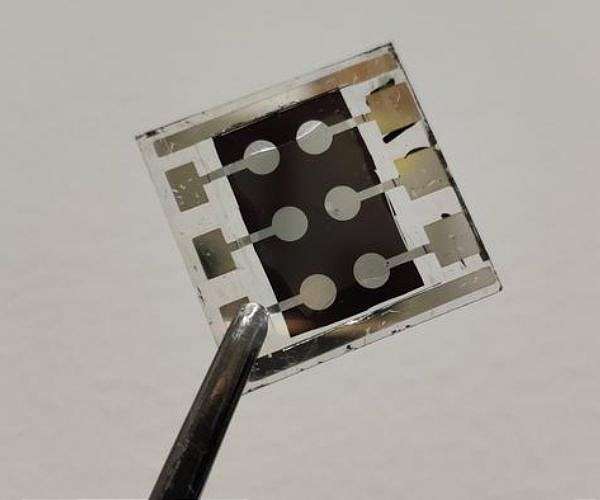
In response to this challenge, a research team led by Professor Hobeom Kim from Gwangju Institute of Science and Technology (GIST) has developed an innovative defect passivation strategy aimed at significantly reducing these defects and improving both efficiency as the stability of perovskite solar cells. Their study, published on July 4, 2024 in ‘Nature Communications’, introduced a hexagonal polytype (6H) perovskite into the cubic polytype (3C) FAPbI3. This development led to a significant improvement in PCE compared to other variants.

“A typical approach so far has been to introduce an external chemical reagent to address the defect problem. However, introducing external reagents could have a direct impact on the crystalline quality of the perovskite during crystal growth, so our work is not dependent of such stabilizers. Instead, we use a chemically identical polytype perovskite, the 6H polytype that contains a corner-sharing component that effectively suppresses the formation of defects in perovskite,” explains Prof. Kim.

See also  Berkeley Lab finds that community solar reaches targeted underserved subscribers

The team integrated the 6H perovskite into FAPbI3 using excess lead iodide and methyl ammonium chloride. This process created a component that interacted with the primary defect site of the cubic polytype (3C) FAPbI3, improving its structural integrity and carrier dynamics. The result was ultra-long carrier lifetimes of over 18 microseconds and PSCs with a PCE of 24.13%. The module achieved a PCE of 21.92%, with a certified efficiency of 21.44%, along with long-term operational stability.

The researchers suggested that the combination of the 3C and 6H polytypes could be the optimal configuration for a polycrystalline perovskite film. This discovery paves the way for further advancements in PSC technology, making it more feasible for both personal and commercial applications, such as rooftop solar panels, wearable devices and portable chargers.

“Perovskite solar cells offer a transformative solution for achieving carbon neutrality and tackling global warming. Their efficiency, versatility and reduced environmental impact make them an essential component in the transition to a sustainable future,” concluded Prof .Kim.

Research report:Shallow defect passivation by 6H perovskite polytype for highly efficient and stable perovskite solar cells


Source link

cells defect efficiency improves passivation perovskite solar stability strategy
Share. Facebook Twitter Pinterest LinkedIn Tumblr Email
solarenergy
  • Website

Related Posts

Solar energy’s rebound effect could increase European electricity demand by 5% by 2050 – SPE

April 23, 2026

Repowering key for Japanese solar assets nears end of feed-in tariff – SPE

April 23, 2026

The largest floating solar panel in the Maldives goes online – SPE

April 23, 2026
Leave A Reply Cancel Reply

Don't Miss
Policy

Solargik reveals platform for AI-driven solar tracking, diagnostics, control-PV Magazine International

By solarenergyMay 5, 20250

Solargik has announced the official debut of his Soma Pro AI-driven platform for solar tracking…

New object detection -algorithm for robots for solar cleaning -PV Magazine International

August 28, 2025

Western tariffs pose a ‘challenge’ for Chinese battery giant CATL

June 28, 2024

Energywise explains UL 3741 Solar Install for an unmarried community

March 17, 2025
Stay In Touch
  • Facebook
  • Twitter
  • Pinterest
  • Instagram
  • YouTube
  • Vimeo
Our Picks

Inside PV Manufacturing: Belga Solar’s module factory in Belgium

April 23, 2026

Solar energy’s rebound effect could increase European electricity demand by 5% by 2050 – SPE

April 23, 2026

Repowering key for Japanese solar assets nears end of feed-in tariff – SPE

April 23, 2026

Peru opens complementary services market to support renewable energy sources – SPE

April 23, 2026
Our Picks

Inside PV Manufacturing: Belga Solar’s module factory in Belgium

April 23, 2026

Solar energy’s rebound effect could increase European electricity demand by 5% by 2050 – SPE

April 23, 2026

Repowering key for Japanese solar assets nears end of feed-in tariff – SPE

April 23, 2026
About
About

Stay updated with the latest in solar energy. Discover innovations, trends, policies, and market insights driving the future of sustainable power worldwide.

Subscribe to Updates

Get the latest creative news and updates about Solar industry directly in your inbox!

Facebook X (Twitter) Instagram Pinterest
  • Contact
  • Privacy Policy
  • Terms & Conditions
© 2026 Tsolarenergynews.co - All rights reserved.

Type above and press Enter to search. Press Esc to cancel.