

Tetracene is a polycyclic aromatic hydrocarbon commonly used in organic field effect transistors (OFETs), organic light emitting diodes (OLEDs) or as a sensitizer in chemiluminescence. Singlet fission solar cells can produce two electrons from one photon, making the cell more efficient
Researchers at the U.S. Department of Energy’s National Renewable Energy Laboratory (NREL) plan to use synthesized tetracenedioic acid (Tc-DA) to develop so-called singlet fission solar cells. Tetracene is a polycyclic aromatic hydrocarbon commonly used in organic field effect transistors (OFETs), organic light emitting diodes (OLEDs) or as a sensitizer in chemiluminescence.
Singlet exciton fission is an effect observed in certain materials where a single photon can generate two electron-hole pairs when absorbed in a solar cell instead of the usual one. The effect has been observed by scientists as far back as the 1970s and although it has become a major area of research for some of the world’s leading institutions over the past decade, translating the effect into a viable solar cell has proven complex.
Singlet fission solar cells can produce two electrons from one photon, making the cell more efficient. This is done via a quantum mechanical process in which one singlet exciton (an electron-hole pair) is split into two triplet excitons. According to the researchers, acenes have the potential to exhibit improved quantum yields in this process.
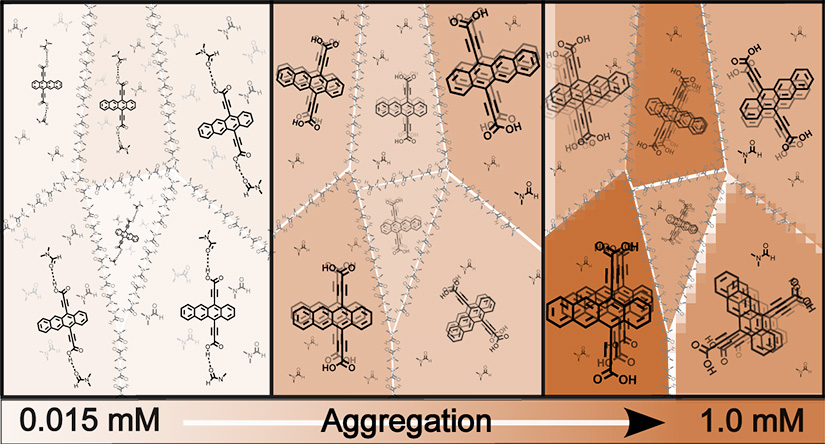
In the study “Tetracenedioic acid aggregates for directing the energy flow to triplet pairs,” published in the Journal of the American Chemical Society, the scientists explained that Tc-DA exploits intermolecular hydrogen-bonding interactions on semiconductor surfaces to form well-ordered monolayers. “However, we found that we could control the aggregation of Tc-DA as it approached the surface through solvent and concentration choices,” says NREL researcher Nicholas Pompetti. “This opened insights about tetracene-based aggregates and how their size and structure provide promising routes for their use in light harvesting applications.”
The team concluded that tetracene and its derivatives are leading candidates for singlet fission (SF) after analyzing their aggregate structures via nuclear magnetic resonance (NMR) spectroscopy and computational modeling. “The excited state dynamics were surprisingly sensitive to crossing a well-defined concentration threshold, almost like experiencing a phase transition for a pure material,” says co-author Justin Johnson.
The group also found that some noncovalent tetracene-based aggregates, stabilized at certain solvent polarities and concentrations, were able to form charge-transfer and multi-excitonic states, which they described as “desirable species for delivering charges to an electrode or catalyst. ”
“Nature uses hydrogen bonds in many types of aggregate architectures to tune energy landscapes in a similar way to directing water to a reservoir,” Johnson said. “Introducing such principles into artificial light collection systems with the potential to control multi-excitons is a logical endeavor that leads to interesting consequences.”
Research into singlet fission has led to other interesting discoveries in recent times.
Last year, researchers from the Massachusetts Institute of Technology (MIT) and the University of Virginia announced plans to use acenes, benzene molecules with unique optoelectronic properties, in singlet fission solar cells. Their approach involved adding carbodicarbene ligands to acenes that were already doped with boron and nitrogen.
In 2019, an MIT research group demonstrated how singlet exciton fission could be applied to silicon solar cells and lead to cell efficiencies as high as 35%. They claimed to be the first group to convey the effect of one of the ‘excitonic’ materials known to exhibit this, in that case also tetracene. They achieved this feat by placing an additional layer of hafnium oxynitride just a few atoms thick between the silicon solar cell and the excitonic tetracene layer.
The MIT researchers describe their work as “turbocharging” silicon solar cells and said it differs from the most common approaches to increasing the efficiency of solar cells, which today focus more on tandem cell concepts. “We add more power to the silicon instead of making two cells,” they explained at the time.
This content is copyrighted and may not be reused. If you would like to collaborate with us and reuse some of our content, please contact: editors@pv-magazine.com.
