

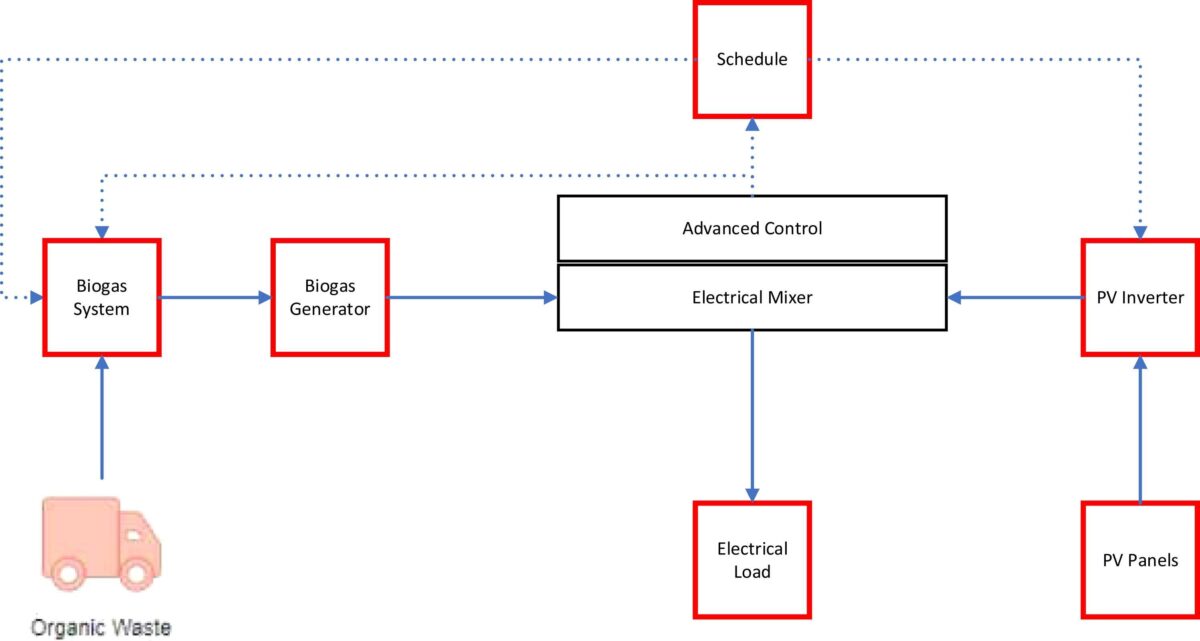
The system was designed in response to Lebanon’s energy crisis and to help homeowners become independent of the electricity grid. Biogas production is used when PV energy generation is insufficient and machine learning techniques help the system predict solar energy production.
A group of researchers from the United Arab Emirates (UAE) and Lebanon designed a new hybrid PV and biogas production system for applications in residential buildings.
According to its creators, the proposed system could help the energy crisis that Lebanon has experienced in recent years, when hundreds of megawatts of off-grid PV systems were deployed in the country.
“Lebanon has been experiencing an economic crisis since 2019, which has had a substantial impact on multiple industries, especially the fuel and energy sectors,” the group explained. “As a result, the Lebanese people have begun to adopt sustainable energy technologies, such as PV systems, as their primary source of electricity generation. Nevertheless, these systems are dependent on unpredictable weather conditions, resulting in power shortages during the night and winter season.”
The novelty of the hybrid system lies in the forecasting component, which provides for the part of demand that can be supplied with PV. It then pre-calculates the waste demand required for the biogas system to compensate for the lack of PV generation.
For the prediction of PV generation, the system uses existing machine learning techniques from previous literature. This capacity is then compared with the expected load, based on the needs of the specific user. When the PV generation is greater than or equal to the expected load, the system runs on it alone. However, when there is insufficient solar energy, the proposed system checks whether the available biomass type and quantities are sufficient to support the shortage. If there is not enough waste, a diesel system runs as a last resort.
“The system will examine the dimensions and capacity of the biogas digester, as well as the expected biogas production, which is determined by different combinations,” the academic group said. “Three forms of manure are being considered: cattle, pigs and poultry. The percentage of ash, volatile and fixed carbon in different types of food waste is also taken into account.”
The proposed model was then implemented in a simulation based on the demand of a real high-capacity manufacturing company operating in an eight-hour cycle. It features a 100 kW PV system consisting of 182 PV panels of 550 W each. A weather dataset was used for PV generation estimates, taking into account sunshine, humidity and wind. Furthermore, the article assumes that the biogas generator has an instantaneous power greater than the load.
“It uses data collected every four seconds during daylight hours in January,” the group explained their analysis results. “The number of cases requiring hybrid cooperation appears to be approximately 6,840 and the external generator is never used. However, the PV system succeeds in supplying the required energy for approximately 5,650 events.”
The tests showed that in the first 15 days of January, 3.4 tonnes of beef manure were needed to support the system and generate 143.83 cubic meters of methane. However, the machine learning calculation resulted in a methane deficit of 11,664 cubic meters compared to the actual results. The company was able to learn from its mistake and in the next simulated year the error for the same period dropped from 12.82% to 8.28%.
“The case study and simulation sections collectively highlight the importance of the proposed equations and control suites in facilitating accurate data evaluation and driving efficiency improvements,” the academics concluded. “This demonstration serves to highlight the article’s valuable contributions to current industry knowledge.”
The system was presented in “Hybrid photovoltaic and biogas system for a stable energy system”, published in Next energy. The research was conducted by scientists from the University of Wollongong in Dubai and Rafik Hariri University in Lebanon.
This content is copyrighted and may not be reused. If you would like to collaborate with us and reuse some of our content, please contact: editors@pv-magazine.com.
