
Close Menu
  • News
  • Industry
  • Solar Panels
  • Commercial
  • Residential
  • Finance
  • Technology
  • Carbon Credit
  • More
    • Policy
    • Energy Storage
    • Utility
    • Cummunity
What's Hot

A deep learning model tracks the status of the EV battery with high precision

March 6, 2026

Mitsubishi Electric Trane announces new heat pump line for hydronic heating – SPE

March 6, 2026

Origis is developing a 413 MW solar portfolio in West Texas

March 6, 2026
Facebook X (Twitter) Instagram
Solar Energy News
Friday, March 6
  • News
  • Industry
  • Solar Panels
  • Commercial
  • Residential
  • Finance
  • Technology
  • Carbon Credit
  • More
    • Policy
    • Energy Storage
    • Utility
    • Cummunity
Solar Energy News
Home - Technology - Perovskite-silicon tandem solar cell treated with n-Butanol achieves an efficiency of 29.4% – SPE
Technology

Perovskite-silicon tandem solar cell treated with n-Butanol achieves an efficiency of 29.4% – SPE

solarenergyBy solarenergyJune 11, 2024No Comments3 Mins Read
Facebook Twitter Pinterest LinkedIn Tumblr Email
Share
Facebook Twitter LinkedIn Pinterest Email

Researchers in China have built a tandem perovskite solar cell with a top perovskite device based on an absorber treated with n-butanol, which is said to reduce the harmful effects of moisture in manufacturing processes carried out in air. The result is a tandem cell with improved charge collection.

June 11, 2024 Emiliano Bellini

A group of researchers led by Nanjing University in China has designed a perovskite-silicon tandem solar cell with a new solvent engineering strategy that uses n-butanol (nBA), also called normal butyl alcohol, which is a primary clear, colorless alcohol. used as a cleaning agent in many industries, including electronics manufacturing.

The scientists explained that nBA provides low polarity and saturation vapor pressure and allows the typical damaging effects of moisture in the production of perovskite cells in an ambient environment to be significantly reduced.

The perovskite film of the top device of the tandem cell had an active area of ​​0.049 cm22 and was fabricated via co-evaporation and blade coating techniques, which, according to the research group, meet the requirements for large-area fabrication of the perovskite films.

“It is worth noting that the second step was implemented in the air to match the realistic production environment,” it also explained, noting that nBa replaced the common ethanol and isopropyl alcohol, which negatively affect the uniformity of the film. “Both the polarity and the evaporation rate of the solvent have a joint effect on H2O absorption levels. In this vision, NBA emerges as the optimal solvent for our specific requirements.”

The nBa-based film was found to have improved charge collection, due to the larger grain sizes that minimize recombination, compared to control films developed with conventional solvents.

See also  Catalyst Power taps to build 650-KW Solar Port Folio for Massachusetts Storage Company

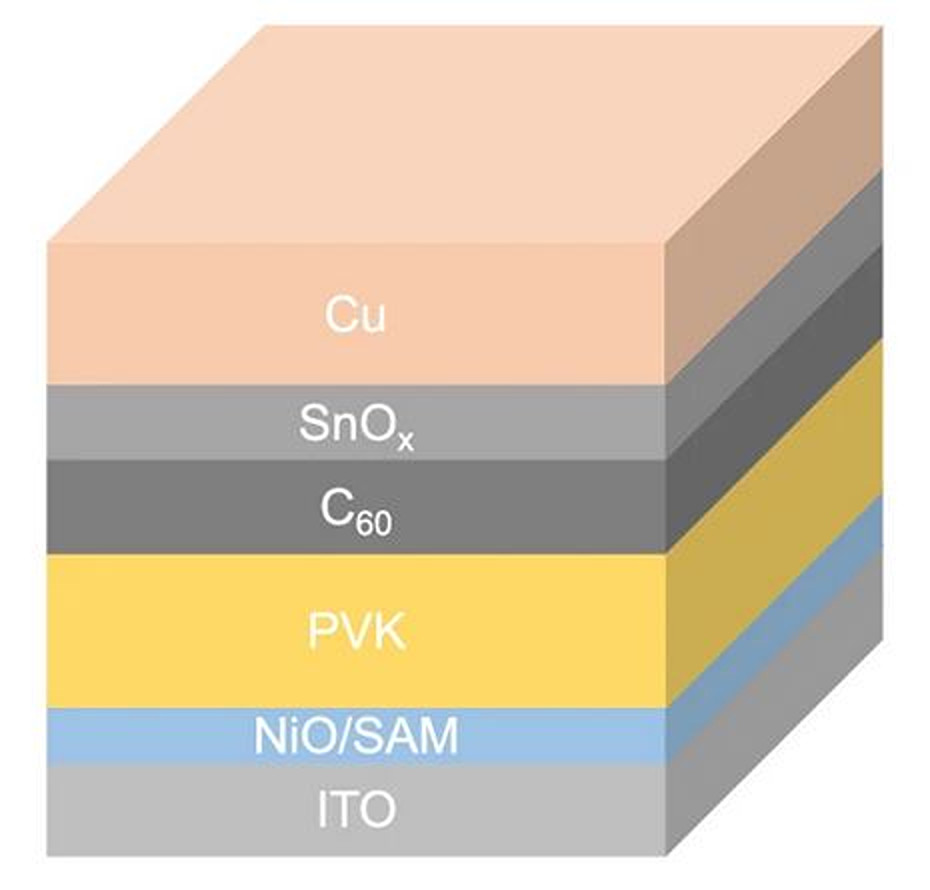
The researchers built the top cell with a glass-coated indium tin oxide (ITO) absorber, a nickel(II) oxide (NiO) layer, a hole transport layer (HTL) with a self-assembling monolayer (SAM), a perovskite absorber with an energy band gap of 1 .68 eV, an electron transport layer based on buckminsterfullerene (C60) and a tin oxide (SnOx) buffer layer, and a copper (Cu) electrode.

Tested under standard lighting conditions, this device achieved an energy conversion efficiency of 20.8%.

The top device was then integrated into a tandem cell with an active area of ​​1,044 cm22 by integrating a silicon solar cell with heterojunction at the bottom. This cell achieved an efficiency of 29.4%, an open-circuit voltage of 1.83 V, a short-circuit current density of 20.45 mA cm−2and a fill factor of 78.63%.

The team was also able to certify an efficiency of 28.7% for the tandem cell and 26.3% for a device with an opening area of ​​16 cm2. “The encapsulated device retained 96.8% of initial output after 780 hours of maximum power point tracking,” the academics added. “Additionally, we demonstrated the potential for commercial scale by achieving a conversion efficiency of 25.9% for 16 cm² devices manufactured via slot-die coating.”

They presented the cell in the newspaper “Solvent engineering for scalable fabrication of airborne perovskite/silicon tandem solar cells,” published in communication about nature. “This solvent technology strategy demonstrates the feasibility of commercial perovskite-silicon tandem solar cells,” they concluded.

This content is copyrighted and may not be reused. If you would like to collaborate with us and reuse some of our content, please contact: editors@pv-magazine.com.

See also  Reducing silver use in heterojunction solar cells via cheap copper wires – SPE

Source link

achieves cell efficiency nButanol perovskitesilicon solar SPE tandem treated
Share. Facebook Twitter Pinterest LinkedIn Tumblr Email
solarenergy
  • Website

Related Posts

Mitsubishi Electric Trane announces new heat pump line for hydronic heating – SPE

March 6, 2026

Origis is developing a 413 MW solar portfolio in West Texas

March 6, 2026

New Jersey expands state community solar program by 3 GW

March 6, 2026
Leave A Reply Cancel Reply

Don't Miss
Energy Storage

Yotta Energy launches ‘panel-level storage’ package for C&I solar – SPE

By solarenergyJuly 1, 20240

US storage and inverter specialist Yotta Energy says its new package has several advantages compared…

UBIQD Development of new Encapsulant technology for solar modules – PV Magazine International

February 28, 2025

Australian study shows that pumped hydro and batteries can meet the needs of energy storage – PV Magazine International

January 31, 2025

Fault detection technology for PV modules based on deep electroluminescence learning

August 20, 2024
Stay In Touch
  • Facebook
  • Twitter
  • Pinterest
  • Instagram
  • YouTube
  • Vimeo
Our Picks

A deep learning model tracks the status of the EV battery with high precision

March 6, 2026

Mitsubishi Electric Trane announces new heat pump line for hydronic heating – SPE

March 6, 2026

Origis is developing a 413 MW solar portfolio in West Texas

March 6, 2026

New Jersey expands state community solar program by 3 GW

March 6, 2026
Our Picks

A deep learning model tracks the status of the EV battery with high precision

March 6, 2026

Mitsubishi Electric Trane announces new heat pump line for hydronic heating – SPE

March 6, 2026

Origis is developing a 413 MW solar portfolio in West Texas

March 6, 2026
About
About

Stay updated with the latest in solar energy. Discover innovations, trends, policies, and market insights driving the future of sustainable power worldwide.

Subscribe to Updates

Get the latest creative news and updates about Solar industry directly in your inbox!

Facebook X (Twitter) Instagram Pinterest
  • Contact
  • Privacy Policy
  • Terms & Conditions
© 2026 Tsolarenergynews.co - All rights reserved.

Type above and press Enter to search. Press Esc to cancel.