By controlling the secondary growth of lead iodide, an international group of scientists has built a perovskite solar cell with low non-radiative recombination and low defect density. The device reportedly showed superior stability in both humidity and thermal stability tests compared to reference cells.
An international research team has fabricated a perovskite solar cell that reportedly exhibits lower non-radiative recombination and lower defect density.
“Our study introduces an innovative strategy for secondary growth of lead iodide (PbI2) and π-π stacking regulation that improves the photovoltaic efficiency and stability of perovskite solar cells,” said the study’s lead author, Mojtaba Abdi-Jalebi. pv magazine. “By promoting controlled PbI2 nucleation and crystallization using 4-fluorobenylamide (FBA), we achieved high-quality perovskite films with large grains and minimal defect states, increasing cell efficiency from 22.06% to 23.62%. ”
π–π stacking interactions consist of a non-destructive non-covalent interaction used in modern chemistry and molecular biology. It offers advantages such as strong binding force, non-destructive manufacturing process and easy operation.
“Through π-π stacking and hydrogen bonding interactions between FBA and the lead iodide (Pb-I) framework, we significantly stabilized the PbI6 skeleton, addressing iodine loss – a key factor in the degradation of perovskite solar cells,” said Abdi-Jalebi. “This approach not only improves the resilience of the Pb-I structure under heat and light stress, but also achieves remarkable retention of 96% of initial efficiency over 1,300 hours, advancing the path to stable, commercially viable perovskite solar cells. “
The group used a porous PbI2 film with low Gibbs free energy and high crystallinity to build a perovskite absorber with large grains and few defects. The Gibbs free energy is the available energy of a substance that can be used in a chemical transformation or reaction.
Image: University College LondonMalet Place
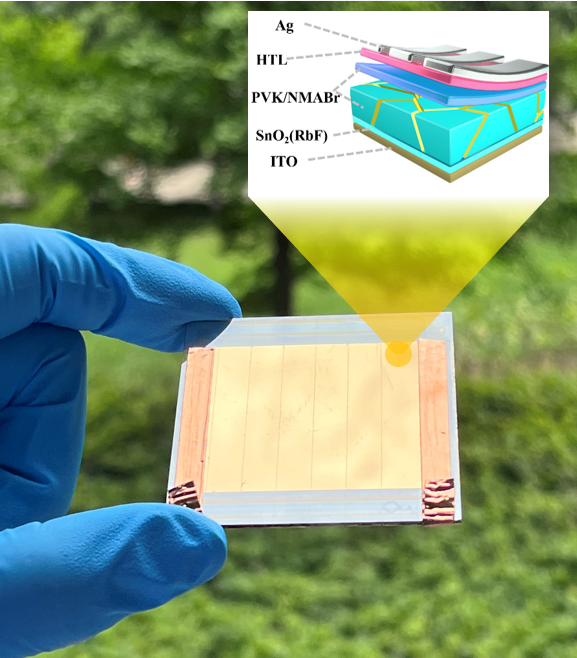
The cell is built with a substrate made of indium tin oxide (ITO), an electron transport layer (ETL) made of tin oxide (SnO2), the perovksite absorber, a hole transport layer (HTL) that relies on spiro-OMeTAD, a spacer based phenyl-C61-butyric acid methyl ester (PCBM) and a silver (Ag) metal contact.
Tested under standard lighting conditions, the device achieved an energy conversion efficiency of 23.62%, an open-circuit voltage of 1.17 V, a short-circuit current density of 26.19 mA/cm2 and a fill factor of 77.24%. A reference cell built without the FBA treatment achieved an efficiency of 22.07%, an open-circuit voltage of 1.15 V, a short-circuit current density of 25.19 mA/cm2 and a fill factor of 76.47%.
The cell was also able to maintain 77% of its efficiency after 1000 hours of exposure to air, compared to 58% for the reference device.
“The targeted perovskite cell showed superior stability in both humidity and thermal stability tests,” the research group explained. “Controlling PbI2 crystallization growth in the sequential deposition method was crucial for optimizing the subsequent growth of perovskite crystals.”
The new cell concept was presented in the study “Secondary growth of lead iodide and π-π stacking regulation for sequential perovskite solar cells with 23.62% efficiency”, published in the Journal of Chemical Technology.
The research team included scientists from China’s Southwest Petroleum University, Chongqing University and University College London Malet Place in the United Kingdom.
This content is copyrighted and may not be reused. If you would like to collaborate with us and reuse some of our content, please contact: editors@pv-magazine.com.
Popular content