

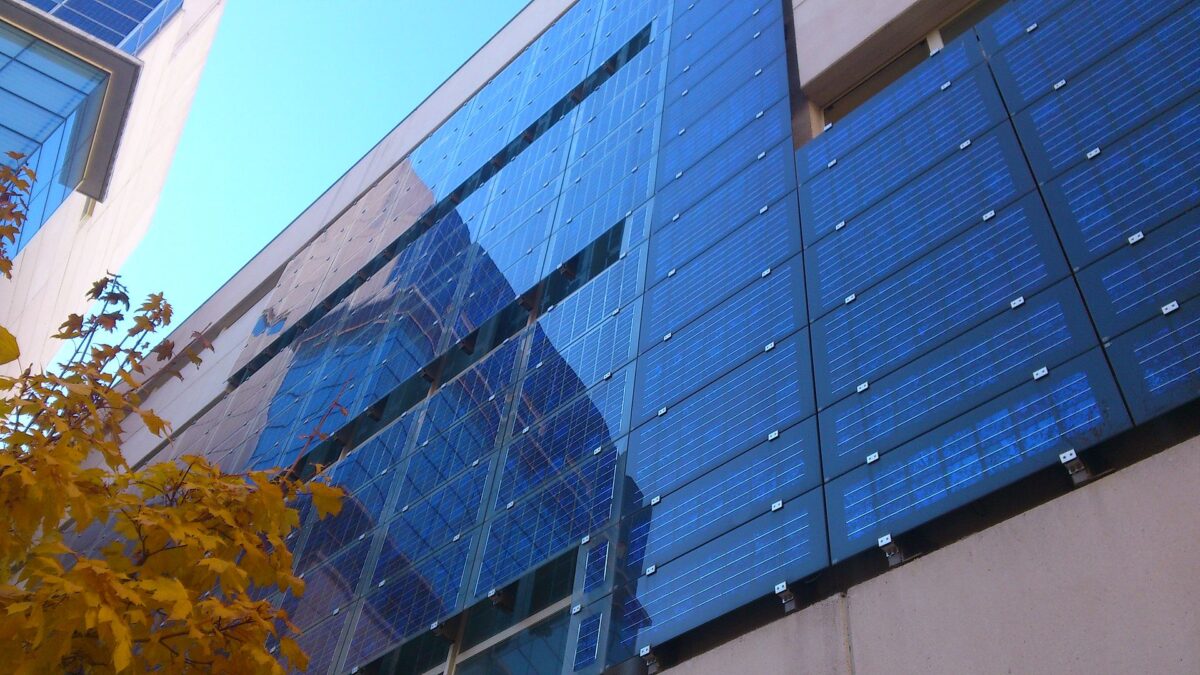
Scientists have designed a new building-integrated PV system that uses 30mm of phase change material on each side of the wall. The array reportedly achieved superior thermoelectric coupling performance compared to reference BIPV systems without PCM.
Researchers from China have designed a new building-integrated photovoltaic system (BIPV) that integrates a layer of phase change material (PCM) on each side of the wall.
The new system, called double-PCM BIPV composite envelope (BIPV-dPCM), was experimentally validated via a numerical model and compared with reference systems. According to the results, it achieved superior thermoelectric coupling performance compared to all other systems.
“The integration of PCM with BIPV offers a compelling approach to improve solar energy utilization and reduce indoor thermal loads, contributing to energy-efficient and low-carbon building development,” the scientists said. “The PCM can lower the PV operating temperature and reduce the peak load difference, while reducing the indoor air temperature fluctuation.”
The proposed system, which was simulated using the TRNSYS software, consists of several layers. First, monocrystalline silicon PV modules are placed on the outer layer, which are then coupled with 30mm RT-28 PCM. This is followed by 10mm thick cement mortar, 120mm brick wall and another 10mm cement mortar. Finally, a 30 mm thick RT-40 PCM is placed on the inside of the apartment.
“During the day, the PV panels convert solar radiation into electricity, generating excess heat that is directed inward,” the academics explained. “The PCM applied to the back of the PV panels absorbs heat, causing it to melt, lowering the PV temperature and improving energy generation efficiency. At night, the PCM near the interior space begins to solidify and thus become exothermic, maintaining the interior temperature with small fluctuations. The dual PCMs increase the thermal resistance of the wall, preventing heat transfer between the inner and outer layers.”
This system was simulated in a south-facing room with a size of 5 meters, located on the middle floor of a civilian residence in Guangzhou, China. It was assumed that one person lived in this room, using 3.8 W/m2 of light and 5 W/m2 of other equipment. The lights were believed to be on between 1am and 2pm, and the remaining equipment was in use between 7am and 9pm. The air conditioning was turned on between 7 a.m. and 5 p.m. during the summer months and set to a 26 hour temperature. c.
“To verify the ability of the proposed new BIPV-dPCM envelope to consider both energy generation and thermal insulation performance, the study compares it with three other typical envelopes,” the researchers said. “The reference wall is called Wall I, while Wall II is a commonly used single-layer PCM coupled with a PV housing structure that shows better power generation performance when close to the PV panels. Wall III shows better thermal insulation performance when it is close to the interior. The proposed BIPV-dPCM in this study is called Wall IV.”
The analysis showed that the new system achieved a cold load reduction of 7.94%, 4.60% and 0.50% less than structures I, II and III, respectively. It improved temperature control and reduced PV peak temperatures by 1.77 C and interior wall temperatures by 6.3 C, delaying heat penetration by 1 hour.
“The exergy analysis of the four types of housing structures shows that the dual PCMs can more effectively improve the overall exergy efficiency and reduce the exergy damage of each part,” the group added. “However, the internal exergy loss of the PV module is responsible for more than 80%, so it is necessary to incorporate cooling techniques such as ventilation.”
Concluding the results, the scientists said that “the self-sufficiency coefficient (SSC) of the BIPV-dPCM system is closely related to the phase transition time of the PCM. The SSC can be higher than 55%, indicating strong PV self-consumption potential. By optimizing the parameters, especially the PCM thickness ratio, the SSC can exceed 65%.”
The system was presented in “Investigation of double PCM-based PV composite walls for energy generation and building insulation: thermal characteristics and energy consumption prediction”, published in Energy and Built Environment. Researchers from China’s Jinan University, Anhui University of Technology and Wuhan University conducted the study.
This content is copyrighted and may not be reused. If you would like to collaborate with us and reuse some of our content, please contact: editors@pv-magazine.com.
