

In a new weekly update for pv magazineOPIS, a Dow Jones company, provides a brief overview of the major price trends in the global PV industry.
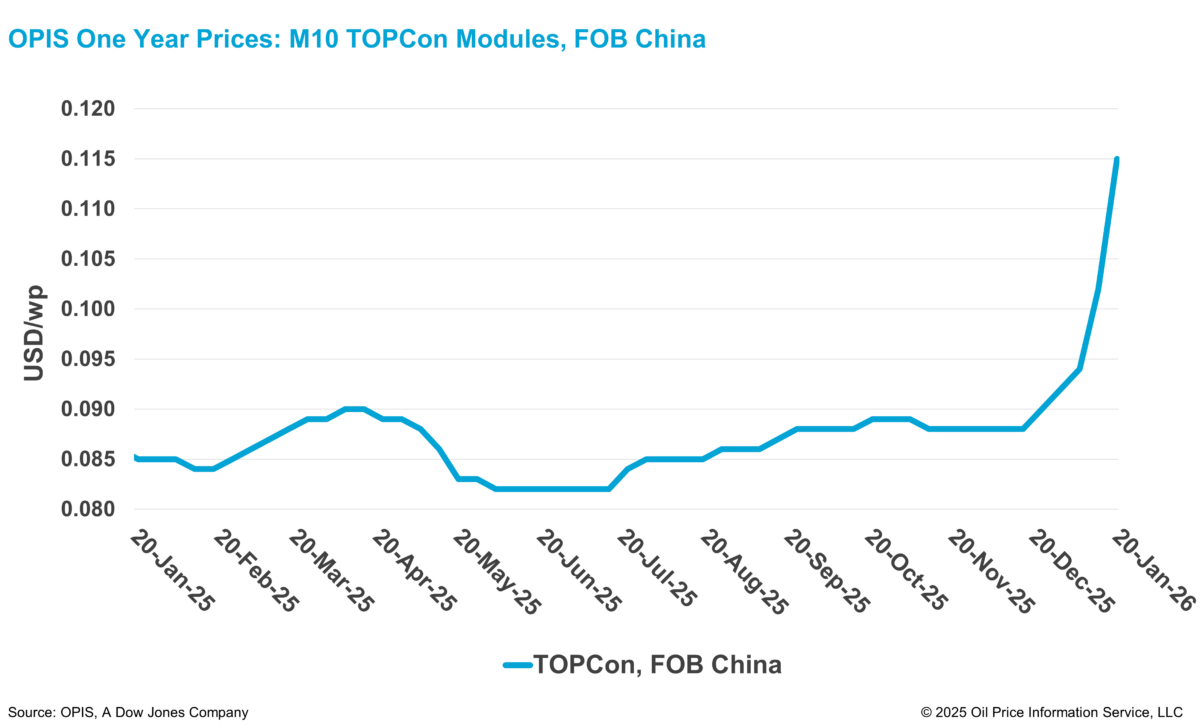
Chinese TOPCon module prices rose for the third week in a row as market participants continued to digest the impact of the loss of export discounts and higher cell prices. In addition to spot prices, prices along the forward curve have also increased, reflecting expectations that recent policy shifts could feed into forward pricing.
According to the OPIS Global Solar Markets Report released on January 20, the Chinese Module Marker (CMM), the OPIS benchmark rating for TOPCon modules from China, rose 12.75% this week to $0.115/W Free-On-Board (FOB) China.
The forward curve indications of OPIS FOB China TOPCon modules for freight loading in Q2 2026 were estimated at $0.120/W, up 14.29% on the week. Forward freight loading prices for Q3 2026 rose to $0.121/W, up 15.24% over the week.
Freight loading in the fourth quarter of 2026 rose 10.42% week-on-week to $0.106/W, while freight loading in the first quarter of 2027 saw the strongest increase of 13.5% to $0.109/W.
Join us on January 28 for pv magazine Webinar+ | The Solar Module Market Playbook: Managing Prices, Risks, and Other Procurement Challenges.
We combine real-time market data, case studies and an interactive Q&A to help EPCs, developers, investors and distributors secure high-quality PV modules at competitive prices, ensuring project financeability.
Silver prices will remain a key variable, according to a tier-1 producer. Even if upstream polysilicon prices soften from April, module prices would struggle to fall back to the end-2024 level of around CNY0.70 ($0.10)/W as long as silver prices remain at current levels. The producer added that buyers have largely accepted the higher price levels and expect the upward trend to continue.
However, some trading sources pointed to continued ‘wait and see’ sentiment in the market, largely driven by uncertainty surrounding upcoming policies, particularly China’s anti-monopoly measures, which could limit the full transmission of recent price increases.
While these measures are primarily aimed at the polysilicon segment and the proposed consolidation platform, downstream market participants told OPIS they could also impact the cell and module markets, where major manufacturers have been operating under strict production and sales coordination arrangements for more than a year.
Several manufacturer sources said this could inadvertently intensify production and price competition in a sector already struggling with significant overcapacity. However, they noted that clearer regulations would still be needed before manufacturers adjust their production and sales strategies.
In early January, the Beijing Municipal Administration for Market Regulation initiated a meeting with major polysilicon producers and the China Photovoltaic Industry Association to address monopoly risks and outline rectification requirements related to anti-monopoly compliance. The rectification measures must be submitted to the State Administration for Market Regulation (SAMR) by January 20.
The proposed framework prohibits companies from making agreements on production capacity, capacity utilization, sales volumes and prices. Capital contribution ratios should not determine market allocation, output or profit distribution, and any coordination or communication about prices, costs, production and sales volumes is not permitted.
Meanwhile, high inventory levels and oversupply remain a headwind downstream, making it difficult to justify current price levels, sources said. One tier-1 producer noted that the cell and module segments are likely to remain challenging in 2026, noting that it is difficult to set a clear price ceiling amid ongoing policy uncertainty, while further price increases could also weigh on power plant investment decisions.
A developer source said uncertainty remains high, with further price increases dependent on market acceptance of current module prices. The source added that while suppliers continue to push for increases, it may be difficult for module prices to continue rising given current electricity rates as most new PV projects are priced through market-based mechanisms rather than guaranteed feed-in tariffs (FiTs).
Major Chinese PV manufacturers are expected to announce their 2025 financial results in the coming weeks, with several already signaling another difficult year in 2025 amid oversupply across the value chain and continued weak prices. Low module sales prices and tighter trading conditions continue to put pressure on margins, with some companies reporting higher losses in the fourth quarter of 2025 than in the third quarter.
OPIS, a Dow Jones company, provides energy prices, news, data and analysis on gasoline, diesel, jet fuel, LPG/NGL, coal, metals and chemicals, as well as renewable fuels and environmentally friendly feedstocks. It acquired assets with pricing data from Singapore Solar Exchange in 2022 and now publishes the OPIS APAC Solar Weekly Report.
The views and opinions expressed in this article are those of the author and do not necessarily reflect those of the author pv magazine.
This content is copyrighted and may not be reused. If you would like to collaborate with us and reuse some of our content, please contact: editors@pv-magazine.com.
Popular content
