

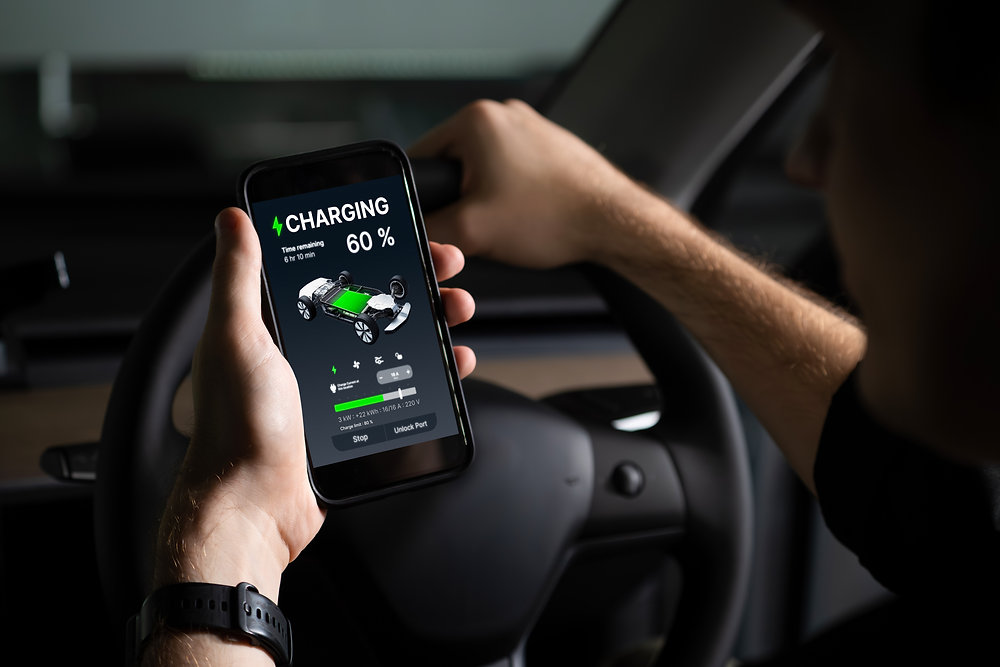
Many drivers of electric cars are afraid of the range. They worry about running out of battery and getting stranded, or having to make inconvenient stops to charge their electric vehicle (EV) batteries. For this reason, the demand for plug-in hybrid electric vehicles (PHEVs) is high. Read on to learn more about charging a PHEV at home and on the go.
What is a PHEV?
A PHEV is a hybrid vehicle which combines a combustion engine with a rechargeable battery. PHEVs can be charged using an external power source, giving them a limited all-electric range before switching to petrol. This double capacity increases fuel efficiency and reduces greenhouse gas emissions, making PHEVs an excellent option for drivers switching to electric mobility.
How do hybrids charge?
Hybrid cars usually charge via regenerative braking and the combustion engine. In addition, some hybrid models are plug-in hybrids, allowing users to charge their batteries by connecting them to an external power source, such as a wall socket or charging station, providing an extended driving range that can be driven on electric power alone.
How long does it take to charge a PHEV battery?
Charging a PHEV depends on factors such as battery capacity,… EV chargerand the existing battery charge. Level 1 Charging (120 V) is the slowest; it takes 8 to 12 hours for a full charge. Level 2 charging (240V) at public EV charging stations or homes varies from 1.5 to 3 hours. Level 3 charging (DC fast chargers) provides fast charging in minutes, if compatible with the vehicle.
How long does it take to charge a fully discharged PHEV with a Level 1 charger?
Charging time depends on the size of the PHEV battery, typically ranging from approximately 13.6 kWh (e.g. Toyota Prius Prime) to 20 kWh (e.g. Mitsubishi Outlander). A level 1 EV charger supplies approximately 1.2 kW to a PHEV battery. Experts recommend keeping PHEV batteries between 20% and 80% charged. According to this recommendation, it would take approximately 6.7 to 10 hours to charge a PHEV battery with a Level 1 charger.
Which chargers are compatible with a PHEV?
PHEVs are compatible with Level 1 chargers that use standard wall outlets, and most PHEVs come with the necessary hardware. They can also use Level 2 chargers often found at public stations or home installations. Some PHEVs may also support DC Fast Chargers (DCFC), which provide the fastest charging.
Can I charge my PHEV with a fast charger?
PHEVs generally cannot use DC fast chargers, also known as Level 3 chargers. These EV charging stations provide a high-voltage direct current (DC) power source, allowing electric cars to be charged quickly. However, PHEVs are designed with a smaller battery capacity compared to fully electric vehicles and typically rely on Level 1 or Level 2 charging options. However, select models have PHEV fast charging capabilities.
What are the fastest charging PHEVs?
Several PHEV models offer fast charging capabilities, making them the fastest charging PHEVs. Some of the PHEVs equipped to use DC fast chargers, according to the automaker’s websites, include:
-
Mitsubishi Outlander PHEV: This model has a CHAdeMO port, making this PHEV compatible with fast chargers.
-
Volvo XC40 Charging T5: The PHEV version of the Volvo XC40 Recharge offers PHEV fast charging capabilities with the CCS charging standard.
-
MINI Cooper SE Countryman ALL4: This PHEV from MINI can use DCFCs, making it one of the fastest charging PHEVs available.
How do I know if my PHEV has fast charging capabilities?
The fastest charging PHEVs have connectors for using DC fast chargers. In North America, a common type of DCFC plug is the Combined Charging System (CCS). Another type of DCFC plug is the CHAdeMO connector, which is widely used by Japanese car manufacturers, including the Mitsubishi Outlander PHEV, for fast charging. Determine if your PHEV has a fast charging port or consult the manufacturer’s information to determine if your PHEV has fast charging capabilities.

How much does it cost to charge a PHEV?
The cost of charging a plug-in hybrid electric car varies depending on electricity rates, battery charge level and battery capacity. The average costs per kWh of electricity in the US it is $0.127 as of January 2024, but some EV charging stations may charge a higher rate. For example, if 6 kWh is required to fully charge a PHEV, at a cost of €0.20 per kWh, the cost is €1.20.
Electricity rates and charging costs can vary greatly by location and energy supplier. Additionally, charging costs can vary for Level 2 and DC fast charging methods, and charging a PHEV with a fast charger is often more expensive.
Can I use public charging stations for my PHEV?
Yes, you can use public charging stations for your plug-in hybrid. Public charging networks, such as ChargePoint and EVgo, offer Level 2 charging stations that are compatible with most PHEVs. Make sure your PHEV has the correct EV charging connector and, if necessary, an adapter. While most PHEVs support Level 3 fast charging, many can use Level 2 stations for convenient and faster outdoor charging.
Where can I charge my PHEV?
You can charge your plug-in hybrid in a variety of locations, including home charging stations, workplace EV chargers and public EV charging networks. Popular charging networks such as EVgo, ChargePoint, And Make America electric provide broad access to public EV charging stationsgiving PHEV owners convenient charging options on the go.
Do I need a special charger to charge my plug-in hybrid at home?
In most cases, you don’t need a special charger to charge your PHEV at home. Most plug-in hybrids come with a Level 1 charging cable, which plugs into a standard household socket. This basic charging configuration is useful for overnight charging.
However, for faster charging at home, you can install a Level 2 charging station. Level 2 chargers operate on 240 V and are more powerful than standard household sockets. While not absolutely necessary, a Level 2 charger can significantly reduce charging time compared to Level 1.
How big are PHEV batteries?
Plug-in hybrid battery pack capacity varies, typically from about 8 kWh to 20 kWh. However, some premium models, such as the Polestar 1 (with a 34 kWh battery) and the Porsche Cayenne E-Hybrid (with a 25.9 kWh battery), have a larger capacity battery pack.
The PHEV battery capacity and the vehicle efficiency determine the all-electric range, with larger batteries typically providing a longer electric-only driving distance before the combustion engine is switched on. However, larger PHEV batteries mean long charging times when the battery is largely empty.
What happens if I don’t charge my PHEV?
If you are not charging your PHEV, it will run solely on gasoline and use the internal combustion engine. While this makes it possible to continue driving without electric charging, it reduces the benefits of reduced emissions and increased fuel consumption that come with electric-only driving. Regularly charging the PHEV ensures optimal use of the dual power sources and improved overall efficiency.
What is the all-electric range of a PHEV?
The all-electric range of a PHEV varies depending on the model. In general, PHEVs offer an electric-only range of between 10 and 60 miles on a fully charged battery. This range allows short trips and daily commutes on electricity alone, reducing dependence on gasoline and lowering overall emissions. However, some premium PHEVs, such as the Porsche Cayenne E-Hybrid and Polestar I PHEV, have long, purely electric ranges of up to 133 and 123 kilometers respectively.
Here is the pure electric range of some of the most popular plug-in hybrids on the US market under ideal driving conditions:
2024 PHEV model |
Hybrid electric range |
Meeting the demand for EV charging station installations
Understanding how PHEVs charge is critical for EV charging station installers to better serve their customers. With sales of plug-in hybrid electric vehicles skyrocketing, there are many opportunities for contractors to install electric car chargers.
Green Lancer specializes in commercial and multi-family EV charging station plans, PE stampings and technical assessments with speed and precision. Our network includes licensed engineers in all 50 states. Complete the form below to learn more about using the GreenLancer design and engineering platform.
