

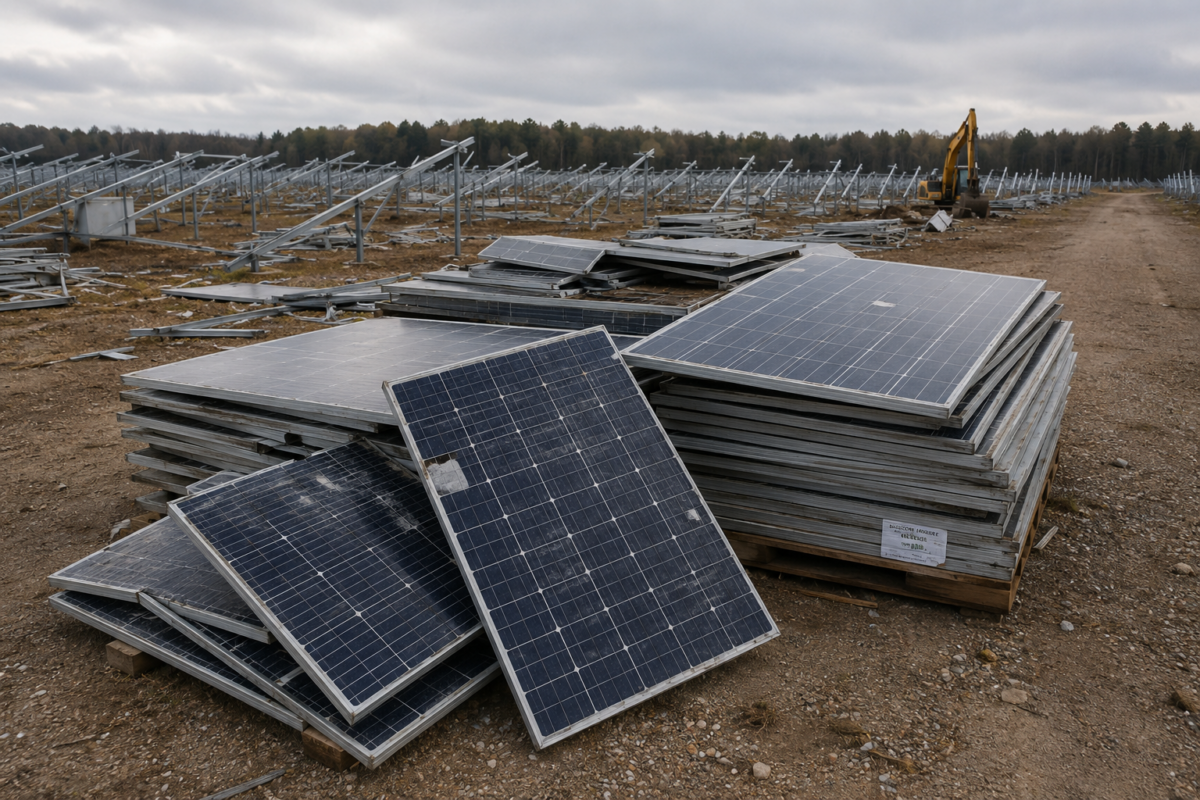
Researchers have developed a hydrogen peroxide-mediated low-temperature oxidative liquefaction process to recycle waste solar panels by selectively breaking down polymers into useful chemical feedstocks. The proposed method reduces energy consumption, eliminates hazardous solvents and minimizes landfill waste compared to traditional recycling techniques.
Researchers from Xi’an Jiaotong University in China have developed a new end-of-life (EoL) recycling process for solar panels that uses oxidative liquefaction (OL) at relatively low temperatures to leverage selective oxidative degradation chemistry.
“Oxidative liquefaction is an aqueous hydrogen peroxide (H₂O₂)-mediated thermochemical process previously applied to the recycling of composite wind turbine blades,” said researcher Xing Fu. “The environmental benefit comes from lower operating temperatures and the potential for process heat recovery from exothermic H₂O₂ decomposition and polymer oxidation reactions.”
The study used 250W silicon-based monocrystalline PV panels, which were cut into 1cm x 1cm chips and used as raw material. The experiments were carried out in a 510 ml stainless steel Parr reactor, using aqueous H202 as the oxidant. While the pressure and reaction time were kept constant at 32 bar N₂ and 90 minutes, three variables were investigated: temperature (210 C, 260 C and 310 C), H₂O₂ concentration (30%, 48% and 65%) and waste to liquid ratio (12.5%, 25% and 37.5%).
Before and after treatment, the PV waste and reaction products were characterized using proximal and ultimate analysis, SEM-EDS, FTIR spectroscopy and thermogravimetric analysis (TGA/DTG). After each reaction, solid and liquid products were separated by filtration. Solid residues were analyzed for polymer degradation, while liquid products were characterized by gas chromatography with flame ionization detection (GC-FID) to identify and quantify oxygenated carbon compounds (OCCs). Statistical optimization and model validation were then performed.
TGA/DTG results showed that EVA decomposes into two phases. Working at 210–310 °C allowed the researchers to focus on the first stage, which releases acetic acid and other useful intermediates, while avoiding the second stage at around 385 °C, in which the polymer backbone undergoes complete degradation and combustion. Response Surface Method (RSM) and ANOVA-based optimization identified the optimal operating conditions as 245 C, 32% H₂O₂ concentration and a waste to liquid ratio of 13%. Under these conditions, the process achieved a total polymer degradation of 88.4% and a yield of oxygen-containing carbon compounds of 52.8 mg per gram of PV waste.
“The normalized energy consumption under optimal conditions (1.95 kWh/kg PV waste) is 46-65% lower than comparable pyrolysis and supercritical delamination processes, mainly due to lower operating temperatures and partial recovery of exothermic heat from the decomposition of H₂O₂,” the academics said. “Preliminary ecological indicators show that OL reduces landfill load to approximately 11.6 wt% of PV input, eliminates the use of hazardous solvents and generates recoverable liquid chemical feedstocks.”
In conclusion, Fu noted that scale-up analysis identifies staged H₂O₂ injection, continuous plug-flow reactor design and heat integration as the key technical challenges for industrial implementation.
The new recycling technology was presented in “Oxidative liquefaction as a sustainable route for end-of-life photovoltaic panel recycling: process optimization, ecological indicators and scale-up assessment”, published in Materials contemporary communication.
This content is copyrighted and may not be reused. If you would like to collaborate with us and reuse some of our content, please contact: editors@pv-magazine.com.
