

An international research team has proposed using iron oxide and copper oxide to reduce the photovoltaic-thermal (PVT) temperature of solar panels. Their analysis showed that the two compounds were able to reduce the operating temperature of the panels by 23.49% and 34.58% respectively.
An international group of scientists proposed using copper oxide (CuO) and iron oxide (Fe2O3) nanofluids to reduce the operating temperatures of photovoltaic-thermal (PVT) systems.
“The present study provides an energy and exergy assessment for a PVT system taking into account the thermodynamic laws using CuO and Fe2O3 nanofluids in different volume fractions, circulated in a heat exchanger located at the back of the PV module has been installed,” the researchers said. The analysis was based on a 2D numerical model developed with MATLAB software.
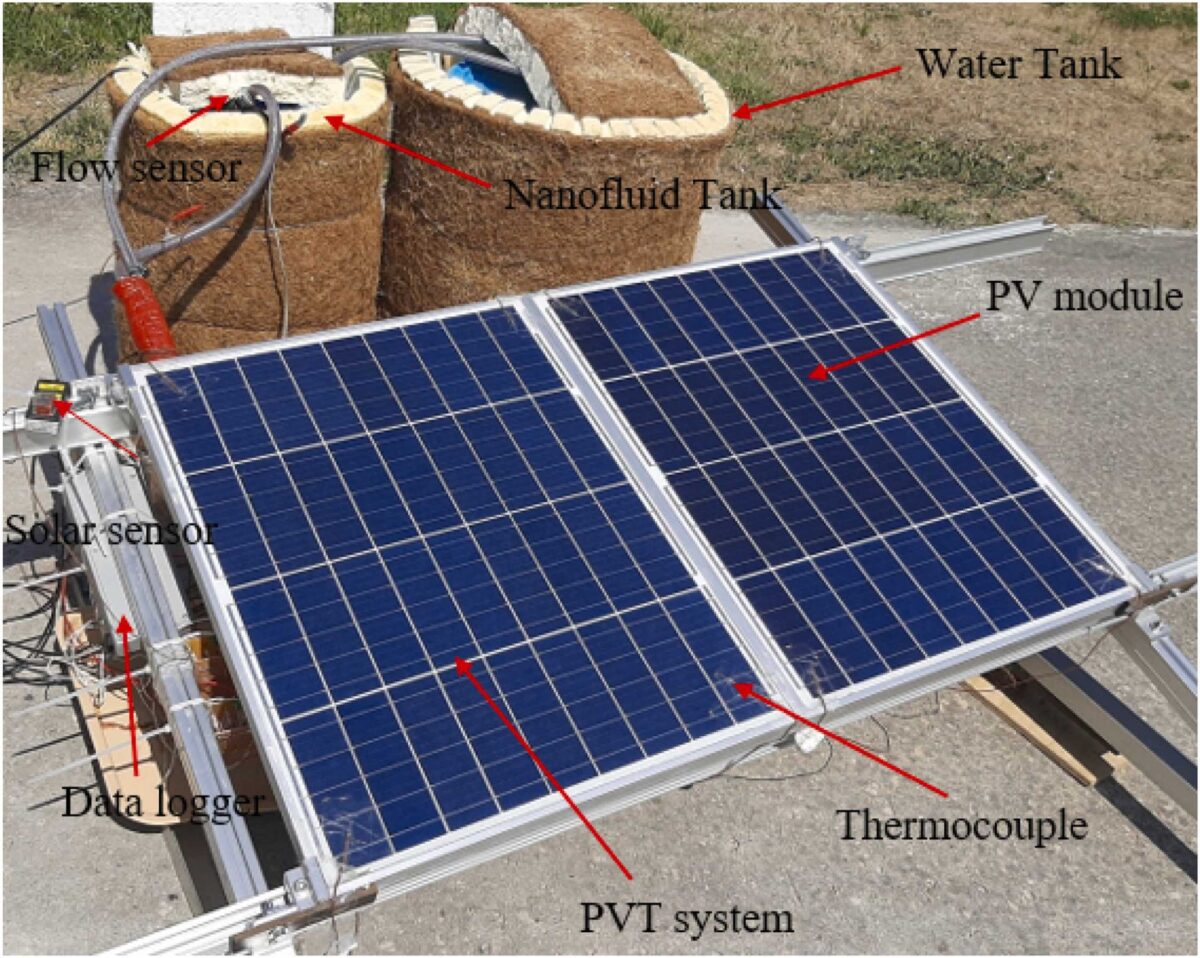
The experimental setup consisted of a 50 W PV module and a 50 W PVT module, based on a heat exchanger made of serpentine tubes placed on a copper absorbing plate. In between, the group used a thermal grease with high thermal conductivity and thickness, while covering the heat exchanger with an insulation layer. The back of the PVT was also covered with an aluminum sheet to minimize heat dissipation.
“A cooling water tank with a capacity of 35 liters is used to cool the outgoing nanofluid coming from the exhaust by circulating in a coil placed in the water tank to dissipate the temperature of the nanofluid,” the group said. “The PV module and the PVT systems were mounted on the upper roof-open part at a tilt angle of 14.8 degrees.”
Both the CuO and Fe2O3 were first synthesized and then added to deionized (DI) water to create the nanofluid. In both cases, the nanofluid contained CuO and Fe2O3 in volume fractions of 0.2% and 0.3%. The system was measured in the city of Miskolc, northeastern Hungary, from 8:30 a.m. to 3 p.m. The conditions and systems have been recreated in the numerical model for compression.
“A good agreement was observed between numerical calculations and experimental measurements, with minor deviations due to the uncertainties of measurements and assumptions of the numerical model,” they said. “The successfully synthesized Fe2O3 NRs and Cuo NPs improved the effectiveness of nanofluids, positively decreasing the temperature of PV cells and improving the energy and exergy.”
For both nanofluids, the best results were obtained at volume fractions of 0.3%. CuO could reduce the temperature of the PV cells by 23.49% and Fe2O3 by 34.58%. They also increased electrical efficiency by approximately 9.21% and 10.30% respectively. “The PV temperature was decreased as the suspension of the nanomaterial in the host fluid increased, increasing the electrical exergy efficiency by approximately 9.2% and 11.18% when cooled with CuO and Fe2O3 nanofluids, respectively, more than when cooling with water, which reached 6.12%. they emphasized.
“Circulating CuO and Fe2O3 nanofluids in the heat exchanger has increased the temperature absorption from the back of the PV module, increasing the thermal efficiency by approximately 38.92% and 43.3%, while cooling by DI water only increased returns by 23%,” academics concluded. “Cooling by nanofluids has affected energy losses and entropy generation more than cooling by water. The highest increase in exergy destruction was 26.06%, while entropy generation was reduced by 68.15% when cooled with Fe2O3 nanofluid. In contrast, cooling by CuO nanofluid increased exergy destruction and reduced entropy generation by 15.43% and 51.72%.”
The study findings were presented in the article “Experimental and numerical investigation of a photovoltaic/thermal system cooled by metal oxide nanofluids”, published in the Alexandria Engineering Journal. The group included academics from Hungary’s Miskolc University, Iraq’s Southern Technical University, Misan University and the University of Oil and Gas.
This content is copyrighted and may not be reused. If you would like to collaborate with us and reuse some of our content, please contact: editors@pv-magazine.com.
