
Close Menu
  • News
  • Industry
  • Solar Panels
  • Commercial
  • Residential
  • Finance
  • Technology
  • Carbon Credit
  • More
    • Policy
    • Energy Storage
    • Utility
    • Cummunity
What's Hot

Dutch solar owners asked to switch off during peak periods to ease the distribution crisis

June 7, 2026

The hydrogen flow: Toyota demonstrates its racing prototype on liquid hydrogen

June 7, 2026

Era of electrification exposing Australia’s weakest link

June 6, 2026
Facebook X (Twitter) Instagram
Solar Energy News
Sunday, June 7
  • News
  • Industry
  • Solar Panels
  • Commercial
  • Residential
  • Finance
  • Technology
  • Carbon Credit
  • More
    • Policy
    • Energy Storage
    • Utility
    • Cummunity
Solar Energy News
Home - News - Research shows that solar energy can meet the British demand without loss of agricultural land
News

Research shows that solar energy can meet the British demand without loss of agricultural land

solarenergyBy solarenergyFebruary 28, 2025No Comments3 Mins Read
Facebook Twitter Pinterest LinkedIn Tumblr Email
Share
Facebook Twitter LinkedIn Pinterest Email
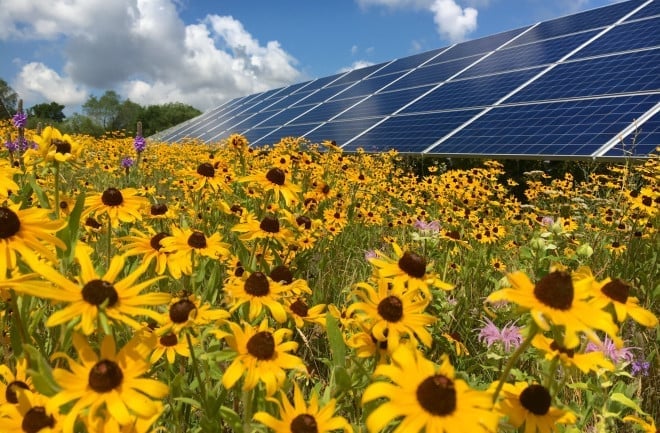
The research shows that a large part of the UK is ideal for Agri-PV. Image: Solar Energy UK.

A new study from the University of Sheffield has shown that the combining of solar panels with agricultural practices can enable the UK to achieve its solar energy goals without sacrificing agricultural land.

The research paper, which is published in the Academic Journal Science Direct, shows that well -managed Agrivoltaics (AGRI -PV) projects can support the simultaneous production of crops, cattle and renewable energy. Moreover, the research shows that Agri-PV has such a high coverage potential in the UK that it could only help to achieve British goals for solar energy, in which about 55.5% of the British country appears to be suitable for the use of Agri-PV.

The study investigated various regions of the UK to investigate, which would be most suitable for Agri-PV implementation, and specially identified Cambridgeshire, Essex, Lincolnshire and the wider East and southeastern regions of England. These regions were particularly emphasized as the ideal for Agri-PV setups due to their high availability of flat country, strong grid connectivity and the prevalence of solar radiation.

The aim of this research is to fill in important knowledge gaps and to inform policy debates in land use by promoting multifunctional land use, and to encourage further research to guide the development of Agri-PV in the UK. Although Agri-PV is common in a large part of Europe, where it has been shown that leafy vegetables, potatoes, grain crops and soft fruit are successfully growing in Agri-PV settings.

In addition, the report emphasizes the work of earlier studies that brands that Agri-PV can in fact be considerably beneficial for crops, because the shadow of the PV panels can minimize the impact of drought and lower water use.

See also  Growatt introduces high-voltage battery for residential, small C&I solar energy – SPE

Co-author Dr. Richard Randle-Boggis, who conducted Agrivoltaics Research at the University of Sheffield and is now research scientist at Sintef, said: “Research into Agrivoltaïschens has been extended on mainland Europe, but very little has been done in the VK.

“Our next step should be field experiments to test the performance of the systems, to investigate different designs with different crops and better understand the perspectives of local communities and other stakeholders.

“The loss of agricultural land is usually an important reason why communities are opposed to the development of Solar Park in their local areas. Our research takes a leading step to show where solar parks can be developed in addition to agricultural activities, so that agricultural land is not lost. “

Professor Sue Hartley, vice-president for research and innovation at the University of Sheffield that co-author of the study, added: “The government and solar developers have ambitious plans for the expansion of solar farms, but this risk the loss of agricultural country needs food production in a time in which global food-automatic.

“Agrivoltaic technology is a potential path from this dilemma. It enables us to use the same country area for both food and the production of clean energy, which tackles part of the criticism of solar farms. This technology is regularly used in many parts of the world, including areas such as Scandinavia with less sunlight than the UK, but has not yet been accepted here.

“Our research identifies the areas in the UK where this technology can be used most effectively, both to reduce conflicts in land use and to deliver the energy needs of the UK.”

See also  Brookfield is exploring the sale of solar developer X-Elio – SPE

Source link

agricultural British demand Energy Land loss meet Research shows solar
Share. Facebook Twitter Pinterest LinkedIn Tumblr Email
solarenergy
  • Website

Related Posts

Dutch solar owners asked to switch off during peak periods to ease the distribution crisis

June 7, 2026

Britain’s next energy dependency is already taking shape

June 5, 2026

Letter from China’s PV Industry: Arctech wins 2.1 GW solar deal

June 5, 2026
Leave A Reply Cancel Reply

Don't Miss
Solar Industry

RenewSys launches TOPCon solar cells at REI 2025

By solarenergyNovember 14, 20250

RenewSys India unveiled its M10R n-type tunnel oxide passivated contact (TOPCon) solar cells at the…

Growatt launches C&I storage system with 95% discharge depth – SPE

May 13, 2026

Bifacial PV thermal solar panels for jet impingement cooling

October 31, 2024

New Mexico is offering $70 million in grants for grid updates to accommodate more renewable energy sources

October 11, 2025
Stay In Touch
  • Facebook
  • Twitter
  • Pinterest
  • Instagram
  • YouTube
  • Vimeo
Our Picks

Dutch solar owners asked to switch off during peak periods to ease the distribution crisis

June 7, 2026

The hydrogen flow: Toyota demonstrates its racing prototype on liquid hydrogen

June 7, 2026

Era of electrification exposing Australia’s weakest link

June 6, 2026

‘Come out from behind your screen, our industry is ultimately about people’

June 6, 2026
Our Picks

Dutch solar owners asked to switch off during peak periods to ease the distribution crisis

June 7, 2026

The hydrogen flow: Toyota demonstrates its racing prototype on liquid hydrogen

June 7, 2026

Era of electrification exposing Australia’s weakest link

June 6, 2026
About
About

Stay updated with the latest in solar energy. Discover innovations, trends, policies, and market insights driving the future of sustainable power worldwide.

Subscribe to Updates

Get the latest creative news and updates about Solar industry directly in your inbox!

Facebook X (Twitter) Instagram Pinterest
  • Contact
  • Privacy Policy
  • Terms & Conditions
© 2026 Tsolarenergynews.co - All rights reserved.

Type above and press Enter to search. Press Esc to cancel.