

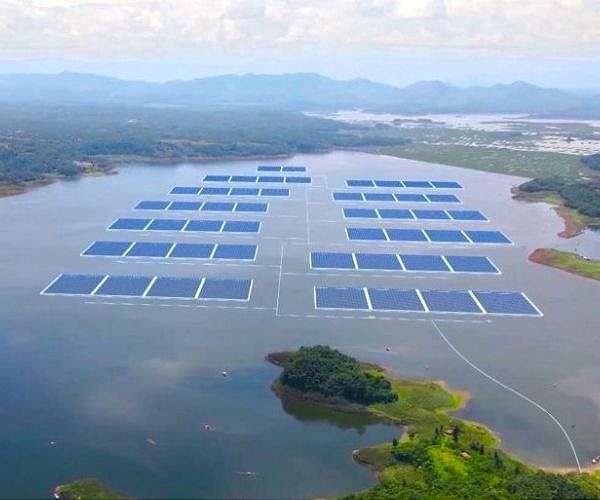
Research shows that some countries can meet their electricity needs with floating solar panels
Floating photovoltaic solar panels (FPV) could meet all the electricity needs of some countries, according to new research. The study by Bangor and Lancaster Universities and the UK Center for Ecology and Hydrology assessed the global potential for low-carbon floating solar panels. Researchers calculated the daily electrical output of FPV at nearly 68,000 lakes and reservoirs worldwide, using climate data for each location.
The study focused on lakes and reservoirs likely to support floating solar technology, located within 10 km of a population center, not in protected areas, and not drying or freezing for more than six months per year. Researchers based their calculations on FPV covering 10% of the area, up to 30 km.
The potential annual electricity generation from FPV on these lakes is 1302 terawatt hours (TWh), approximately four times the total annual electricity demand in Great Britain. The findings have been published in Nature Water.
FPV systems offer several advantages over land-based solar installations, including freeing up land for other uses and keeping panels cooler for better efficiency. There is also evidence of additional environmental benefits, such as reducing water evaporation and limiting algae blooms. However, further research is needed on the overall environmental impact of FPV, and decisions about deployment should take into account the intended function of water bodies and the potential ecological impact.
Lead author Dr. Iestyn Woolway from Bangor University said: “We still don’t know exactly how floating panels could impact the ecosystem within a natural lake, under different conditions and in different locations. But the potential gains in energy generation from FPV are clear, so we should establish that research so that this technology can be safely deployed. We chose 10% of the surface area of a lake as a likely safe deployment level, but that may need to be reduced in some situations, or higher in others.”
The research shows that five countries, including Papua New Guinea, Ethiopia and Rwanda, could meet their entire electricity needs with FPV. Others, such as Bolivia and Tonga, could meet 87% and 92% of their demand. Many countries, especially in Africa, the Caribbean, South America and Central Asia, could meet 40% to 70% of their electricity needs through FPV. In Europe, Finland could meet 17% and Denmark 7% of their demand.
Britain could generate 2.7 TWh from FPV annually, enough to power around a million homes. Britain’s largest FPV installation is a 6.3 MW floating solar farm on the Queen Elizabeth II Reservoir near London.
Dr. Woolway added: “Even with the criteria we set to create a realistic scenario for FPV deployment, there are benefits to be had across the board, especially in lower-income countries with lots of sunshine, but also in Northern European countries. The criteria we chose were based on obvious exclusions, such as lakes in protected areas, but also on what could reduce the costs and risks of deployment.”
Co-author Professor Alona Armstrong from Lancaster University said: “Our work shows that there is great potential for FPV around the world. But implementation must be strategic, taking into account the implications for energy security, nature and society, as well as for Net Zero.”
The research is funded by the Natural Environment Research Council, part of UK Research and Innovation.
Research report:Decarbonization potential of floating solar photovoltaics on lakes worldwide
