

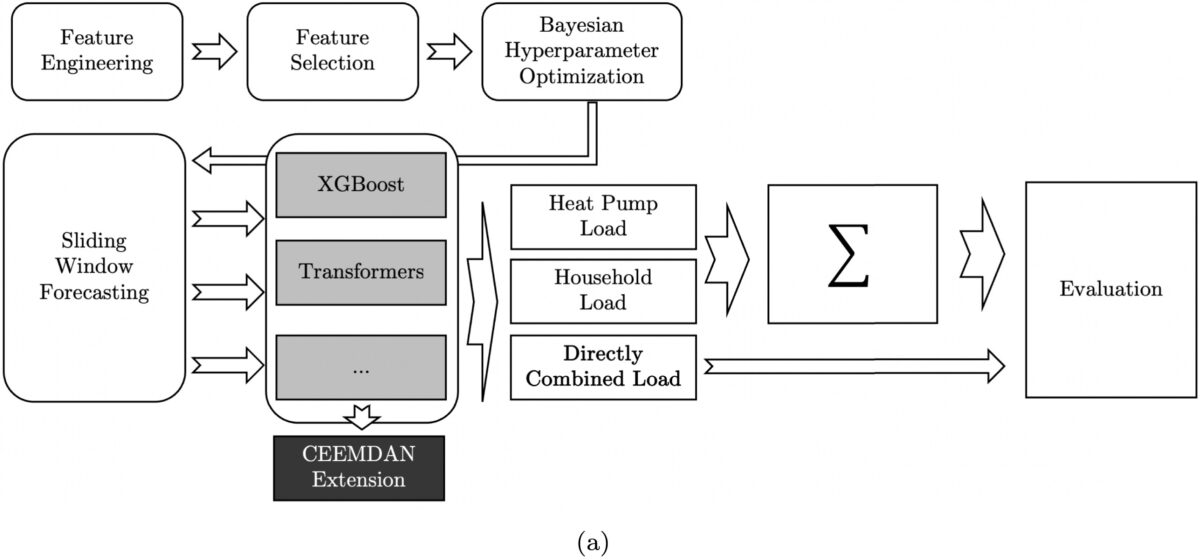
New research from Germany and the US has analyzed the impact of heat pump (HP) integration on the ability of day-ahead load forecasting in energy communities. Using different models, the scientists also investigated whether HP loads should be predicted separately from the rest of the household or both together.
An international research group has investigated the impact of heat pumps on load forecasting for the energy community and found that the use of so-called transformer models improves forecast quality.
“Traditional load patterns will change in many countries as the heating sector transitions to heat pumps,” the academics explained. “This development has serious consequences for energy community operators. First, it is unclear whether the same forecasting methods perform well for traditional household loads and heat pump loads. Second, the potential impact of aggregation level on energy community load forecasts has not been explored.”
The group used prediction models based on machine learning techniques, such as random forests and XGBoost, as well as the recurrent neural network technique of long-short-term memory networks (LSTMs). In addition, it evaluated the new neural network architecture of transformers.
In addition to given load and perfect weather data, the academics have proposed additional features that may need to be implemented in any forecast: the type of day, cyclical calendar features, the moving average of the apparent temperature, the average load at the same time step and previous loads. For each prediction case and prediction method, the group used the Bayesian optimization model to identify the most relevant features.
Furthermore, the researchers used the Full Empirical Mode Decomposition with Adaptive Noise (CEEMDAN) method as an extension of each prediction technique. “An increasing number of load forecasting studies apply decomposition techniques to improve model performance,” they explained. “The CEEMDAN algorithm has several advantages over alternative decomposition methods: it shows improved handling of the mode mixing problem, it is more robust against noise and is also non-stationary.”
Image: Karlsruhe Institute of Technology, Applied Energy, CC BY 4.0 DEED
All forecasting models, extensions and aggregation scenarios were applied to a high-quality dataset of household loads in an energy community in Hamelin, Germany. The dataset includes measurements of active and reactive power, voltage and current from 38 households equipped with water-to-water HPs and an additional heating rod for backup heating. According to the researchers, the installation of HPs in this case changed the peak load from 20.1 kW to 80.1 kW.
The model is trained and analyzed to predict loads at the level of low-voltage transformers, to which several households of an energy community are connected. Data from 2019 was used for training and testing hyperparameter selection, while data from 2020 was used for actually benchmarking the different methods.
The results show that the best performing prediction methods change after the installation of heat pumps. Although random forests or
“The quality of the energy community’s day-ahead load forecast cannot be significantly improved by obtaining separate heat pump load measurements, which would represent an additional effort for the energy community or distribution system operators,” the results further showed. “Transformer-based models also provide the best performance in a real-world case of battery energy storage systems (BESS) with peak reduction for the heat pump energy community studied.”
The research was presented in the article “The impact of heat pumps on day-ahead load forecasting of the energy community,” published in Applied energy.
Researchers from Germany’s Karlsruhe Institute of Technology and Purdue University in Indiana conducted the study. “We encourage researchers to use our dataset, results and evaluation pipeline, which we publish open-source, to benchmark new methods against them to advance accurate forecasting techniques for many heat pump energy communities and to apply our methodology to alternative datasets, they emphasized.
This content is copyrighted and may not be reused. If you would like to collaborate with us and reuse some of our content, please contact: editors@pv-magazine.com.
