

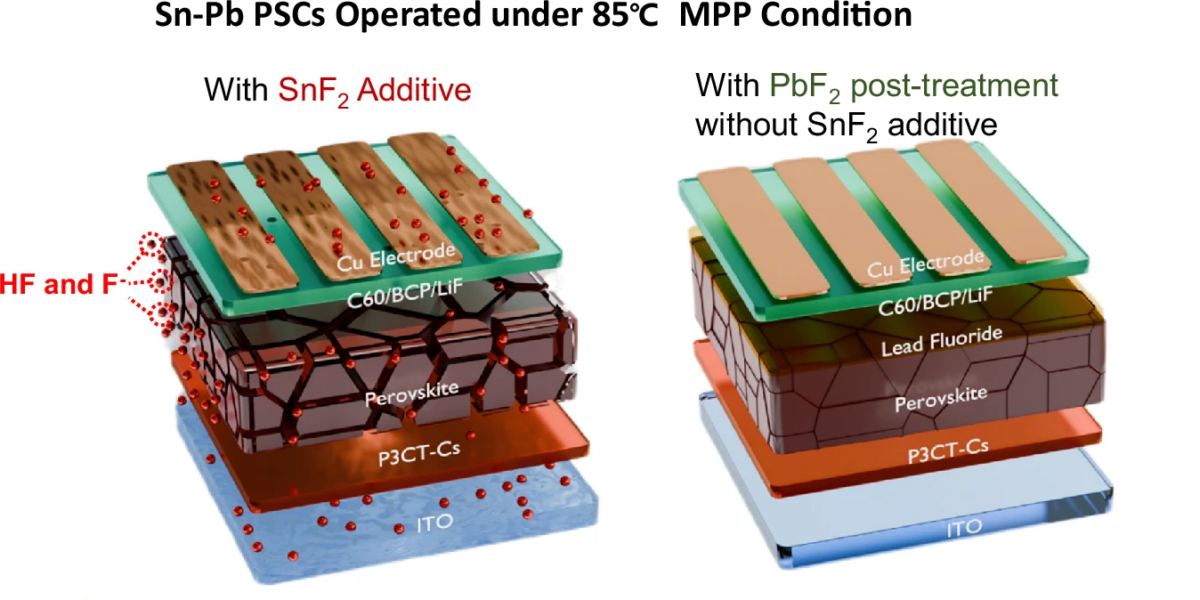
A Chinese-Swedish research team has improved the performance of tin-lead-perovskite solar cells by tweaking additives and post-treatment processes. The device also showed improved stability and retained 60% of its initial efficiency after 550 hours at 85°C under maximum power point conditions.
Researchers from East China Normal University and Sweden’s Linköping University have developed an alternative passivation method for tin-lead (Sn-Pb) perovskite solar cells that improves both efficiency and stability by avoiding the use of tin fluoride (SnF₂). The approach combines a lead fluoride (PbF₂) after-treatment with lead powder in the precursor.
“We have identified and elucidated a previously unknown factor driving the photothermal instability of Sn-Pb perovskite solar cells,” said Wenxiao Zhang, co-first and co-corresponding author of the study. pv magazineexplaining that the study showed that SnF2 “Parasitic reactions” cause perovskite breakdown and degradation of functional device layers.
“While the significantly lower stability of Sn-Pb perovskites compared to their Pb-only counterparts is usually attributed solely to the oxidation of stannous ions (Sn²⁺), antioxidant strategies alone have failed to provide a substantial improvement in photothermal durability. This work pinpoints the underlying cause and proposes an effective alternative,” said Zhang.
“To prevent the adverse effects of SnF2 we replace SnF for stability and hole transport2 additive with lead powders, known for its antioxidant and crystallization regulating effects, as reported in our previous work, to remove Sn4+ of the precursor, combined with a PbF2 post-treatment to passivate surface defects,” he continued.
The Sn-Pb test cells were 0.09 cm2 in size. The basic stack was as follows: indium tin oxide (ITO) substrate, P3CT-Cs layer, perovskite, lead fluoride, electron transport layer (ETL) based on buckminster fullerene (C60), bathocuproin (BCP) and insulating lithium fluoride (LiF) and copper (Cu) contacts.
The strategy enabled the efficiency of the SnF2-free tin-lead-perovskite solar cell reaches 24.07% compared to 16.43% of the control device. Regarding photothermal stability, the cells without the SnF2 The additive retained 60% of its initial efficiency after continuous use at 85°C under MPP (Maximum Power Point) conditions for 550 hours.
The negative effect of SnF2e was clear during testing. For example, the researchers noted that both Cu and ITO electrodes showed reactions “even at room temperature or in the absence of light,” indicating the “corrodibility of migrated ions and reaction products.”
The manufacturing requires precision, but the process is simple, according to the scientists. “Tin-containing perovskites require a carefully controlled atmosphere with extremely low oxygen levels, and the film formation temperature along with associated processing parameters must be precisely tuned while using high-purity SnI₂. Yet device fabrication remains simple,” said Zhang.
The scientists concluded that the work has implications for overcoming the stability bottlenecks of Sn-Pb single-junction and all-perovskite tandem solar cells. Their work is described in “A tin fluoride-free, efficient and sustainable tin-lead-perovskite solar cell”, published by communication about nature.
“We are working on the simultaneous efficiency and stability improvements of all-perovskite tandem solar cells and tin-lead perovskite solar cells,” said Zhang, referring to the future direction of the team’s work.
This content is copyrighted and may not be reused. If you would like to collaborate with us and reuse some of our content, please contact: editors@pv-magazine.com.
