Researchers measured the power loss of a 50 W panel stationed in a 30 meter wave tank. Based on ten different scenarios, they were able to create an empirical equation for predicting power loss, with the highest loss measured at 12.7%.
Scientists from the United Kingdom and Australia have built an experimental setup to measure the loss of solar energy due to wave movements when deploying floating PV (FPV) panels. Based on their results, they were also able to derive an empirical equation showing that the power loss is predictable via the rotation amplitude.
“Solar panels undergo periodic movements with the waves, causing the tilt angle to constantly change. The variation in tilt angle is a suboptimal process and leads to a loss of efficiency in energy utilization,” the academics said. “While the mismatch phenomenon is known to exist, there is a lack of scientific analysis on how the wave-induced motions of FPV relate to energy efficiency.”
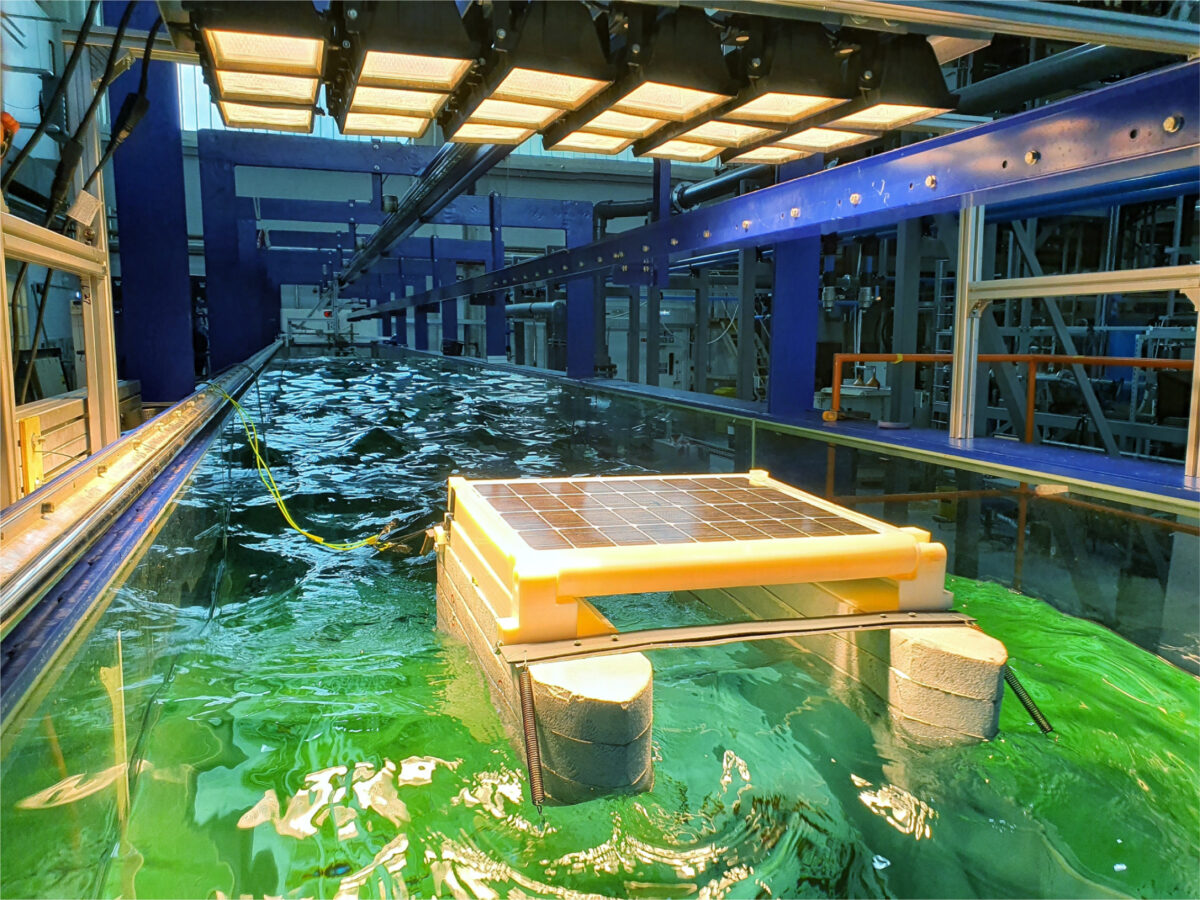
To investigate this phenomenon, the team installed 21 500 W halogen floodlights on top of a wave tank. It was 30 m long and 1.5 m wide and was filled with fresh water to a depth of 1.5 m, with flaps on one side and a beach on the other. A 50W monocrystalline PV panel was then placed on a catamaran-shaped float with two hulls made of extruded polystyrene (XPS) material. A four-point mooring approach was instituted to limit panel drift.
For reference, a calm water environment was measured, in addition to ten different wave scenarios. These differed in their wave amplitude, wavelength and wave frequency. According to their measurement, the lowest power loss of 1.5% was measured under a wave amplitude of 0.025 m, a wavelength of 1.561 m and a wave frequency of 1 Hz. On the other hand, the most severe power loss of 12.7% was recorded at a wave amplitude of 0.05 m, a wavelength of 1.730 m and a wave frequency of 0.95 Hz. In the former case the tone amplitude was 2.9◦, and in the latter case it was 6.7◦.
Image: Cranfield University, Ocean Engineering, CC BY 4.0
“It should be noted that the wave conditions tested were limited by the size of the facility and are thus generally smaller than those in real seas, meaning that the slope angles in real life will be larger and greater energy losses are expected” , the team said. “One way around this is to use the derived empirical equation, which can be introduced with conditions that have not been tested.”
According to the researchers, it was discovered that the value of the power loss can be predicted by the sin function of the pitch amplitude. “In practice, for an FPV system with known power on calm water, experiments/simulations/analysis can be used to determine the rotational amplitude in waves, and then the power loss due to the dominating wave environment can be predicted by the empirical equation , where power is estimated based on sea conditions,” they pointed out.
As a solution to the power loss caused by waves, the group has also proposed the application of attaching breakwaters to a floating solar farm. “The additional construction costs would not be significant with respect to calm water FPVs because the main additional component is the breakwater in the barrier, i.e. the costs do not increase proportionately with the surface coverage,” they emphasized.
The results are presented in “Drifting loss of solar energy due to motions caused by ocean waves: an experimental study”, published in Ocean engineering. Researchers from Britain’s Cranfield University, University College London and Australia’s University of New South Wales conducted the study.
This content is copyrighted and may not be reused. If you would like to collaborate with us and reuse some of our content, please contact: editors@pv-magazine.com.
Popular content