

Scientists develop customizable perovskite waveguides with edge laser capabilities
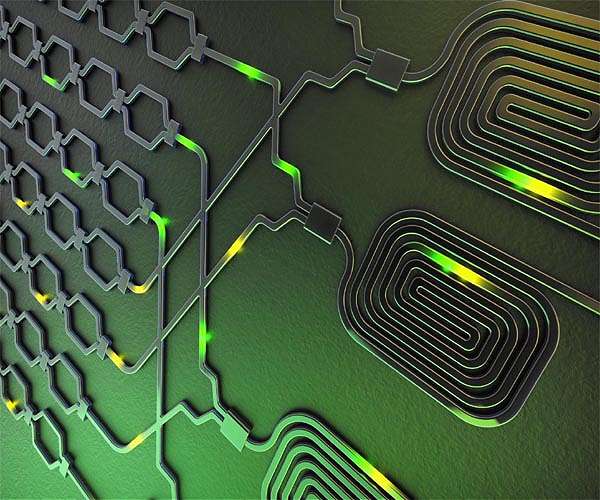
Researchers from the University of Warsaw’s Faculty of Physics, in collaboration with institutions from Poland, Italy, Iceland and Australia, have successfully created perovskite crystals with precise shapes suitable for non-linear photonics. These structures, including waveguides, couplers, splitters, and modulators, are notable for their ability to operate at room temperature and can significantly impact both classical and quantum signal processing. The findings, published in ‘Nature Materials’, highlight the edge-welding effect of the crystals, which is associated with the formation of exciton-polariton condensates – a state in which quasiparticles exhibit both light and matter properties.
‘Perovskites show great versatility: from polycrystalline layers, nano- and microcrystals to bulk crystals. They can be used in various applications, from solar cells to lasers. Some, like the CsPbBr3 (cesium-lead-bromide) material we used, are also ideal semiconductors for optical applications due to their high exciton binding energy and oscillator strength,” says Professor Barbara Pietka from the University of Warsaw, highlighting the materials’ potential for improved light interactions and reduced energy requirements for nonlinear light amplification.
The team used scalable synthesis techniques to produce perovskite crystals with precise dimensions, using a microfluidic approach to grow the crystals in polymer molds. By precisely controlling solution concentration and growth temperatures and using nearly atomically smooth gallium arsenide templates, the researchers were able to produce high-quality single crystals that could be formed into different shapes, making them compatible with existing photonic devices.
“These crystals, due to their high quality, form Fabry-Perot type resonators on their walls, allowing strong nonlinear effects to be observed without the need for external Bragg mirrors,” explains Mateusz Kedziora, a PhD student and the first author of the article. . This quality opens up new possibilities for using these materials in integrated photonic circuits.
A major achievement of the research is the demonstration of polaritonic laser radiation from the edges and corners of the microwires. According to Professor Pietka: “The wavelength of the emitted light is modified by the effects of strong light-matter interactions, indicating that the emission results from the formation of a non-equilibrium Bose-Einstein condensate of exciton-polaritons. ” The research shows that this lasing action is not conventional, but instead arises from a condensate in a strong light-matter coupling regime, as confirmed by far-field photoluminescence and angle-resolved spectroscopy.
Dr. Helgi Sigurosson from the University of Iceland and the Faculty of Physics at the University of Warsaw added: “The high coherence between different signals of the emitted light from the edges and corners, confirmed in far-field photoluminescence and angle-resolved spectroscopy, indicates the formation of a coherent, macroscopically extended polariton condensate.” The observed blue shift, an increase in energy with increasing population of a given mode, further confirms the nonlinear effects and interactions within the condensate.
The simulations of the research team, led by Dr. Andrzej Opala and Prof. Tomasz Czyszanowski, revealed how natural light mode resonators and crystal edge scattering influence emission characteristics. Their findings could enable the development of compact ‘on-chip’ systems for both classical and quantum computers, integrating nanolasers with waveguides on a single chip. “We predict that our discoveries will open the door to future devices that can operate at the level of single photons, integrating nanolasers with waveguides and other elements on a single chip,” said Prof. Michal Matuszewski, who explained the importance of this breakthrough underlined.
These advances could play a crucial role in the further development of optical technologies, potentially integrating perovskite crystals into nonlinear photonic systems that function at room temperature. The compatibility of these structures with existing silicon technology also increases their commercial potential.
Research report:Pre-designed perovskite crystal waveguides for exciton-polariton condensation and edge lasing at room temperature
