

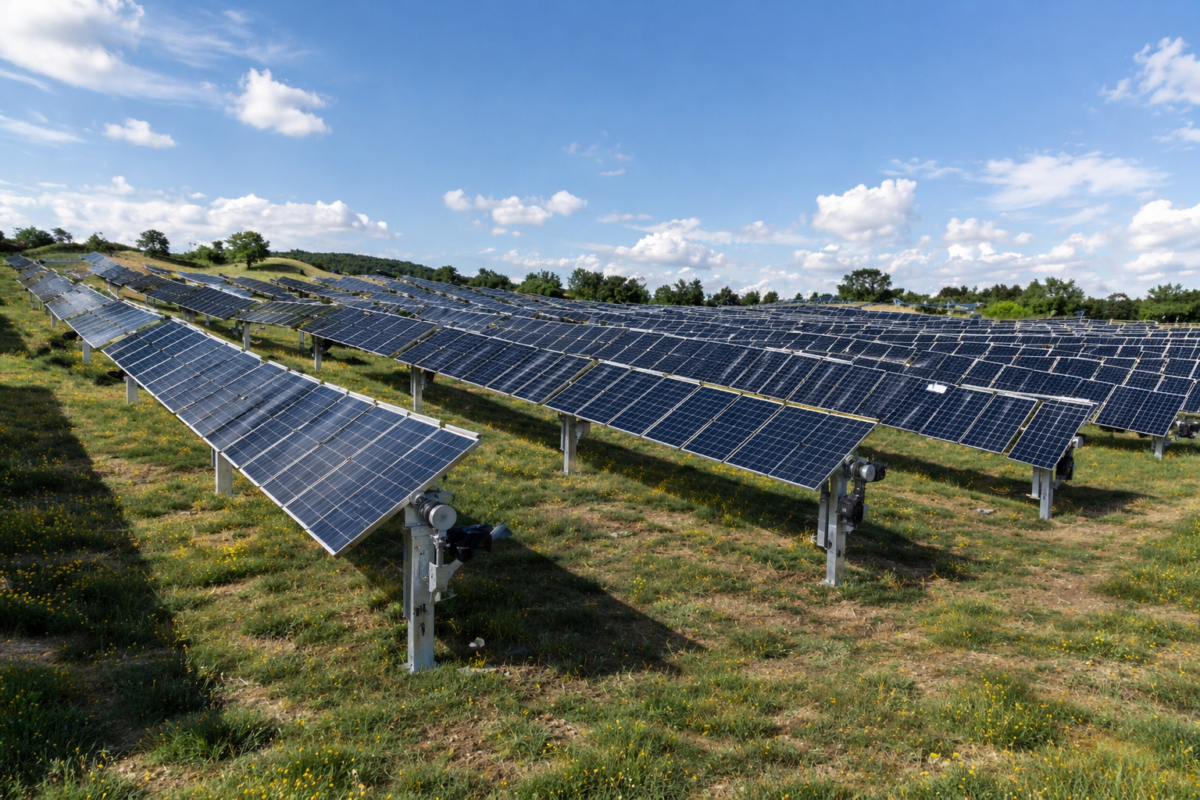
Researchers in Spain have identified a new source of underperformance in utility-scale PV installations, caused by “suboptimal backtracking” on slightly uneven terrain. The study shows that real tracker control systems deviate from ideal flat terrain assumptions, reducing radiation capture and causing measurable energy losses compared to simulations.
Researchers from the Polytechnic University of Madrid claim to have identified a new source of underperformance in ground-mounted PV installations using solar trackers.
“We started this work after receiving several questions at IES-UPM wondering why the radiation gain of trackers in utility-scale PV installations was lower than estimated during the design phase,” said the corresponding author. Juan Santamaría Sancho told it pv magazine. “To address this issue, we analyzed real operational data from more than 7,000 trackers in seven utility-scale PV installations. The results show that tracker angles are ignored to avoid shadow effects caused by slightly undulating terrain, leading to a lower than expected increase in tracking irradiance because actual operating angles are more tilted than those assumed in standard simulations.”
“This behavior reveals a new category of energy losses, defined as suboptimal backtracking losses, which explain part of the gap between simulated and actual energy yields. We quantify these losses using our PV simulation tool SISIFO, finding differences of up to 2% in tracking-related radiation gains between standard modeled expectations and actual operation,” he continued.
Backtracking in PV installations is a control strategy used in solar tracking systems to reduce shading between adjacent rows of panels. Instead of always pointing directly at the sun, trackers tilt back slightly when the sun is low to prevent one row from casting shadows on the other. This helps maximize overall energy yield throughout the plant, especially in dense layouts or in the early morning and late afternoon.
The scientists explained that under assumptions of flat terrain, shadow is precisely avoided and the energy yield matches the simulation results, while real PV installations often exhibit small height differences between tracker rows due to uneven terrain. These deviations break the coplanarity assumption and introduce unexpected shadows during retracing when ideal angles are used.
Image: Polytechnic University of Madrid, Renewable Energy, CC BY 4.0
To prevent this, tracker controllers apply an overcorrection, where the tilt is slightly reduced to eliminate shadows between the rows. This overcorrection leads to visible ground illumination patterns, indicating lost radiation that is not captured by the solar panels. Such effects are particularly evident during backtracking periods, in both morning and afternoon transitions, with field observations confirming that this phenomenon is absent during the afternoon, when trackers track the sun directly.
“Standard performance indicators such as the performance ratio do not capture these losses because they rely on assumptions about in-plane irradiance,” the scientists explained. “As a result, the discrepancy between the simulated and actual energy yield becomes difficult to detect with conventional measurement data.”
The researchers compared experimentally measured tracker rotation angles from SCADA systems of the PV installations with theoretical values calculated for perfectly flat terrain under ideal backtracking conditions. All installations analyzed used single-axis tracking systems installed in nominally horizontal locations.
Operational data showed deviations from simulated behavior. These deviations were determined by imperfection correction strategies embedded in tracker control algorithms and inherent tracking delays or misalignments. In addition, time series data for representative trackers were analyzed and compared with several modeled backtracking correction approaches, identifying the best-fitting correction model for each PV installation by minimizing deviations between measured and simulated angles.
“The results showed that even plants on flat terrain show systematic angular changes during return, confirming the presence of hidden correction strategies in real controllers,” said Santamaría Sancho. “Additional simulations using SISIFO indicate that including measured or corrected angles significantly improves the agreement with real energy production compared to idealized assumptions.”
The analysis also showed that annual losses due to tracking-related effects can exceed 5% compared to ideal simulations without operational constraints. Overall, the results showed that the behavior of the real tracker systematically deviates from the ideal backtracking models due to practical control adjustments. These deviations have a measurable impact on radiation capture and help explain some of the gap between simulated and actual PV performance.
“An examination of tracker rotation angle data from systems supplied by different manufacturers and operating under different configurations in seven real PV installations, spread over five geographical regions with a total capacity of approximately 1 GW, showed that the problem arises from simulations that typically assume perfectly flat terrain, while actual locations exhibit varying levels of ground irregularities,” the researcher said.
“Importantly, these losses are particularly valuable from an economic perspective because they occur during periods without restrictions and when energy prices tend to be higher,” the scientists concluded. “This makes even apparently small deviations of 1% to 3% in the captured radiation significant in terms of turnover”
Their findings are available in the study “Modeling energy losses due to overridden backtracking in utility-scale photovoltaic installations on gently undulating terrain: implementation in the SISIFO pre-performance assessment tool”, published in Renewable energy.
This content is copyrighted and may not be reused. If you would like to collaborate with us and reuse some of our content, please contact: editors@pv-magazine.com.
Popular content

