

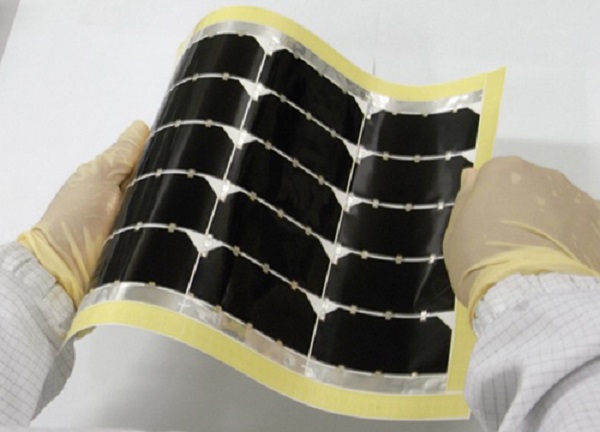
The Japanese technology company offers three types of space-grade composite solar cell designs for satellites and spacecraft.
Japan-based technology company Sharp Corporation offers a range of space-qualified composite solar cells for use in low Earth orbit (LEO) satellites and other spacecraft. The company recently showcased its space-grade PV devices at Space Tech Expo Europe 2025, a space industry trade show and conference in Bremen, Germany.
“The company has more than fifty years of experience in the development and research of aerospace products,” a Sharp spokesperson said pv magazine. It now offers a thin, plate-shaped solar panel that encases its high-efficiency composite triple-junction cells for space applications.
Such panels, developed and manufactured by Sharp, are lightweight and flexible, yet robust and, according to the company, suitable for mounting on curved surfaces. The modules were used last year on the Japan Aerospace Exploration Agency (JAXA) Smart Lander for Investigating Moon (SLIM) probe, which landed on the lunar surface in January 2024.
“Even after the moon landing, the solar panel continued to provide the power needed to communicate with Earth for months, demonstrating reliable performance under harsh conditions,” the company said in a statement.
Sharp also offers a glass plate panel for its composite solar cells, made of protective, radiation-resistant glass. The design is lightweight and offers “superior flexibility,” making it suitable for long-term missions such as planetary exploration and deep space exploration.
A third variant is a solar cell construction integrated into a cover glass, called cell-interconnect-coverglass (CiC), which attaches the protective cover glass to each solar cell. It is based on Sharp’s “unique internal wiring technology” that enables the use of CiC thin-film composite solar cells despite their thinness.
The company has a wide range of space-qualified cell technologies. The standard triple junction inverted metamorphic solar cells have an efficiency of 31%. The standard triple-junction compound space cells are based on germanium (Ge) and have an efficiency of 28.7%. The space-qualified silicon products have an efficiency of 17.4%.
Sharp also confirmed recent media reports of its plans to leverage its manufacturing expertise in organic light-emitting diodes (OLED) to develop perovskite solar PV products for a range of applications.
In February this year, Sharp announced ahead of a PV Expo 2025 event in Japan that it was developing highly efficient perovskite-silicon tandem solar cells for practical applications such as “building rooftops with limited installation space, mobile devices, automotive and powering digital signage.”
This content is copyrighted and may not be reused. If you would like to collaborate with us and reuse some of our content, please contact: editors@pv-magazine.com.
