

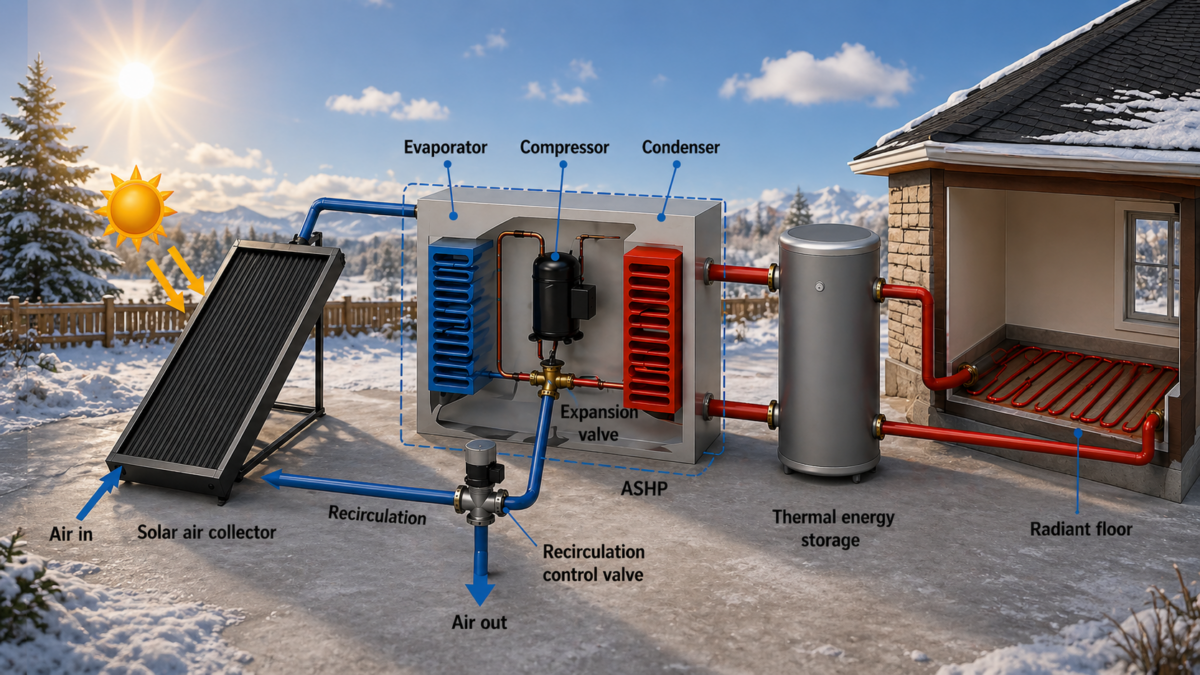
Researchers in Canada designed an air source heat pump integrated with an air-based solar collector and underfloor heating for cold climates, demonstrating that the proposed system configuration could improve the coefficient of performance from 2–4 to 2–6 and significantly reduce annual energy consumption.
Researchers from the University of Calgary in Canada have investigated the thermodynamic performance of an air source heat pump (ASHP) integrated with an air-based solar collector (SAC) for underfloor heating in cold climates.
The system was simulated in the Transient System Simulation Tool (TRNSYS) under Calgary ambient conditions.
“Heat pumps integrated with solar energy and underfloor heating have the potential for high efficiency,” say the academics. “However, the performance of the combined system in cold climates has still not been extensively studied. Furthermore, the influence of air recirculation and its associated control logic on the performance of SACs in combination with ASHPs has not been extensively investigated.”
The main heating component was an ASHP with a rated heating capacity of 10.52 kW, operating between -25 C and 35 C and supplying water at 45 C for underfloor heating. The heated water was stored in a 300 liter thermal energy storage tank (TES), which maintained stable supply temperatures and included an additional heater as a backup during very cold periods. To improve ASHP performance in winter, an unglazed SAC with a black painted aluminum absorber plate was used to preheat the outdoor air before entering the heat pump evaporator. It had an air mass flow rate of 1 kg/s and an area ranging from 16 to 40 m².
The team explained that the heat pump supplies heat to a thermal energy storage tank, where energy is stored when demand is low and released when needed. The stored water then circulates through the building’s underfloor heating system, providing space heating through radiant heat transfer. They also noted that, unlike previous studies, the system includes air recirculation from the heat pump’s evaporator. In particular, when the exhaust air temperature is higher than the ambient air temperature, the air is returned to the SAC; otherwise, ambient air is supplied directly to the SAC.
The building modeled in the study was a single-storey detached bungalow-style house with a floor area of 79.15 m and designed for three residents. It included three rooms, a kitchen, a living room and a laundry room, and was represented as a single thermal space. The heating thermostat was set at 22 C and the cooling thermostat at 24 C, with underfloor heating as the primary heat delivery system. Weather conditions were based on a typical meteorological year (TMY) weather record for Calgary with 333 sunny days and temperatures ranging from -25 C to 33 C.
“Coupling ASHP with SAC improved the coefficient of preference (COP), ranging from 2 to 4 to 2-6, especially during winter and daylight hours when solar radiation is available,” the academics pointed out. “The integration of a 40 m2 SAC increased the annual average COP of the ASHP by 7%, while reducing energy consumption by 256 kWh annually when the system operated at a lower evaporator air temperature threshold of -25 C.”
The researchers further emphasized that linking larger SAC sizes further improves the COP of the ASHP and reduces electricity consumption.
They explained that increasing the incoming evaporator air temperature threshold limits the ASHP’s operation at higher temperatures, which are generally considered favorable conditions, thus improving its overall performance. However, this adjustment also reduces the heat pump fraction (HPF) and increases the system’s dependence on additional heat, although the HPF remains below 20%. They further noted that the integration of the SAC significantly improves system efficiency, enabling effective operation in severe weather conditions down to -25°C, comparable to the performance of an ASHP without SAC operating in milder conditions around -15°C.
“The system demonstrates the ability to maintain indoor temperatures within the desired range for more than 97% of the year,” the scientists said. It was presented in “Thermodynamic performance of an air-to-water heat pump integrated with an air-based solar collector for underfloor heating in cold climates”, published in the Journal of Construction Technology.
This content is copyrighted and may not be reused. If you would like to collaborate with us and reuse some of our content, please contact: editors@pv-magazine.com.
