

Austrian researchers conducted tests on thermoplastic polyolefin (TPO) as an alternative to conventional ethylene-vinyl acetate (EVA) copolymer and polyolefin elastomers (POE) to assess its use in glass-glass modules. They report that all TPO samples outperformed EVA and POE, especially TPO-3.5 encapsulants.
Austrian researchers assessed the degradation potential of thermoplastic polyolefin (TPO) encapsulants for use in glass-glass modules, as an alternative to conventional ethylene-vinyl acetate (EVA) copolymer and polyolefin elastomers (POE).
“TPO films are currently used for niche products, such as colored double-glazed modules and building-integrated PV modules. Double-glazed modules require encapsulants with a significantly lower amount of reactive byproduct. In contrast to cross-linking EVA and POE encapsulants, TPO materials allow for easy processing and recycling,” says Martin Tiefenthaler, researcher at Johannes Kepler University Linz (JKU), narrated pv magazine, adding that TPO films are free of peroxides and do not contain vinyl acetate comonomer units, which are susceptible to hydrolytic degradation.
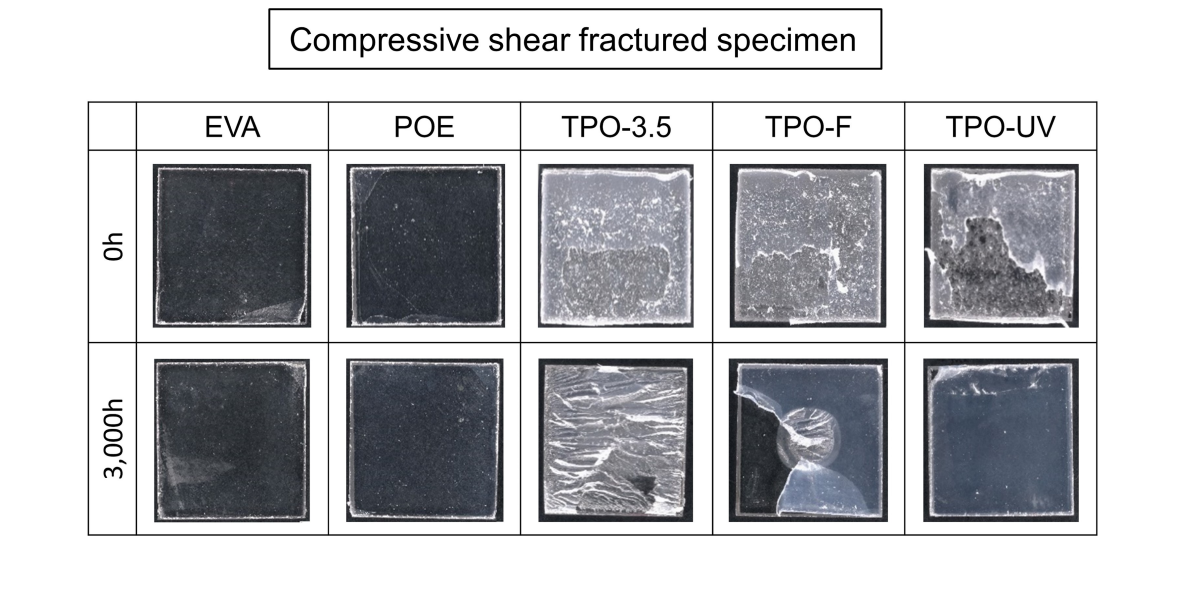
In the study, the team fabricated double glass laminates measuring 25mm x 25mm x 7mm, using three TPO film adhesives, each with a different formulation, TPO-3.5, TPO-UV, TPO-F, and supplied by the Austrian company Borealis. Two additional specimens made with EVA and POE were used as benchmarks.
Before the compressive shear tests, the experimental samples were exposed to ultraviolet (UV) radiation of 40 W/m2, temperatures of 65 C and a relative humidity of 10% for up to 3000 hours. A visual, optical, mechanical and chemical analysis of the changes was made possible using various instruments including microscopy, UV-visible-near-infrared spectroscopy, compressive shear testing, as well as differential scanning calorimetry, Fourier transform infrared spectroscopy and X-ray. photoelectron spectroscopy.
The team analyzed and ranked the results. They found that the best performing TPO variant was TPO-3.5, followed by TPO-UV, TPO-F, EVA and POE. “Although the aged and fractured EVA, POE, TPO-F, and TPO-UV laminates showed carboxylic acid signatures that differed in intensity, no carboxylic acid residues were detected on the fractured TPO-3.5 surface,” the team said.
Additionally, TPO-3.5 had a “lower melt flow index,” which translates into “a higher average molar mass” compared to TPO-F and TPO-UV. “For the cross-linked EVA and POE, the test temperature was already within the melting range of the non-cross-linked, polyethylene-rich phase of these peroxide cross-linked encapsulants,” the academics specified.
The team concluded that the “obtained results clearly indicate that special attention should be paid to the TPO-3.5 encapsulants for double-glazed PV modules in future research.” “The next step will be to evaluate the subsequent moist heat and UV aging of TPO glass laminates on long-term performance,” said Tiefenthaler, adding that the positive findings at sample level should be validated and investigated by scaling up to PV modules. sizes.
The results of the study are presented in “Effect of UV aging on the debonding of double glass laminates based on different crosslinking and thermoplastic PV encapsulants,” published by Solar energy materials and solar cells. The researchers came from the Johannes Kepler University Linz, the Christian Doppler Laboratory for Superimposed Mechanical-Environmental Aging of Polymeric Hybrid Laminates, and Borealis.
Last year, another research group at Johannes Kepler University Linz conducted long-term moisture-heat tests for more than 10,000 hours on double-glazed solar modules made with UV-transparent EVA and POE encapsulants, finding several advantages of using POE encapsulants compared with EVA materials.
This content is copyrighted and may not be reused. If you would like to collaborate with us and reuse some of our content, please contact: editors@pv-magazine.com.
