

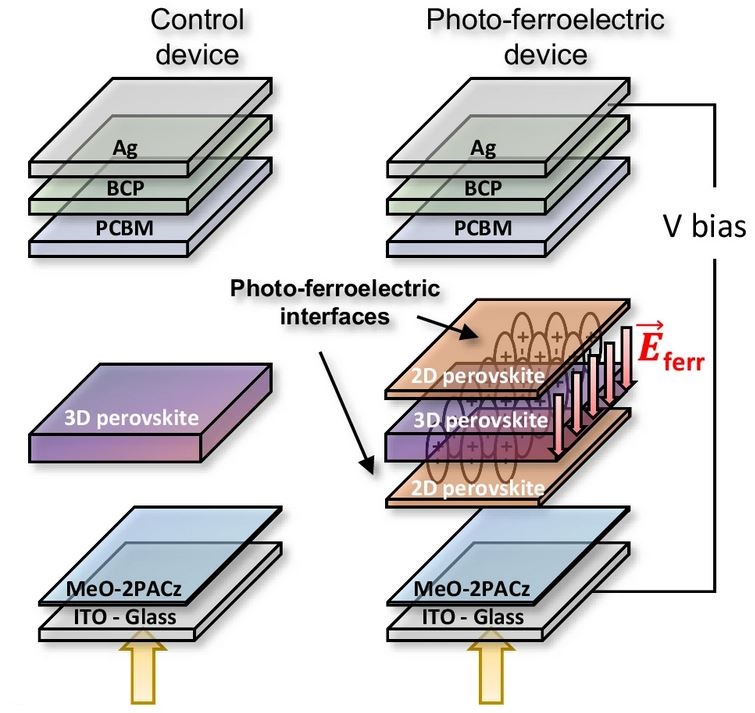
The experimental device achieved an open-circuit voltage of 1.21 V, which is the highest value reported to date for high-efficiency perovskite photovoltaics. The cell is based on a photo-ferroelectric 2D/3D/2D perovskite junction in which 2D ferroelectric perovskite single crystals are integrated into the perovskite bulk.
An international research group led by the Università Degli Studi Di Pavia in Italy has built a perovskite solar cell based on a photoferroelectric perovskite interface that reportedly helps reduce open-circuit voltage losses typical of perovskite PV devices.
Ferroelectric materials have attracted the attention of the solar scientific community in recent years because they have unique piezoelectric and optoelectronic properties. Ferroelectric PV has mainly attracted attention because of its unusual photovoltaic effect and its controllability. In these devices, the photogenerated voltage is independent of the band gap in the polarization direction. However, the small photo-generated current remains one of the challenges to be overcome.
In the study “Photoferroelectric perovskite interfaces for stimulating VO.C in efficient perovskite solar cells”, published in communication about naturethe academics explained that the use of two-dimensional (2D) ferroelectric perovskites in PV devices is still in its infancy. Perovskite cells built with 2D hybrid materials are well known to be more stable than conventional 3D devices, due to the protection provided by the organic ligands, and to exhibit large exciton binding energies.
“We design a photo-ferroelectric 2D/3D/2D perovskite junction by integrating a 2D ferroelectric perovskite single crystal into the perovskite bulk, as a tool to manipulate the perovskite electrical interface,” they explained. “With external polarization, the 2D ferroelectric layer polarizes, creating an electric field that adds to the original built-in electric field.”
The perovskite absorber consists of a 3D perovskite bulk with three cations, sandwiched between thin layers of two ferroelectric 2D perovskite layers. The selected 2D material is a ferroelectric fluorinated perovskite known as (4,4-DFPD)2PbI4(where 4,4-DFPD is 4,4-difluoropiperidinium).
The solar cell is built with a substrate made of indium tin oxide (ITO), a hole transport layer (HTL) that relies on MeO-2PACz, the perovskite absorber, an electron transport layer based on phenyl-C61-butyric acid methyl ester (PCBM), and a silver (Ag) metal contact. “The perovskite layer was deposited via a two-step spin-coating procedure at 1000 and 5000 rpm for 12 and 27 seconds, respectively,” the researchers explained.
The group tested the device’s performance under standard lighting conditions and found that it achieved a power conversion efficiency of 24%, an open-circuit voltage of 1.21 V, and a fill factor of 84%. The open-circuit voltage achieved by the device is described as the highest value reported to date for high-efficiency perovskite photovoltaics.
“The inclusion of the 2D interfaces improved the fill factor of the device and the open-circuit voltage ultimately improved its efficiency,” the scientists said, referring to a comparison they made with the performance of a benchmark device without the 2D perovskites.
The analysis also showed that the new cell retained more than 90% of its relative efficiency after more than 1000 hours, compared to only 40% in the control device.
“As a result of the interface modification, the additional electric field induced by spontaneous polarization in the ferroelectric 2D layer contributes to the built-in device, driving interfacial charges apart and reducing their recombination,” the group said. “This concept opens a new path for the advancement of perovskite materials and interface engineering by exploiting the electrostatic fields produced by polar building blocks, with immediate impact on the operating mechanisms and performance of optoelectronic devices.”
The research team included scientists from the Chinese Academy of Sciences (CAS), King Abdullah University of Science and Technology (KAUST) in Saudi Arabia and Imperial College London in Britain.
This content is copyrighted and may not be reused. If you would like to collaborate with us and reuse some of our content, please contact: editors@pv-magazine.com.
