

Elon Musk, the CEO of both Tesla and SpaceX, raised some eyebrows at this year’s World Economic Forum (WEF) in Davos, Switzerland, when he predicted “that space will be space and that this will be true in two to three years, three years at the latest.” pv magazine reported on Musk’s vision on January 26, 2026 on our global website www.pv-magazine.com, and exactly one week later SpaceX announced it was acquiring xAI “to form the most ambitious, vertically integrated innovation engine on (and beyond) Earth, with AI, rockets, space-based internet, direct-to-mobile device communications and the world’s premier platform for real-time information and free expression.”
From the magazine
Solar PV plays a central role in the growing buzz around building data centers in space. The February 2 statement from SpaceX and its founder Elon Musk said that “current advances in AI rely on large terrestrial data centers, which require enormous amounts of power and cooling. Global electricity demand for AI simply cannot be met with terrestrial solutions, even in the short term, without imposing hardships on communities and the environment.”
As Musk noted in an interview at WEF with Larry Fink, the founder and CEO of global investment firm BlackRock: “If you have solar energy in space, you get five times more effectiveness, maybe even more than that, than solar energy on the ground. It’s always sunny, so you don’t have day-night cycles or seasonality or weather and you get about 30% more energy in space because you don’t have any atmospheric weakening of the energy. The net effect is that every solar panel will do five times more energy in space than on the ground.”
The space also offers excellent thermal conditions. Musk explains: “It’s a no-brainer to build solar-powered AI data centers in space because, as I said, it’s also very cold in space. If you’re in the shade, it’s very cold in space, 3 degrees Kelvin. So you have solar panels facing the sun and then a radiator facing away from the sun so there’s no sun coming in, so it just cools, it’s a very efficient cooling system. The net effect is that the The lowest cost place to place AI will be space and that will be the case within two to three years, three years at the latest.”
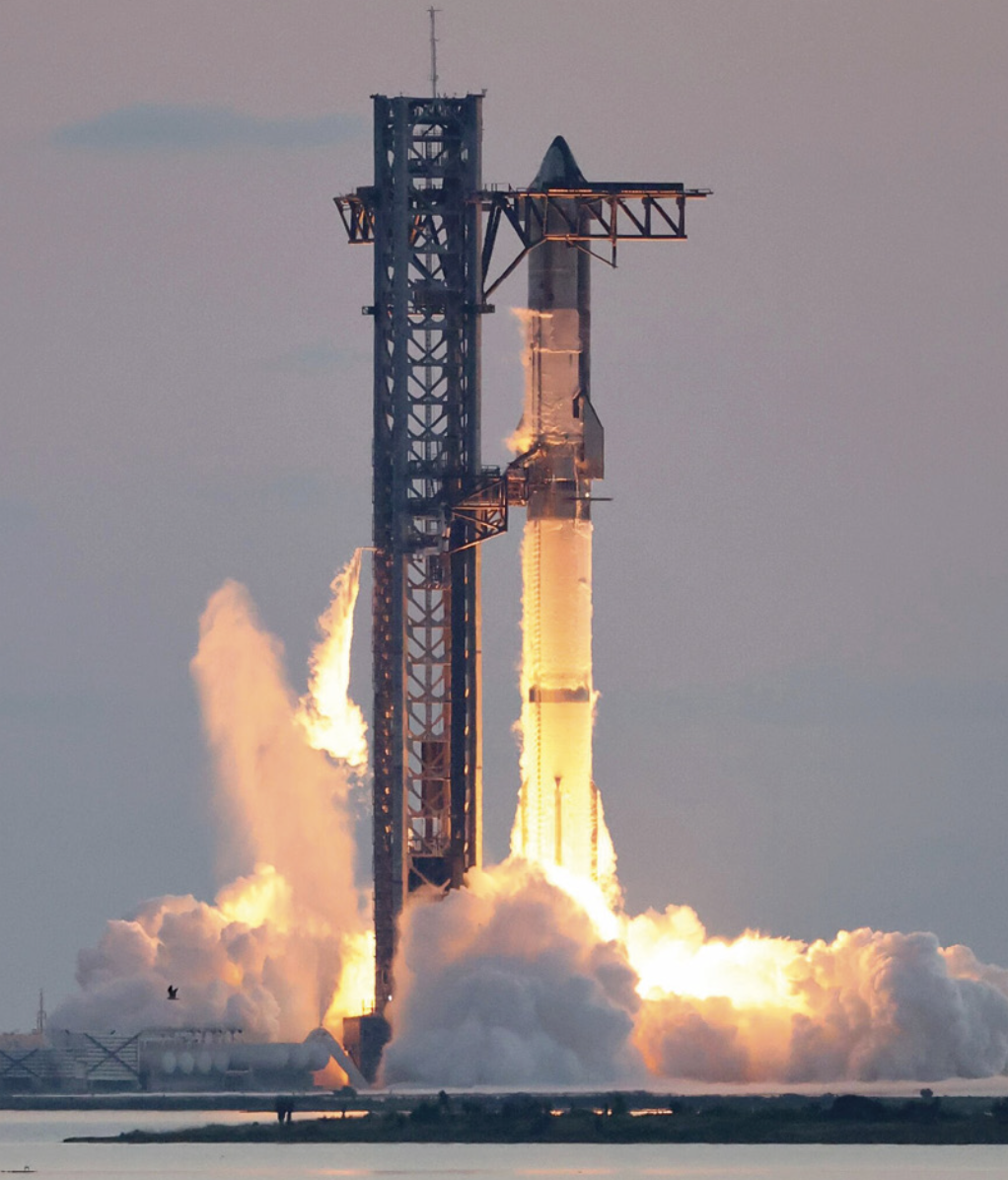
But how do we get all this stuff into space? Much will depend on the pace of innovation at SpaceX, as the company heads toward a successful IPO later this year. At Davos, Musk revealed that SpaceX is on track to further dramatically reduce what he calls the “cost of access to space”: “Hopefully this year we should prove the full reusability of Starship, which would be a profound invention, because the cost of access to space would drop by a factor of 100 if you achieved full reusability.” He continues: “We believe this puts the cost of access to space lower than the cost of freight on airplanes, easily below $100 per pound.”
Starship is the largest rocket ever built and would be the vehicle to position solar-powered AI infrastructure in space. Ultimately, solar-powered AI infrastructure on the moon and planets like Mars could follow, especially as smart AI-powered robots become commonplace to build and maintain such space-based assets. The first step in this roadmap is solar-powered AI satellites. According to Musk, “one of the things we’re going to do with SpaceX in a few years is launch solar-powered AI satellites. Space is really the source of enormous power and then you don’t have to take up any space on Earth, there’s so much space in space, and you could scale up to eventually, I think, hundreds of terawatts a year.”
As the Wall Street Journal reported on February 2, the day SpaceX announced its acquisition of xAI, the combination will create a company valued at $1.25 trillion before the company goes public in what will likely be the largest IPO ever, surpassing Saudi Aramco’s 2019 IPO in terms of company valuation. Much of the money raised from this IPO will go towards this solar-powered AI vision in space, as sending swarms of AI satellites into space will cost billions of dollars, not to mention the R&D and product development required to make it happen.
Solar energy production
It will also require the large-scale production of solar panels. During the WEF interview, Musk revealed that “the SpaceX and Tesla teams, both separately, are working on building 100 GW per year of solar in the US, of manufactured solar. That will probably take us three years or something like that. These are pretty big numbers and I would encourage others to do the same.” Tesla’s record in PV production isn’t exactly stellar with plans to produce 1 GW of panels, first with Silevo technology and then with Panasonic, which won’t happen at a factory in Buffalo, New York, which Tesla acquired in 2016 as part of its SolarCity acquisition. However, in an exclusive interview with PV magazine USA at the end of January, the Tesla Energy team revealed details about the new Tesla Solar Panel and plans to ramp up the Buffalo Gigafactory to 300 MW per year in an initial phase.
But that’s back on earth. Different panels will be needed in space, and we can only speculate about what kind of cell and panel technology SpaceX has in store. Scale will certainly play a crucial role in space-based PV and AI, just as it does in PV and battery storage on Earth. As production scales, economies of scale occur and the cost of the technology steadily decreases. SpaceX’s February 2 statement outlines the scope of the undertaking:
“The basic calculation is that launching a million tons per year of satellites generating 100 kW of computing power per ton would add 100 gigawatts of AI capacity annually, without ongoing operational or maintenance needs. Ultimately, there is a path to launching 1 TW/year from Earth.”
Both the required scale and the required expansion are enormous. As the same statement notes, “even in 2025, the most productive year in history in terms of the number of orbital launches, only about 3,000 tons of payload was launched into orbit, consisting mainly of Starlink satellites carried by our Falcon rocket.”
Another company focused on space-based solar AI is Starcloud Inc., based in Redmond, Washington. As their September 2024 whitepaper describes, “orbital data centers can be scaled virtually indefinitely without the physical or permitting limitations that Earth faces, using modularity to deploy them quickly.” It then describes a 5 GW AI data center with a 4 by 4 km solar array, much smaller than a 5 GW terrestrial AI data center would need, given the much higher capacity factor and peak generation in space compared to Earth. This data center would include hundreds of individual satellites, all in a sun-synchronous orbit to optimize PV generation.
In its 2024 white paper, Starcloud advocates the use of thin-film cells because “these cells use silicon wafers less than 25 µm thick and achieve power densities of >1,000 W/kg, enabling highly mass- and volume-efficient arrays.” Thin-film panels can also provide flexibility, an important feature for achieving a compact configuration at launch.
Clearly, a lot of innovation needs to happen in solar-powered space-based AI to achieve a competitive position against Earth-based AI data centers. This includes innovation at the level of photovoltaic cells and modules, the configuration of PV arrays, thermal management, a major topic both on Earth and in space, the reusability of rockets, to name just a few of the bigger challenges. Latency is another, as some AI users, such as hedge funds, will need very fast responses from the data center in space.
The massive investments involved likely led to the merger of SpaceX and xAI in February. With a valuation of $1.25 trillion for the combined entity, a SpaceX IPO later this year will give the company a rather unique war chest to pursue its space ambitions. As with terrestrial PV, once the project is built and comes online, opex is much less of an issue. In fact, in its white paper, Starcloud estimates the energy required for a 40 MW AI data center cluster at $140 million over ten years, for a cluster on Earth that pays $0.04 per kWh for its electricity. In space, there is simply a $2 million capital investment for the PV array, without any operational costs. The same goes for water use, a major cost item for terrestrial AI data centers. Here the white paper estimates 1.7 million tonnes over a ten-year period, with 0.5 liters of water required for every kWh consumed. In the room there is only the investment of using a radiator to remove residual heat.
On the other hand, the Starcloud white paper allocates $5 million for the “single launch of computer modules, solar and radiators,” a figure that would likely drop significantly if full rocket reusability were achieved in 2026 or 2027. Ultimately, huge investments will be required and SpaceX clearly has an advantage over the competition in that area. Its vertical integration and deep pockets make the company a frontrunner to realize competitive solar-powered space-based AI in the not-too-distant future.
This content is copyrighted and may not be reused. If you would like to collaborate with us and reuse some of our content, please contact: editors@pv-magazine.com.
