

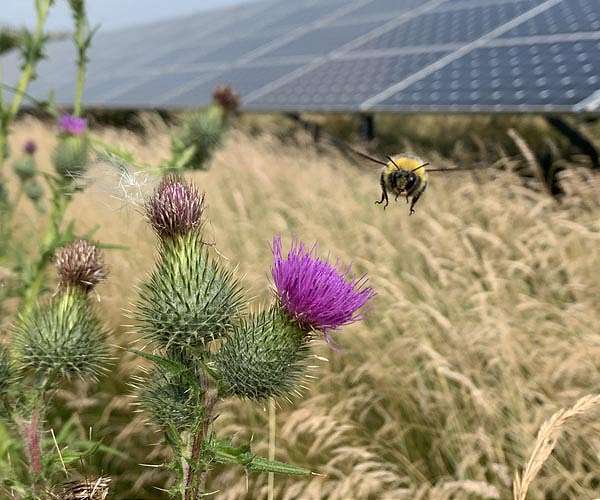
Solar farms poised to protect Britain’s bumblebees if managed for biodiversity
Solar farms in Britain could serve as important refuges for bumblebees, according to new research led by Lancaster University in collaboration with the UK Center for Ecology and Hydrology and the University of Reading. However, the benefits are largely limited to the sites themselves.
In field studies, the management approach was the dominant driving force behind bee numbers within solar farms. Sites with wildflower edges supported many more bumblebees than those maintained as turf. Modeling shows that bee abundance in solar farms could more than double, with an increase of 120%, if the sites are managed for biodiversity rather than grass cover.
“Our results indicate that well-managed solar farms can provide refuges to help protect local bumblebee populations from landscape changes taking place outside the site’s boundaries,” said Dr Hollie Blaydes, Senior Research Associate at Lancaster University. “We expected to find that solar farms with more resources would support more bees, but we were also interested in how this management interacts with broader land use changes.”
Using a high-resolution modeling framework, the team evaluated how the 1,042 existing UK solar farms could boost bumblebee populations based on three future land use visions, aligned with representative concentration pathways and shared socio-economic pathways. Scenarios ranged from sustainable development to fossil fuel pathways, downscaled from 1 km to 10 m resolution.
In the future, the surrounding landscapes will change substantially, with agricultural land decreasing in all scenarios due to factors such as changing diets and urban expansion. Researchers expanded the maps to include hedgerows and wildflower patches and then linked them to a pollinator model that simulates foraging and nesting based on resource distribution, an unusually detailed approach for this type of analysis.
The revival due to biodiversity-friendly management was largely local: the increase in bee density remained largely within the boundaries of solar farms and declined over wider foraging areas. In surrounding areas, overall landscape composition exerted a stronger influence on bumblebee density than on-site practices alone.
A sustainability-oriented pathway that restores floral resources and habitats in rural areas produced the most positive, far-reaching results, increasing bumblebee densities both around and outside solar farms. Strategic siting and network connectivity further improve pollinator prospects at the landscape scale.
Alona Armstrong, professor of energy and environmental sciences and co-author, said: “While the benefits of solar farms for bumblebee density may be limited to the local scale, our findings help demonstrate that site management plays a role in supporting bumblebee populations. Solar farms can be considered an emerging conservation tool to help protect bumblebee populations in the future.
“If we need additional solar farms to meet our national renewable energy obligations, then strategic placement of solar farms could be considered to connect bumblebee habitats or provide bumblebee resources where they are otherwise limited.”
Dr. Blaydes added: “Solar farms can provide a refuge for bumblebees, both now and in the future, and can play a role in limiting habitat loss – if managed properly. But solar farms alone will not be able to counter the effects of all future land use changes on bumblebees and other biodiversity.”
The peer-reviewed study, funded by the Natural Environment Research Council with support from Low Carbon, describes these results and credits authors from Lancaster University, the UK Center for Ecology and Hydrology and the University of Reading.
Research report:Solar farms as potential future refuges for bumblebees
